
2011 military intervention in Libya
- When
- 19 March to 31 October 2011
- Where
- Libya
- Sides
- NATO and partners vs Gaddafi government
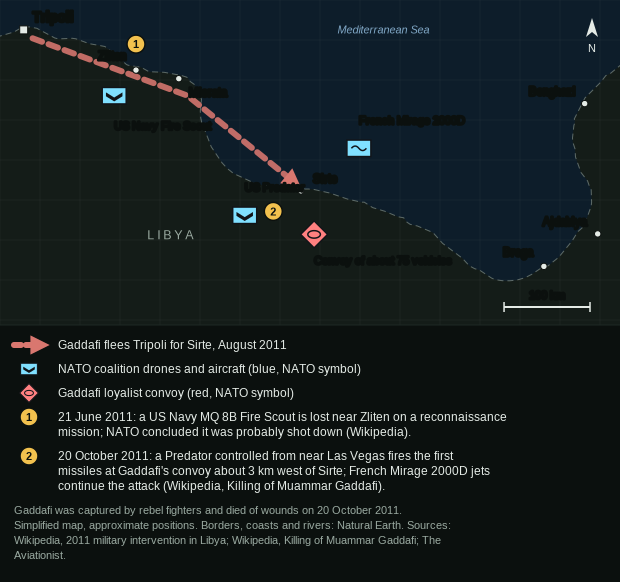
From 19 March to 31 October 2011, a NATO led coalition enforced United Nations Security Council Resolution 1973 against the government of Muammar Gaddafi in the First Libyan Civil War, and a small number of American, French and Italian drones took part. Wikipedia names the sides as NATO, partner states and the Libyan opposition, against the Libyan Arab Jamahiriya and pro Gaddafi militias. The best known drone action came on 20 October, when a US General Atomics RQ 1 Predator fired on Gaddafi's convoy near Sirte.
What happened
Wikipedia records that the Security Council passed Resolution 1973 on 17 March with ten votes in favour and five abstentions. The intervention began on 19 March, and NATO took command as Operation Unified Protector by 31 March. Wikipedia states that Gaddafi's forces shot down no NATO aircraft, and that NATO flew more than 26,000 sorties, 42 percent of them strike sorties, damaging or destroying about 6,000 military targets. After Gaddafi's death on 20 October, the Security Council ended NATO's mandate on 31 October. A second Libyan civil war followed from 2014 to 2020, including the Western Libya campaign.
The drones
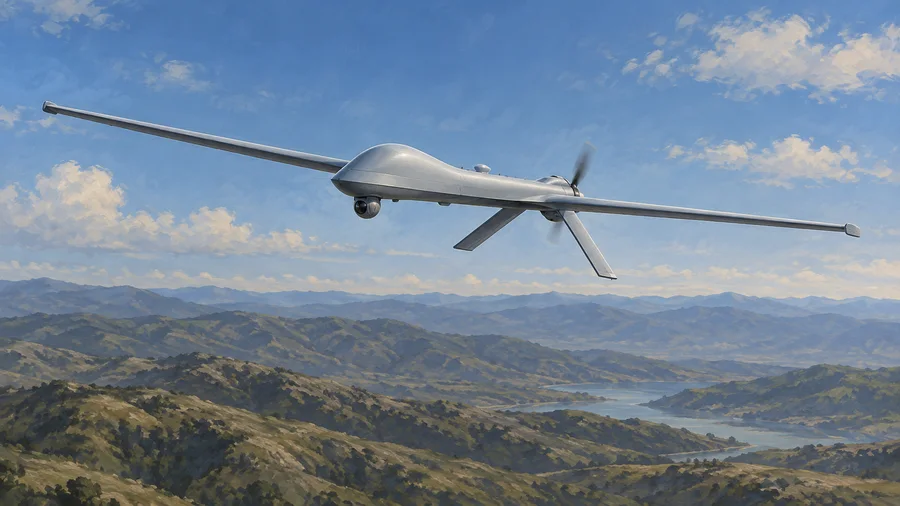
Wikipedia records that the United States used MQ 1 Predator aircraft to strike targets in Libya on 23 April. The Aviationist reported that Predators were already flying over Libya two or three days before President Obama announced them. Air & Space Forces Magazine reported that the surveillance force grew to include two Predators, an unarmed MQ 9 Reaper provided by Italy and an unarmed French Harfang drone. The Associated Press reported that the US also had three Global Hawk surveillance drones assigned, and Wikipedia lists a US Navy MQ 8B Fire Scout unmanned helicopter.
How they were used
Lt. Gen. Ralph Jodice, NATO's air commander, said platforms from the French Atlantique to a Predator would scout and sometimes laser designate targets for other aircraft. On 21 June an MQ 8B Fire Scout lost radar contact near Zliten on a reconnaissance mission; a NATO investigation concluded on 5 August that it was probably shot down. On 20 October a Royal Air Force Tornado spotted a convoy of about 75 vehicles leaving Sirte at about 08:30 local time. Wikipedia states that a Predator controlled from a base near Las Vegas fired the first missiles, hitting a target about 3 kilometres west of Sirte, and that French Mirage 2000D jets then continued the attack. The Aviationist reported that the Predator used Hellfire missiles and that a Mirage 2000D later destroyed 11 vehicles with a GBU 12 bomb.
What effect they had
US officials confirmed the Predator's part in the strike, the Associated Press reported. Wikipedia records that rebel fighters on the ground captured Gaddafi, who died of wounds. NATO said it did not know Gaddafi was in the convoy and does not target individuals, and later said the strike was likely to have contributed to Gaddafi's capture and death. The Aviationist wrote that Predators and Global Hawks were important, though American tankers mattered more. Air & Space Forces Magazine reported that remotely piloted aircraft were hard to spare from Southwest Asia, and that Jodice said NATO never had more than four fighters over Libya at once.
For the classroom
- Why did NATO need a drone and manned jets working together to stop the convoy near Sirte?
- NATO said it did not know Gaddafi was in the convoy; what does this show about identifying targets from the air?
- Why would a shortage of surveillance aircraft limit a campaign that had few fighters over Libya at any time?
Sources
- Wikipedia: 2011 military intervention in Libya
- Wikipedia: Killing of Muammar Gaddafi
- U.S. Predator drone fired on Gadhafi convoy (Associated Press via HeraldNet, 2011)
- NATO's Lessons From Libya (Air & Space Forces Magazine, 2013)
- Operation Unified Protector explained: Final Report (The Aviationist, 2011)
Written 2026-10-04.