
2025 Iranian militia attacks in Iraq
- When
- February to December 2025
- Where
- Kurdistan Region and bases across Iraq
- Sides
- Unclaimed attackers vs Kurdistan facilities and Iraqi and coalition bases
From 2 February to December 2025, drones struck oil and gas fields, military bases and airports across Iraq, most of them in the Kurdistan Region. Wikipedia names the sides as Iraq, the Kurdistan Region and the United States against the Popular Mobilization Forces and Iran, and says the attacks were likely carried out by Iranian aligned Iraqi militias. No group claimed them. Kurdish authorities blamed Popular Mobilization Forces groups, and Baghdad rejected that charge.
What happened
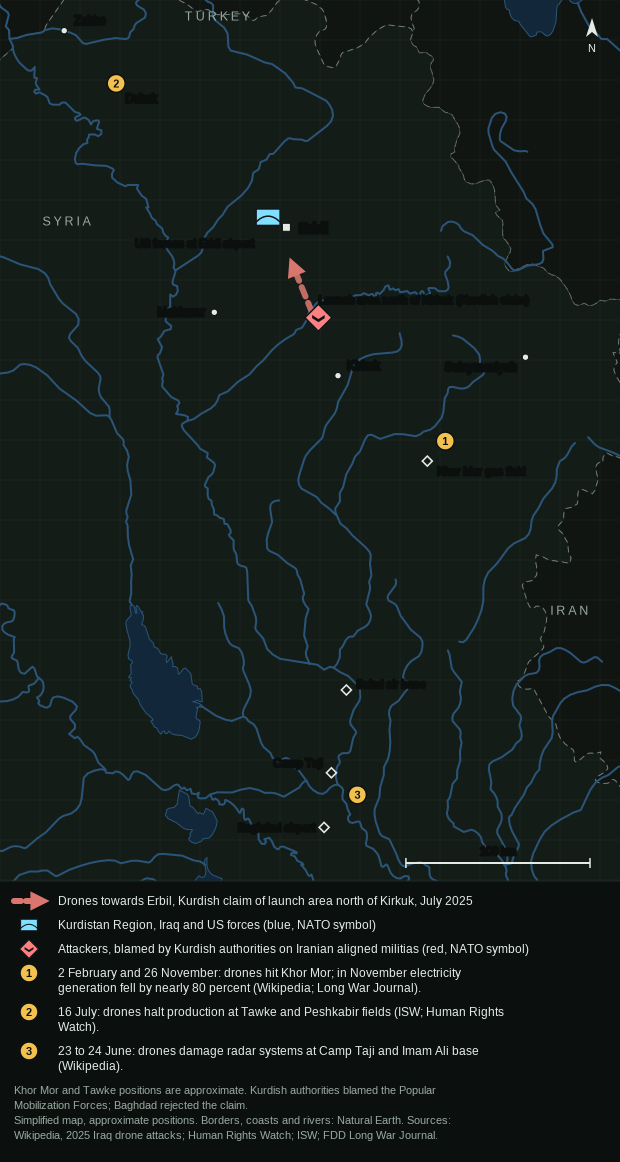
On 2 February a kamikaze drone hit the Khor Mor gas field. Dana Gas, which operates the field, said it caused no damage and no injuries. Seth Frantzman of FDD's Long War Journal wrote that this was the ninth attack on the site in four years. Wikipedia records that on 23 and 24 June drones hit radar systems at Camp Taji and Imam Ali base, and that US forces shot down five drones near Baghdad airport and in western Iraq. Frantzman wrote that the attacks appeared to begin as the Twelve Day War between Iran and Israel ended in a ceasefire. A July wave followed, then a strike on Khor Mor on 26 November.
The drones
No drone model has been named for the 2025 strikes. Wikipedia calls them kamikaze drones, and the Institute for the Study of War, in its 16 July update, described them as one way attack drones. Kurdish counter terrorism officials described drones laden with explosives. On 30 July one crashed near Dugirdkan village in Makhmur district without exploding, according to the Kurdish counter terrorism directorate. Frantzman wrote that the drone used in the April 2024 Khor Mor attack, which killed four people, was identified from surveillance footage as an Iranian style Shahed. Kurdish authorities suggested that the drones were launched from an area north of Kirkuk.
How they were used
Wikipedia records strikes on the Tawke and Peshkabir fields on 16 July, with three drones, and two drones on the Ain Sifni field the same day. A drone hit Sarsang on 15 July, and HKN Energy said it halted 30,000 barrels of production. Wikipedia lists two drones on Khurmala earlier that month and five fields attacked on 27 August. ISW counted at least six drone attacks on four fields on 16 July alone. Airports were also targeted: three projectiles hit Kirkuk airport on 1 July and wounded two civilians, and drones aimed at Erbil airport on 3 July were intercepted. On 1 July a drone struck the Darkar camp for displaced Yazidis near Zakho and injured one child; the United Nations Assistance Mission for Iraq condemned it.
What effect they had
Human Rights Watch said strikes by unknown groups on five Kurdistan oil fields between 14 and 16 July took about 220,000 barrels a day offline, a 70 percent cut in regional output according to The New Arab, and that no casualties were reported. Wikipedia reports that the 26 November strike on Khor Mor collapsed gas flows to the regional power grid, cut electricity generation by nearly 80 percent and destroyed a newly completed liquefied gas facility. Human Rights Watch noted that Khor Mor supplies most of the region's power generation and that no investigation results had been published. Iraqi President Abdul Latif Rashid, the United States and the United Kingdom condemned the attacks.
For the classroom
- Why did the attackers hit oil fields, radar sites and airports, and what did each target do to the Kurdistan Region or to Iraq?
- No group claimed the strikes. Why might attackers prefer a weapon that is hard to trace back to them?
- How could a base or oil field defend against a few cheap one way drones arriving at night?
Sources
- Wikipedia: 2025 Iraq drone attacks
- Iraq: Damage to Kurdistan Region Oil Fields Puts Rights at Risk (Human Rights Watch, 2025)
- Drone attack targets gas field in northern Iraq (FDD's Long War Journal, 2025)
- Kurdish government blames Iranian backed PMF for drone attacks (FDD's Long War Journal, 2025)
- Iran Update, July 16, 2025 (ISW)
- Kurdistan: 22 drone strikes tied to Iran backed militias (The Jerusalem Post, 2025)
Written 2026-10-04.