
American military intervention in Somalia (2007–present)
- When
- June 2011 onward
- Where
- Southern Somalia
- Sides
- United States vs al Shabaab
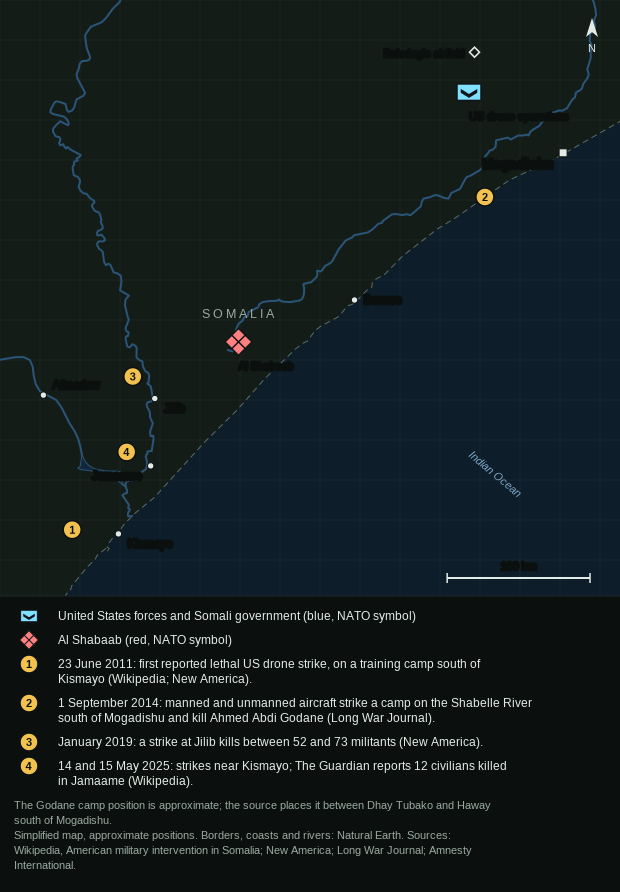
The first reported lethal US drone strike in Somalia hit a training camp south of Kismayo on 23 June 2011, and armed drones have since been a main weapon in the American military intervention in Somalia that Wikipedia dates from 7 January 2007. Wikipedia lists the United States as supporting Somali forces and an African Union force with drone strikes, intelligence and training against al Shabaab.
What happened
New America records that the first American airstrike in Somalia came on 7 January 2007, when an AC 130 gunship guided by a Predator drone fired on al Qaeda operatives, and at least eight were reportedly killed. New America counts 12 US counterterrorism operations in Somalia between 9/11 and 2011, all ground raids until that strike. On 23 June 2011 the Obama administration approved the first military drone strike, on two al Qaeda linked operatives, New America reports. Wikipedia says it was said to have killed Ibrahim al Afghani, but Stratfor reported in August that al Afghani was alive.
The drones
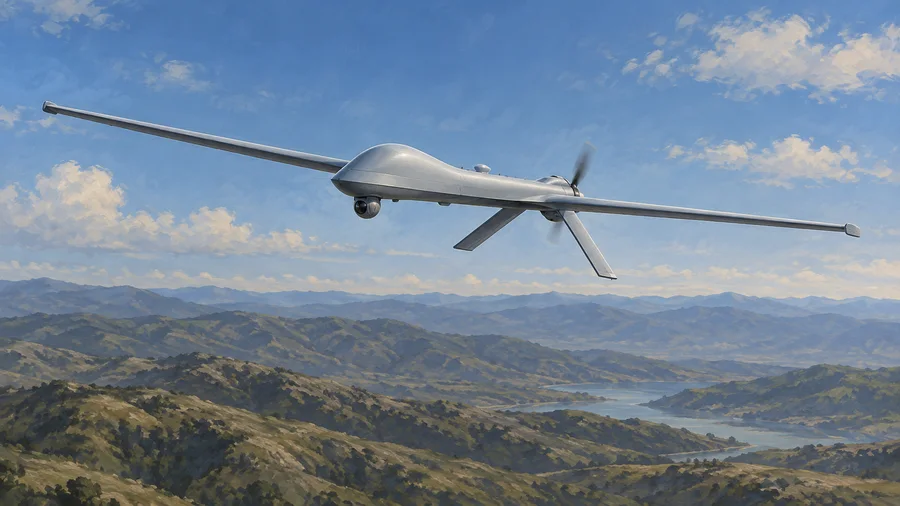
Wikipedia says the MQ 9 Reaper is commonly used over Somalia by US forces. Wikipedia's Reaper article gives it a 950 shaft horsepower turboprop and an endurance of 14 hours fully loaded. It lists GBU 12 Paveway II laser guided bombs and AGM 114 Hellfire II missiles among its weapons, flown by crews on a satellite link from bases such as Creech Air Force Base in Nevada. Wikipedia says Baledogle Airfield, about 90 km northwest of Mogadishu, is used by the US Air Force and Somali forces for drone operations against al Shabaab.
How they were used
On the night of 1 September 2014 US special operations forces used manned and unmanned aircraft against a camp between Dhay Tubako and Haway on the Shabelle River south of Mogadishu, destroying an encampment and a vehicle with several Hellfire missiles and laser guided munitions, the Long War Journal reported. On 5 September Pentagon spokesman Rear Admiral John Kirby confirmed that the al Shabaab co founder Ahmed Abdi Godane was dead. New America reports that a March 2016 operation northwest of Mogadishu with air and drone strikes killed about 150 fighters, according to officials, and that a January 2019 strike at Jilib killed between 52 and 73.
What effect they had
New America says the shift from ground raids to drone strikes, from 2011, escalated the campaign, and that in 2017 the Trump administration conducted more than twice as many strikes as in any Obama year. Amnesty International wrote that since April 2017 the US had tripled its annual rate of strikes by manned aircraft and drones. Amnesty documented five incidents in Lower Shabelle in which 14 civilians were killed and eight injured, and found US air strikes responsible for four. It documented two more deaths near Jilib in February 2020, including a Hormuud Telecom employee, Mohamud Salad Mohamud, killed by a Hellfire missile. Amnesty said AFRICOM had admitted civilian deaths in only one strike, on 1 April 2018. Wikipedia, citing The Guardian, reports that strikes on 14 and 15 May 2025 killed at least 12 civilians in Jamame, including eight children.
Related battles
For the classroom
- Why did the US add drone strikes to Somalia in 2011 after earlier operations had been ground raids and missile strikes?
- The 2014 strike on Godane used manned and unmanned aircraft together. What does each add to such an attack?
- Why did crews flying from Baledogle and Nevada need long endurance to strike camps in southern Somalia?
Sources
- Wikipedia: United States intervention in Somalia
- The War in Somalia (New America)
- US confirms Shabaab emir Godane killed in airstrike (FDD's Long War Journal, 2014)
- Somalia: The hidden US war in Somalia (Amnesty International, 2019)
- Somalia: Zero accountability as civilian deaths mount from US air strikes (Amnesty International, 2020)
- Wikipedia: General Atomics MQ 9 Reaper
- Wikipedia: Baledogle Airfield
- Wikipedia: Kismayo
- Wikipedia: Jilib
- Wikipedia: Mogadishu
- Wikipedia: Barawa
- Wikipedia: Jamame
- Wikipedia: Afmadow
Written 2026-10-04.