
Battle of Debaltseve
- When
- 14 January to 20 February 2015
- Where
- Debaltseve, Donetsk Oblast
- Sides
- Ukraine vs DPR, LPR and Russian forces
- Drones
- Orlan-10
From 14 January to 20 February 2015, forces of the Donetsk People's Republic (DPR) and Luhansk People's Republic (LPR), joined by Russian units that Russia denied, fought Ukraine for the railway town of Debaltseve in Donetsk Oblast, and Wikipedia records a DPR and LPR victory. Drones played a small and only partly documented part. Ukraine flew Tu 141 and Tu 143 reconnaissance drones against separatists in 2014 and 2015, and a Ukrainian convoy commander said the team flew a UAV to check the road before each run.
What happened
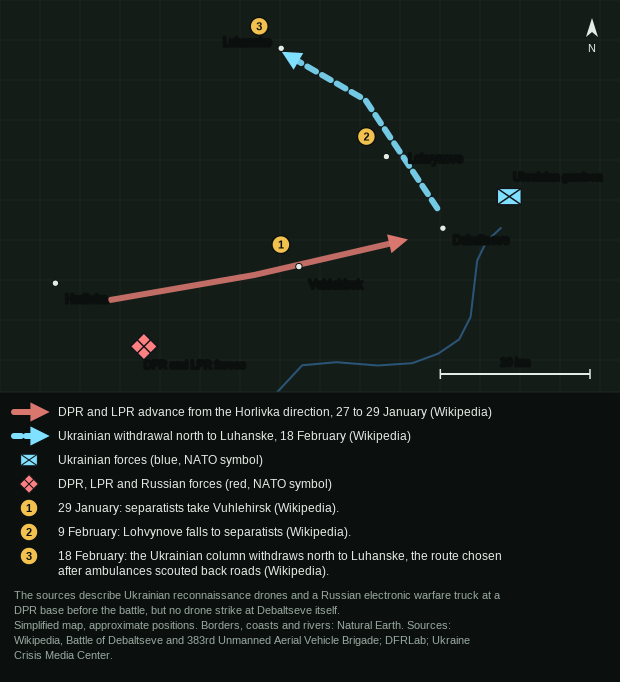
Wikipedia describes Debaltseve as a vital railway and road junction held by Ukraine as a 15 mile salient between DPR and LPR territory. Heavy shelling began on 17 January. Separatists took Vuhlehirsk on 29 January and Lohvynove on 9 February, and by 10 February they held the Bakhmut highway. Wikipedia records that at least seven civilians were killed when a Grad rocket hit a block of flats on 30 January. After a failed Ukrainian attempt to retake Lohvynove, one soldier called it worse than the fighting at the Donetsk and Luhansk airports, a reference to the Second Battle of Donetsk Airport among others. Ukrainian forces began to withdraw early on 18 February.
The drones
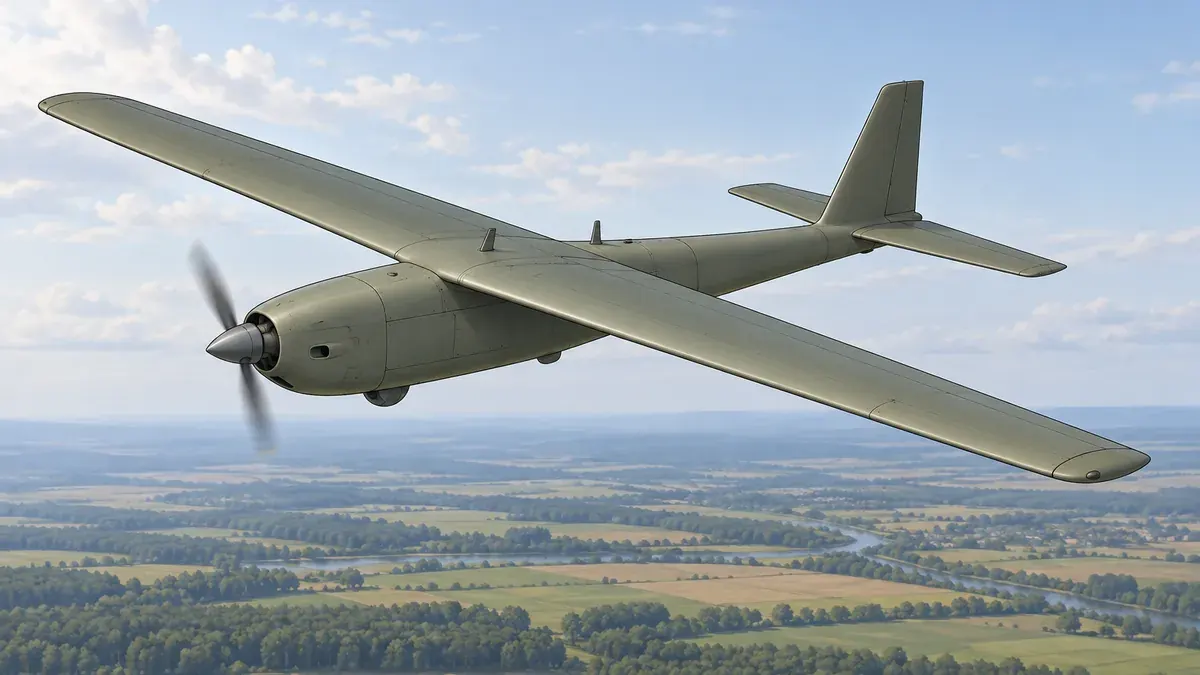
Wikipedia says the regiment that became Ukraine's 383rd Unmanned Aerial Vehicle Brigade operated Tu 141 and Tu 143 reconnaissance drones. DFRLab wrote in 2018 about two Russian truck based systems in the Donbas. The Leer 3 is an electronic warfare station that launches Orlan 10 drones to jam cellular signals, and the Orlan 10 also serves as artillery reconnaissance. The Granat 4 is a reconnaissance drone designed mainly to direct artillery fire, with a command vehicle on a four wheeled Kamaz 4350 chassis. DFRLab dated both vehicle sightings it found to summer 2015, after the battle.
How they were used
DFRLab reported that before the battle a Leer 3 sat at the base of the DPR Separate Reconnaissance Battalion Sparta, which it called a dumping ground for Russian electronic warfare systems. On the Ukrainian side, Second Lieutenant Oleksandr Sych, a team commander on the supply road into Debaltseve, said: "We launched a UAV and only after video shooting, we made a decision about moving on." If there was a threat, convoys did not go that day. Wikipedia records that separatists shot down a Tu 143 near Irmino in Luhansk Oblast on 3 February 2015.
What effect they had
DFRLab concluded that the Granat 4 was likely used less in the Donbas because static front lines reduced the need for drone reconnaissance to direct artillery. Wikipedia records artillery as the main weapon: US State Department spokeswoman Jen Psaki said Russia had deployed a large amount of artillery and rocket launchers around Debaltseve. Major General Oleksandr Syrskyi said supplies never stopped completely because of a parallel road.
For the classroom
- How did Ukrainian convoy teams use a drone to decide whether a road was safe near Debaltseve?
- Why did DFRLab link fewer Granat 4 sightings after 2015 to static front lines?
- Why might a reconnaissance drone matter less in a siege where artillery already covers the roads?
Sources
- Wikipedia: Battle of Debaltseve
- #MinskMonitor: The Russian Drone Wagons of the Donbas (DFRLab, 2018)
- Ukrainian military leaders on Debaltseve (Ukraine Crisis Media Center, 2016)
- Wikipedia: 383rd Unmanned Aerial Vehicle Brigade
- Wikipedia: Debaltseve
- Wikipedia: Vuhlehirsk
- Wikipedia: Lohvynove
- Wikipedia: Bakhmut
- Wikipedia: Horlivka
- Wikipedia: Luhanske, Bakhmut Raion, Donetsk Oblast
- Wikipedia: Irmino
Written 2026-10-04.