
Battle of Krynky
- When
- 20 October 2023 to 17 July 2024
- Where
- Left bank of the Dnipro, Kherson Oblast
- Sides
- Russia vs Ukraine
- Drones
- FPV attack drone
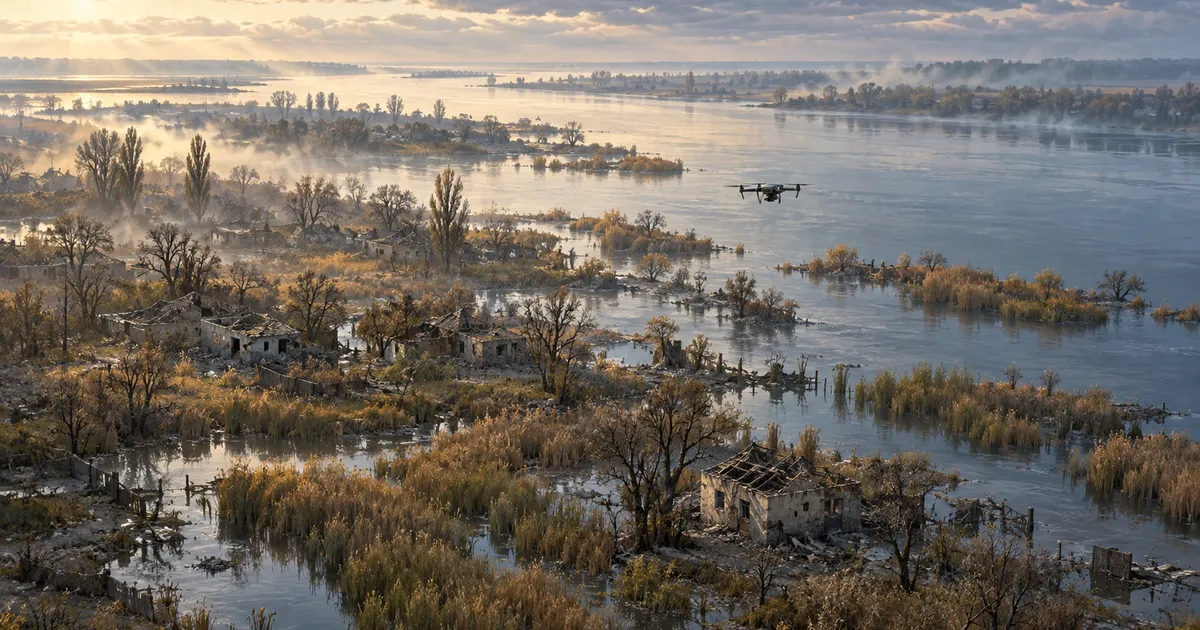
From 20 October 2023 to 17 July 2024, Ukrainian marines held a small and shifting bridgehead around the village of Krynky on the left bank of the Dnipro in Kherson Oblast, and drones shaped who could cross, resupply or leave. Wikipedia names the sides as Ukraine and Russia and records the result as a Russian victory. The sources describe Russian FPV drones striking boats and infantry, and Ukrainian drone teams and jammers working to keep them off.
What happened
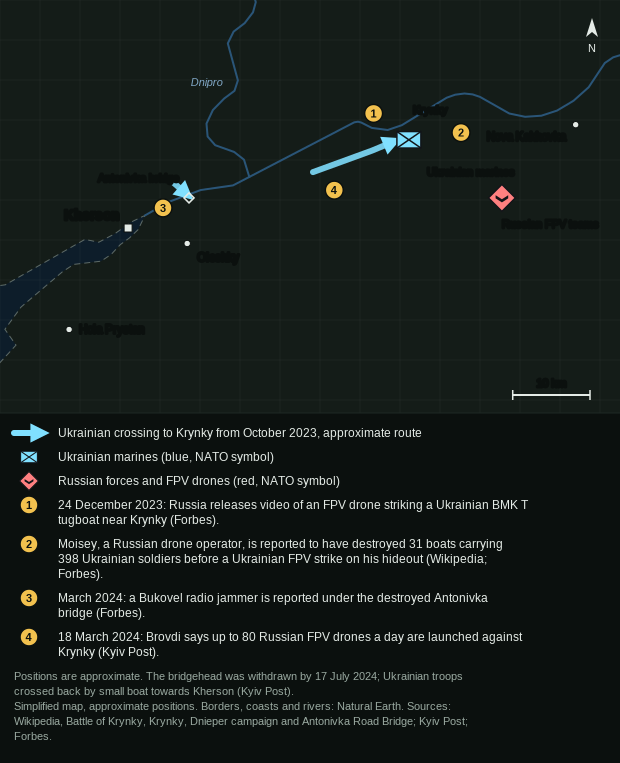
Wikipedia records that Ukraine formed the Katran group in September 2023 and that small units began crossing around 17 October. It gives a minimum aim of holding positions on the left bank to disrupt Russian traffic on the M14 highway, and a maximum aim of controlling ground from the Antonivka bridge to Perekop. Wikipedia notes that troops were attacked midstream or before crossing. The Kyiv Post reported on 20 March 2024 that small groups had also crossed near the Antonivka bridge. Wikipedia dates the Ukrainian withdrawal to 16 and 17 July 2024. The Kyiv Post reported that fewer than 200 fighters held the position and that they left by small boat. Wikipedia cites official sources for 262 Ukrainian dead identified and buried and 788 missing from October 2023 to June 2024.
Scenario: The Krynky Bridgehead (20 October 2023 to 17 July 2024)
The drones
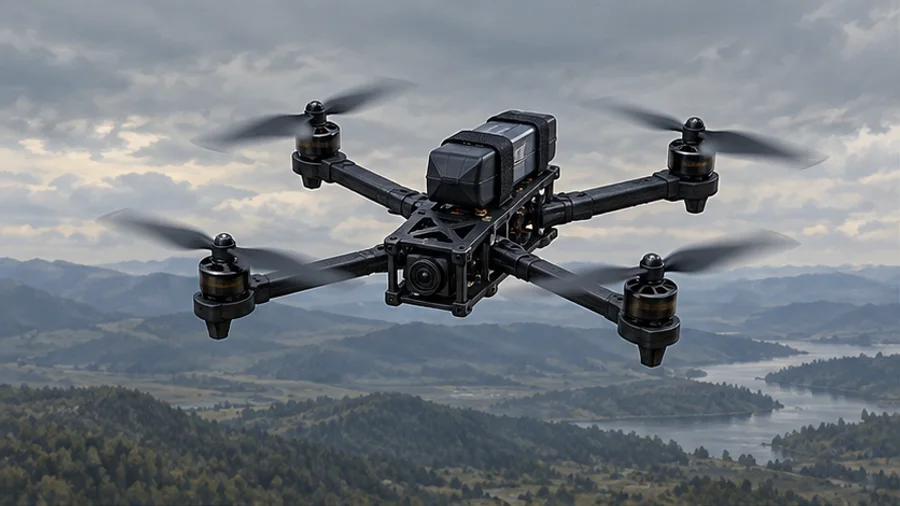
The sources name few models or specifications. They describe Russian FPV attack drones, which Forbes reported on 27 December 2023 hitting a Ukrainian BMK T tugboat in a video Russia released. Forbes described the BMK T as a Soviet era 31 foot craft built to deploy pontoon bridge sections. Forbes said Ukraine's 501st Marine Battalion operated FPV drones. Robert Brovdi, whom the Kyiv Post described as a senior commander of Ukrainian drone reconnaissance teams in the sector, said Ukrainian operators could jam Russian attack drones and sometimes take control of them. Forbes reported that a Bukovel radio jammer, valued at $50,000, could disrupt a drone's control signal from as far as 30 miles.
How they were used
Brovdi said in an update on 18 March 2024 that Russian forces launched up to 80 FPV drones a day against Krynky. The Kyiv Post reported that the military spokesman Serhiy Beskrestnov said the marines stayed underground around the clock, because a marine on the surface would be attacked by a drone. Forbes reported on 8 March 2024 that Ukrainian forces switched the jammer on during troop movements and off afterwards so their own drones could fly. Forbes added that Russian marines spotted the jammer through drone surveillance and attacked it with Izdeliye 305 missiles.
What effect they had
Forbes cited the analyst Andrew Perpetua's estimate that about 50 boats had been damaged or sunk by 27 December 2023. Wikipedia's Dnieper campaign article credits Russian drones, glide bombs and artillery. Lieutenant Aleks, serving with the marines, wrote on Telegram that "Transport there is a big part of our losses" and that wounded men could wait days or weeks for evacuation. Brovdi said about 77 percent of Russian drones were destroyed or jammed, which Brovdi said kept the bridgehead supplied. Forbes quoted a Russian blogger saying 90 percent of the equipment sent toward Krynky did not return. These are claims by participants and commentators, not independent counts.
For the classroom
- Why would a jammer be switched on only during troop movements, and what does that show about the trade between protecting your own side and using your own drones?
- The 77 percent figure and the 80 drones a day come from a Ukrainian commander. What evidence could a researcher use to test them?
- Why might a bridgehead held by so few marines still draw so many Russian drone strikes?
Play this battle in the simulation
Take either side in the scenario built on this battle, with the same drones on a real map.
Sources
- Wikipedia: Battle of Krynky
- Wikipedia: Dnieper campaign (2022–present)
- Wikipedia: Krynky
- Wikipedia: Antonivka Road Bridge
- Wikipedia: Oleshky
- Wikipedia: Hola Prystan
- Wikipedia: Nova Kakhovka
- Embattled Marines on Dnipro Bridgehead Gain New Foothold Despite Swarms of Russian Drones (Kyiv Post, 2024)
- Reports: Ukrainian Marines Retreat From Dnipro Bridgehead (Kyiv Post, 2024)
- Jam The Drones, Cross The River (Forbes, 8 March 2024)
- Dnipro Boat Massacre (Forbes, 27 December 2023)
- Russians' Lives Are Temporary In The Drone Kill Zone Around Krynky (Forbes, 9 January 2024)
Written 2026-10-04.