
Battle of Sievierodonetsk (2022)
- When
- 6 May to 25 June 2022
- Where
- Sievierodonetsk
- Sides
- Russia vs Ukraine
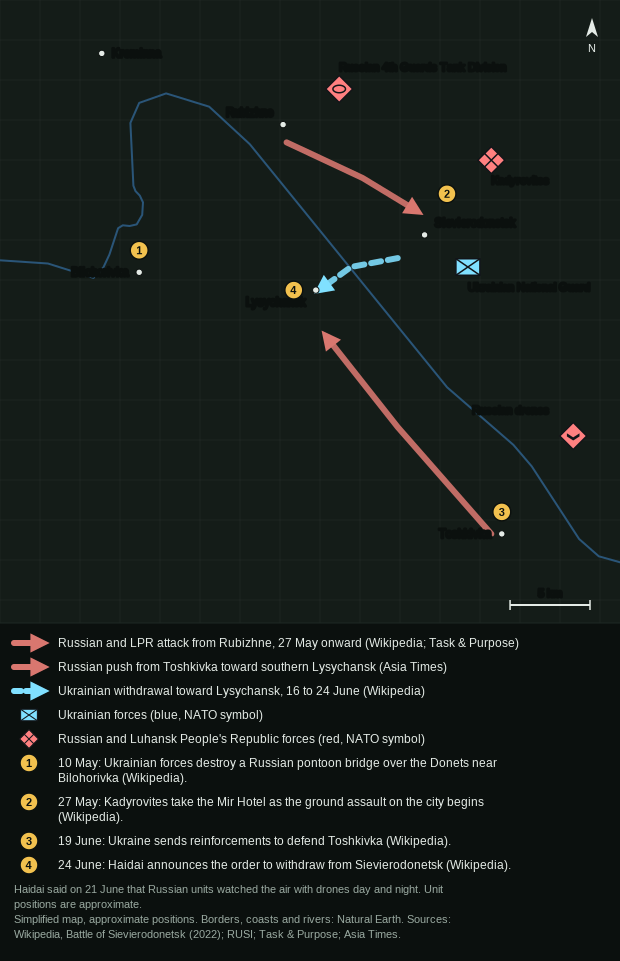
From 6 May to 25 June 2022, Russian and Luhansk People's Republic forces fought Ukrainian forces for Sievierodonetsk in Luhansk Oblast and took the city, and drones were part of the Russian artillery system that wore the defence down. Wikipedia names the sides as Russia and the Luhansk People's Republic against Ukraine and records a Russian victory. Luhansk governor Serhiy Haidai said on 21 June that Russian units monitored the air day and night with drones and adjusted fire quickly.
What happened
Wikipedia records that on 6 May Russian and LPR forces gained ground on the outskirts, attacking Voevodivka and capturing Voronove, and that mayor Oleksandr Stryuk called the city virtually surrounded. On 10 May Ukrainian forces destroyed a Russian pontoon bridge over the Donets near Bilohorivka, in the Battle of the Siverskyi Donets. Russia then relied mostly on artillery, and on 27 May began a ground assault, with Chechen Kadyrovites taking the Mir Hotel. Haidai said on 9 June that more than 90 percent of the city was under Russian control. Haidai said Russia sought to take the city or cut the Lysychansk to Bakhmut highway, the road toward Bakhmut that was later fought over in the Battle of Bakhmut. On 24 June Haidai announced the order to withdraw.
The drones
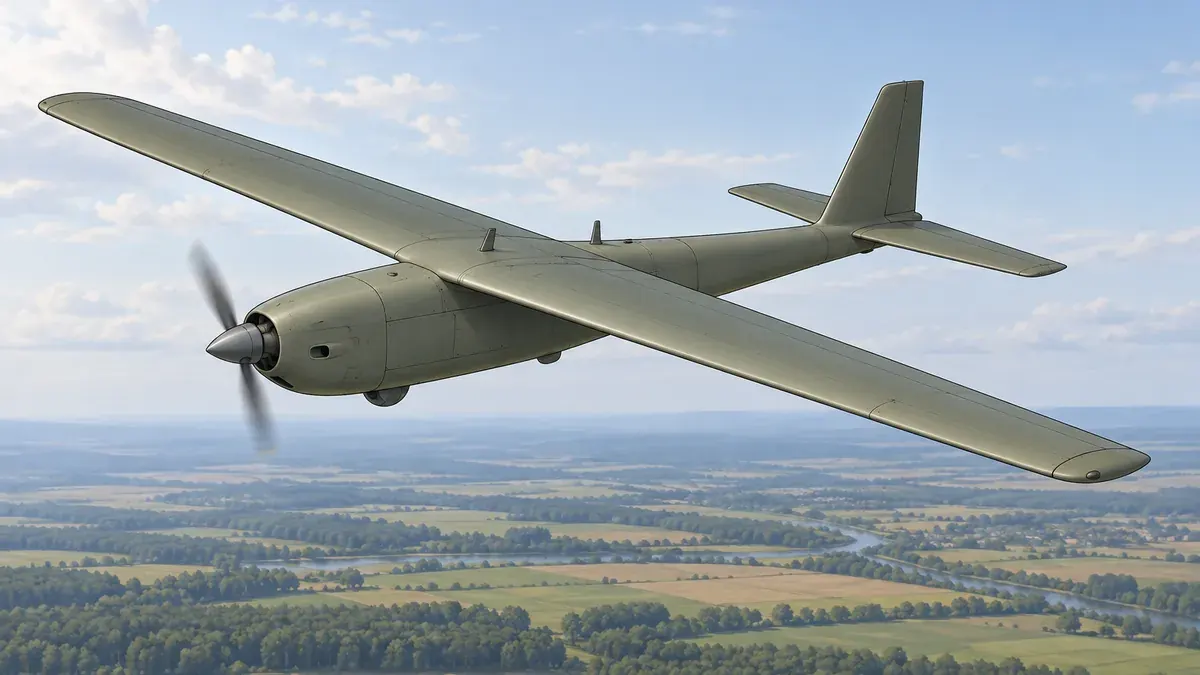
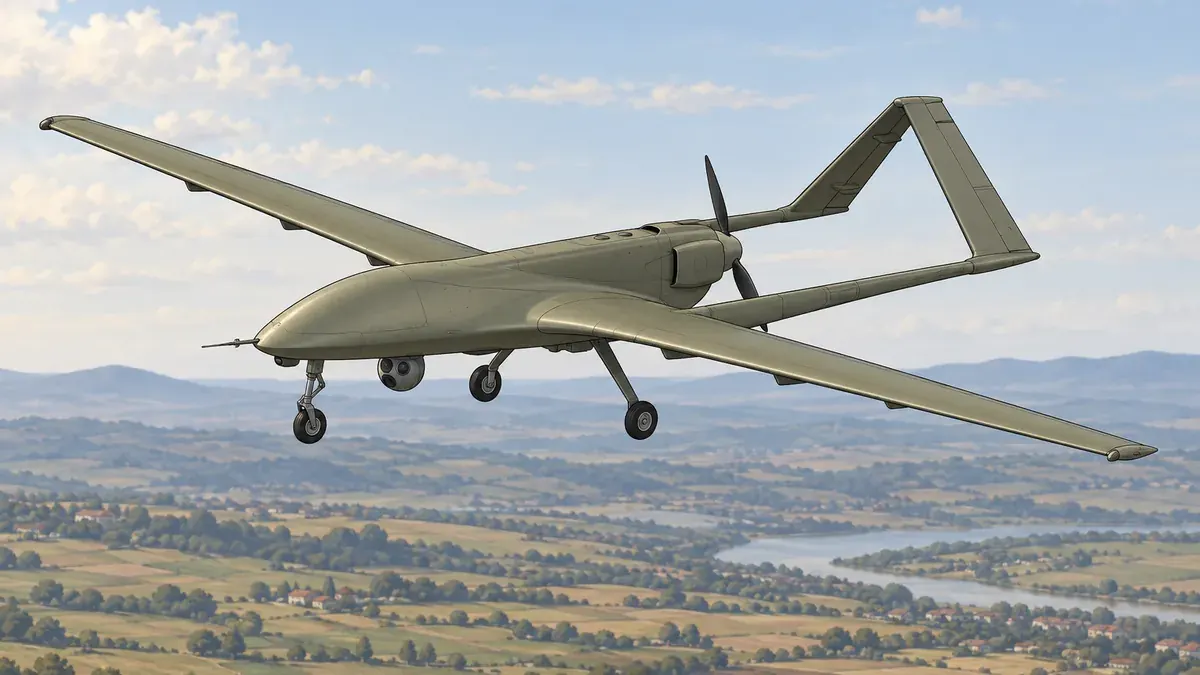
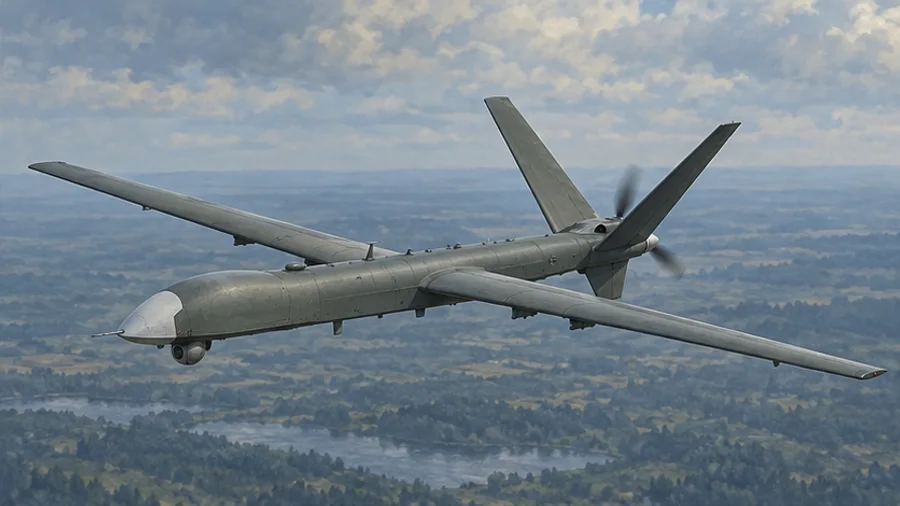
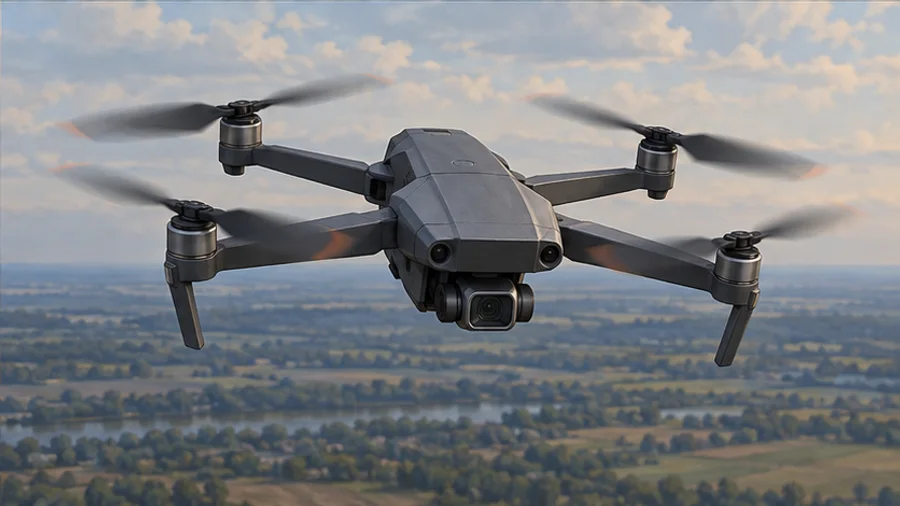
RUSI, in a study by Mykhaylo Zabrodskyi, Jack Watling, Oleksandr Danylyuk and Nick Reynolds, says the Donbas fighting used commercial and adapted quadcopters at tactical level and fixed wing reconnaissance drones such as the Russian Orlan 10. RUSI called the Orlan 10 especially valuable because it flew at medium altitude and was too cheap to be an economical target for air defences. Wikipedia says a team of two or three flies together: one for reconnaissance at 1,000 to 1,500 m, one for electronic warfare and one as a data relay. RUSI wrote that large drones such as the Bayraktar TB2 and Russia's Orion were scarcer and more vulnerable.
How they were used
RUSI says the Donbas war became dominated by artillery duelling, so rapid target acquisition mattered, and a narrow front left fewer chances for human reconnaissance. It reports that a Ukrainian company position about 3 km wide could take 6,000 rounds a day. Russian units with their own drones got fire onto targets within 3 to 5 minutes; targets sent through a fire control headquarters took 20 to 30 minutes at tactical level. On Ukraine's side, the ISW reported on 22 June, citing Foreign Policy, that Ukrainian forces had largely halted Bayraktar flights because Russian air defences had improved.
What effect they had
Haidai told Ukrainian television on 12 June that Russian artillery was winning the fighting in residential areas. RUSI concluded that the volume of fire destroyed Ukrainian defensive positions until they were no longer viable, which led in mid June to the decision to leave Sievierodonetsk. RUSI also found that only around a third of drone missions overall succeeded, and that Russia lacked enough Orlan 10 drones to cover its losses in Donbas. Stryuk said on 27 May that more than 1,500 civilians had been killed since 24 February.
For the classroom
- Why did a cheap fixed wing drone such as the Orlan 10 matter more to Russian artillery than a larger and costlier drone?
- RUSI says drones could shorten a fire mission from 20 to 30 minutes to 3 to 5 minutes. What would that change for a Ukrainian unit holding a street?
- Why would Ukraine halt Bayraktar flights once Russian air defences improved?
Sources
- Wikipedia: Battle of Sievierodonetsk (2022)
- Preliminary Lessons in Conventional Warfighting from Russia's Invasion of Ukraine, February to July 2022 (RUSI)
- Russian Offensive Campaign Assessment, June 22 (ISW, via Kyiv Post)
- Wikipedia: STC Orlan 10
- A Ukrainian Army unit of 60 was reduced to 4 soldiers (Task & Purpose, 2022)
- Ukraine: the situation, June 24 (Asia Times, 2022)
- Wikipedia: Sievierodonetsk
- Wikipedia: Lysychansk
- Wikipedia: Rubizhne
- Wikipedia: Toshkivka
- Wikipedia: Popasna
- Wikipedia: Bilohorivka, Luhansk Oblast
- Wikipedia: Kreminna
- Wikipedia: Bakhmut
- Wikipedia: Syrotyne
Written 2026-10-04.