
February 2018 Israel–Syria incident
- When
- 10 February 2018
- Where
- Northern Israel and Syria
- Sides
- Israel vs Syria and Iran
On 10 February 2018 an Israeli AH 64 Apache helicopter shot down an Iranian made drone over northern Israel, and Israeli jets then struck targets in Syria. Wikipedia describes the drone as a copy of the American RQ 170 and names it the Saegheh. During the strikes Syrian air defences shot down an Israeli F 16I, and Israel hit Syrian air defences and Iranian targets in reply.
What happened
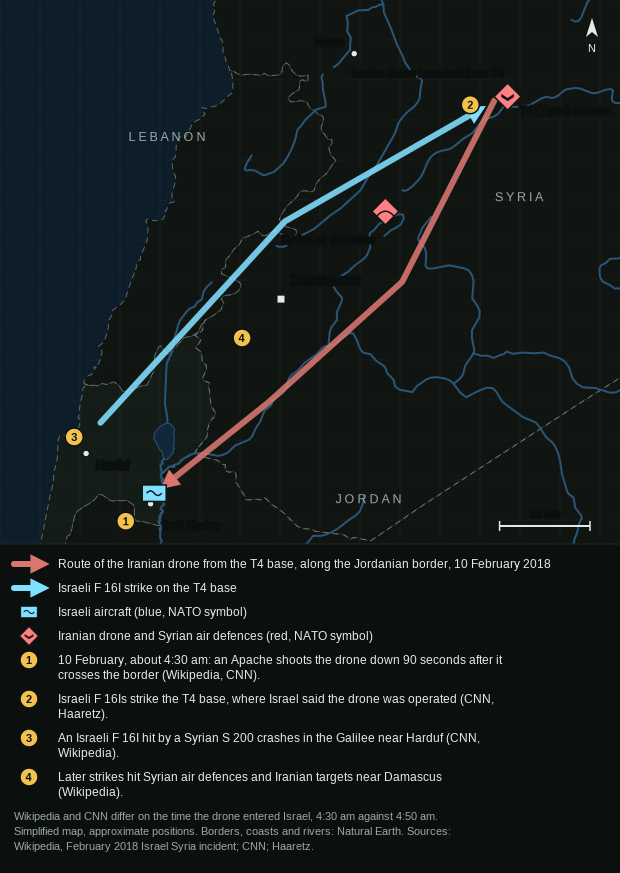
Wikipedia records that the drone was sighted taking off from a base in Syria, flew along the Jordanian border and was intercepted 90 seconds after crossing into Israel, at about 4:30 am. CNN gave the border crossing as 4:50 am and said the remains fell north of Beit She'an. Israel then sent eight F 16I jets against the base it said the drone came from. Wikipedia calls it Tiyas airbase, while CNN and Haaretz call it the T4 base near Homs. Syrian batteries fired at the jets, and one F 16I crashed in the Galilee region; CNN reported that both pilots ejected. IDF spokesman Jonathan Conricus said twelve further targets were hit in Syria, eight Syrian and four Iranian. The Wall Street Journal cited Syrian media for 25 people killed.
The drones
Wikipedia describes the Shahed Saeqeh, also called the Shahed 191, as an Iranian flying wing combat drone made by Shahed Aviation Industries and based on, but smaller than, the RQ 170 Sentinel that Iran captured in 2011. CNN reported that Iran said in May 2014 it had built a copy after reverse engineering most of the technology. Wikipedia gives the Shahed 191 a wingspan of 7.31 m, a length of 2.7 m and a maximum takeoff weight of 500 kg and, citing Tasnim News, 60 percent of the size of the RQ 170. Rodger Shanahan of the Lowy Institute told CNN it did not appear to have stealth features.
How they were used
Haaretz reported that the drone was operated from a command centre at the T4 base. Israeli journalist Ron Ben Yishai said it was sent to test whether Israeli air defences could detect a stealth drone, and that the test failed. Brigadier General Tomer Bar of the Israeli Air Force told CNN that Israel let the drone cross the border so that it could be destroyed. On 13 April the IDF said the drone carried explosives and was tasked to attack Israeli territory; spokesman Ronen Manelis called its aim an act of sabotage. Iran's Foreign Ministry spokesman, Bahram Qassemi, called the claims too ridiculous to address.
What effect they had
Conricus told CNN it was the first time an Iranian drone had entered Israeli airspace since the Syrian civil war began. Wikipedia calls the day the first direct confrontation between Israel and Iran since 1979. Two weeks later the IDF said an S 200 missile hit the F 16I and that its crew did not take proper evasive action. It said Syria fired 13 missiles at the first eight jets and 14 more in later waves, 27 in all. Hezbollah called the loss of the jet the start of a new strategic phase. An Israeli army assessment said the retaliatory strikes destroyed nearly half of Syria's air defences. Israel and Iran later exchanged direct strikes in the April 2024 Iranian strikes against Israel and the Iran Israel war (Twelve Day War).
For the classroom
- Why would Israel let a drone cross the border before shooting it down?
- How did a Syrian air defence missile bring down an F 16I that had been sent to strike the drone's base?
- What could the wreckage of a drone show about its mission?
Sources
- Wikipedia: February 2018 Israel Syria incident
- Wikipedia: Shahed 191
- Israel: Iranian drone we shot down was based on captured US drone (CNN, 12 February 2018)
- Israel: Iranian drone shot down in February was weaponized (CNN, 13 April 2018)
- Israel Says Downed Iranian Drone Was Armed and Heading for Attack (Haaretz, 13 April 2018)
Written 2026-10-04.