
Kargu-2 use in Libya
- When
- 2020
- Where
- Western Libya
- Sides
- GNA vs LNA
- Drones
- STM Kargu-2, Bayraktar TB2
In March 2020, during the fighting between the Government of National Accord (GNA) and the Libyan National Army (LNA) in western Libya, a Turkish made STM Kargu 2 loitering munition was reported to have hunted down retreating LNA forces. A UN Panel of Experts on Libya said in its March 2021 report that the weapon was programmed to attack without a data link to its operator. The report did not say anyone was killed, and STM denies that the Kargu 2 selects targets on its own.
What happened
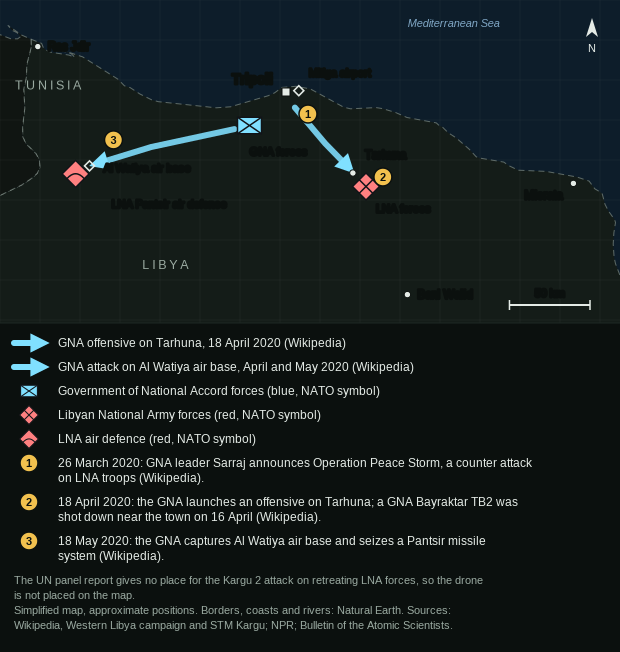
Wikipedia dates the second phase of the Western Libya campaign from 26 March to 5 June 2020. On 26 March the GNA leader Fayez al Sarraj announced Operation Peace Storm, a counter attack against LNA troops. Wikipedia records that GNA forces besieged the Al Watiya air base on 16 April, launched an offensive on the town of Tarhuna on 18 April, and captured Al Watiya on 18 May, seizing a Pantsir missile system. The UN panel's report, released on 8 March 2021 according to Project Ploughshares, placed the Kargu 2 in that campaign. That fighting is part of the Western Libya campaign.
The drones
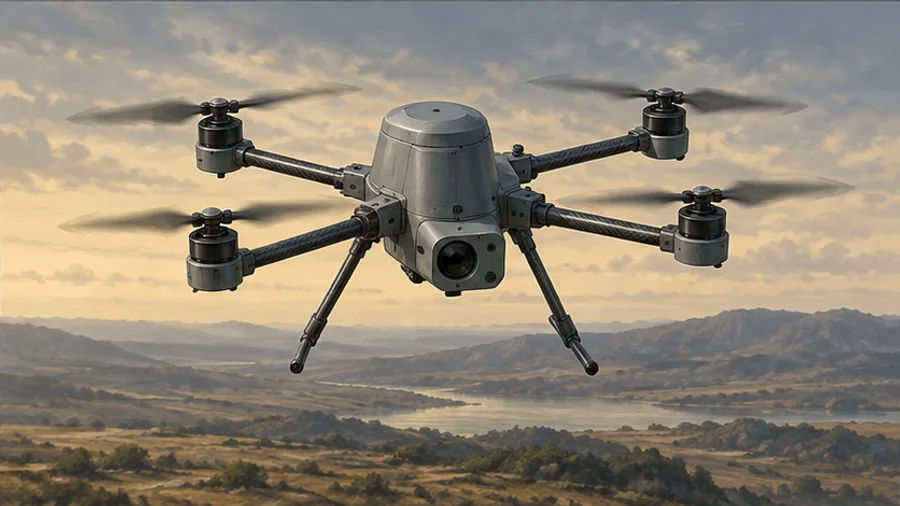
Wikipedia describes the STM Kargu as a small portable quadrotor loitering munition made by STM of Turkey, first flown in 2017 and introduced in 2020. It lists figures from the official STM website: 60 cm long, 7,060 g, a top speed of 72 km/h, 30 minutes of endurance, a range of 10 km and a camera with 10x optical zoom. Zachary Kallenborn wrote in the Bulletin that it can use machine learning to classify objects and that swarms of 20 were in development. Wikipedia reports that the STM chief executive Murat Ikinci said it has facial recognition.
How they were used
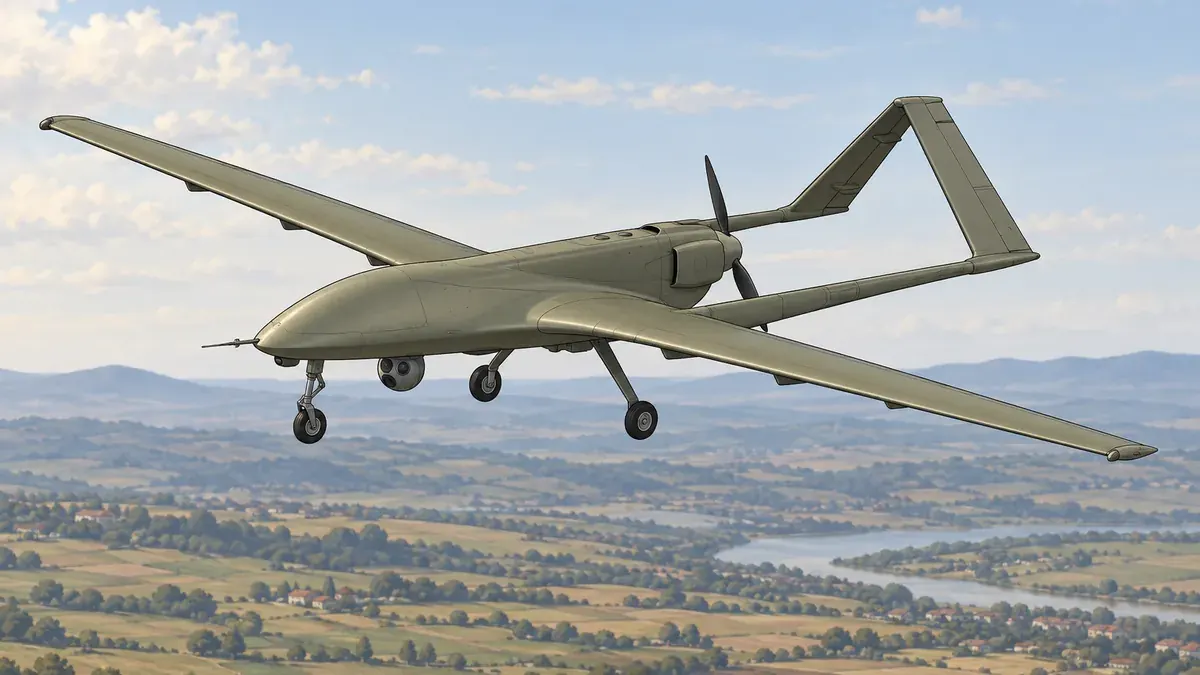
The panel wrote that logistics convoys and retreating Haftar affiliated forces "were subsequently hunted down and remotely engaged" by combat drones or lethal autonomous weapons such as the Kargu 2. It added that the systems were programmed to attack "without requiring data connectivity between the operator and the munition: in effect, a true 'fire, forget and find' capability." NPR reported that Jack McDonald of King's College London said the report did not make clear whether the Kargu 2 was working autonomously or manually. Wikipedia notes that STM promotional films show a human operator selecting the target. Wikipedia also lists GNA Bayraktar TB2 drones shot down near Tripoli on 31 March and near Tarhuna on 16 April.
What effect they had
The report started a public argument over autonomous weapons. Kallenborn wrote that a death in an autonomous attack would be a historic first, but that the report is not explicit. Ulrike Franke of the European Council on Foreign Relations asked why this story drew so much attention, since loitering munitions had been used for some time. NPR cited a survey for the Campaign to Stop Killer Robots in which 62 percent of respondents opposed lethal autonomous weapons. STM's chief executive Ozgur Guleryuz told Project Ploughshares that "unless an operator pushes the button, it is not possible for the drone to select a target and attack." Ismail Demir, quoted by TURDEF on 23 June 2021, said the final order is given under human control.
For the classroom
- What could a quadrotor with a 10 km range and 30 minutes of endurance do against a retreating convoy?
- Why would a weapon that attacks without a data link to its operator worry critics of autonomous weapons?
- Why would the GNA fly TB2s and loitering munitions against the same LNA forces near Tripoli and Tarhuna?
Sources
- Wikipedia: STM Kargu
- Wikipedia: Western Libya campaign
- A Military Drone With A Mind Of Its Own Was Used In Combat, U.N. Says (NPR, 2021)
- Was a flying killer robot used in Libya? Quite possibly (Bulletin of the Atomic Scientists, 2021)
- Kargu 2 debate raises awareness of autonomous weapons (Project Ploughshares, 2021)
- Demir Denies UN Report: KARGU 2 Does not Attack Autonomously (TURDEF, 2021)
Written 2026-10-04.