
Khmeimim air base attack
- When
- 5 to 6 January 2018
- Where
- Khmeimim and Tartus, Syria
- Sides
- Unclaimed Syrian armed opposition vs Russia
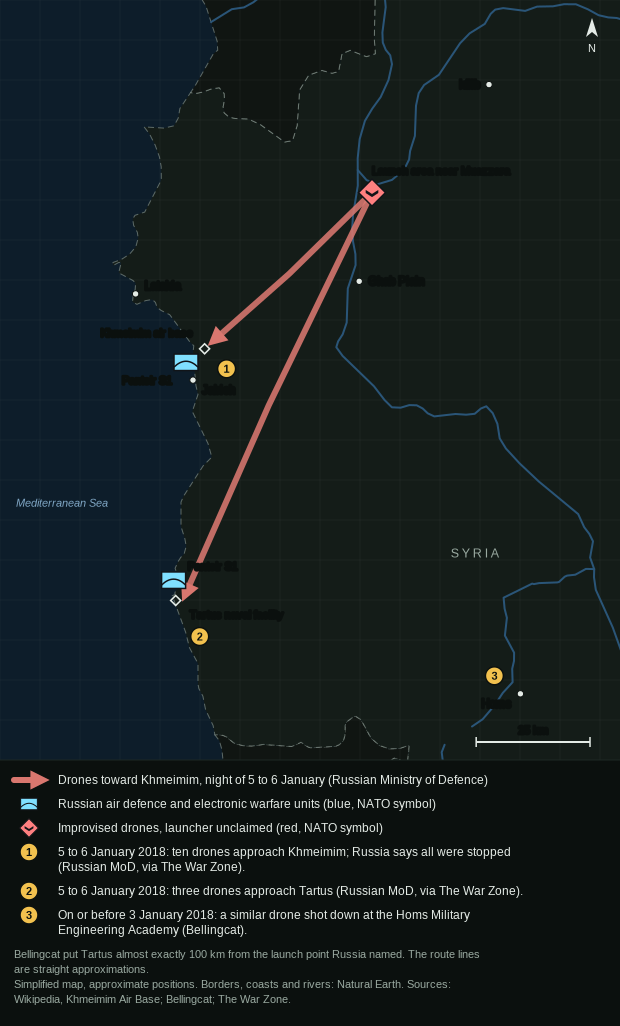
On the night of 5 to 6 January 2018, 13 armed fixed wing drones approached the Russian air base at Khmeimim and the Russian naval facility at Tartus on the Syrian coast. The Russian Ministry of Defence said it stopped all of them with electronic warfare units and Pantsir S1 air defence systems and that the bases suffered no casualties or damage. No group claimed the attack. Bellingcat found the drones were improvised from cheap materials.
What happened
Russia announced on 8 January 2018 that its air defence forces had detected 13 small air targets approaching at a distance on the evening of 5 January. It said ten drones went toward Khmeimim and three toward Tartus. The base had been shelled on 31 December 2017. Wikipedia records that the ministry confirmed two servicemen killed in that shelling and denied that seven aircraft were destroyed, as the newspaper Kommersant had reported. Roman Saponkov, a Russian military journalist, said ten aircraft were damaged but none destroyed. On 12 January the ministry said it had killed the militants behind the shelling and destroyed a drone depot in Idlib province.
The drones
Bellingcat's Nick Waters described drones with a wingspan of about three to four metres, a plywood body covered in plastic sheeting and held with tape, and a small engine, possibly petrol. Waters saw a GPS antenna and no camera. Under the wings, struts could carry up to ten small bomblets each, built as explosive inside a layer of ball bearings in a plastic shell. The Russian ministry said the drones had pressure sensors and altitude servo actuators and that the launch site lay more than 50 km away. It said they could reach about 100 km. Bellingcat put Tartus almost exactly 100 km from the launch point the ministry named, near Muazzara in Idlib province.
How they were used
The Russian ministry said six drones were intercepted by electronic warfare units and taken under control. Three landed outside the base and three exploded on touching the ground. It said seven more were shot down by Pantsir S1 systems. Waters concluded that, with no cameras, the drones were probably loaded with a flight plan and flown on their own to a GPS point, then dropped their bombs together, since the bombs were unguided. The ministry also said the technology had to come from a country with advanced satellite navigation. In October 2018 Deputy Defence Minister Alexander Fomin said an American Poseidon 8 aircraft had patrolled for eight hours, and the Pentagon called any suggestion of a US role baseless.
What effect they had
Russia reported no damage from the attack. Bellingcat counted at least four attacks with this drone in early January 2018, including one near Khmeimim on or before 1 January and one at the Homs Military Engineering Academy, over 100 km away, on or before 3 January. Waters called Russia's claim of state help doubtful, since the parts could be sourced locally. Wikipedia records further drone attacks on the base on 24 April and 30 June 2018 and a claim by spokesman Igor Konashenkov on 27 September 2019 of more than 100 drones downed in two years. It lists attacks repelled as late as 27 September 2021. In December 2024, after the 2024 Syrian opposition offensives, the base came under threat and Russian air defences were moved to Tartus.
For the classroom
- Why are 13 cheap drones launched together harder to stop than one?
- Why would a drone with no camera need a preloaded flight plan to reach its target?
- How could electronic warfare units take control of six of the drones?
Sources
- Wikipedia: Khmeimim Air Base
- The Poor Man's Air Force? Rebel Drones Attack Russia's Airbase in Syria (Bellingcat, 2018)
- Russia Says January 5th Attack On Its Syrian Air Base Was By A Swarm Of Drones (The War Zone, 2018)
- Wikipedia: Tartus naval base
- Wikipedia: Jableh
- Wikipedia: Homs
- Wikipedia: Idlib
Written 2026-10-04.