
Kursk campaign
- When
- 6 August 2024 to March 2025
- Where
- Kursk Oblast, Russia
- Sides
- Ukraine vs Russia with North Korean troops
- Drones
- Fibre optic FPV, FPV attack drone
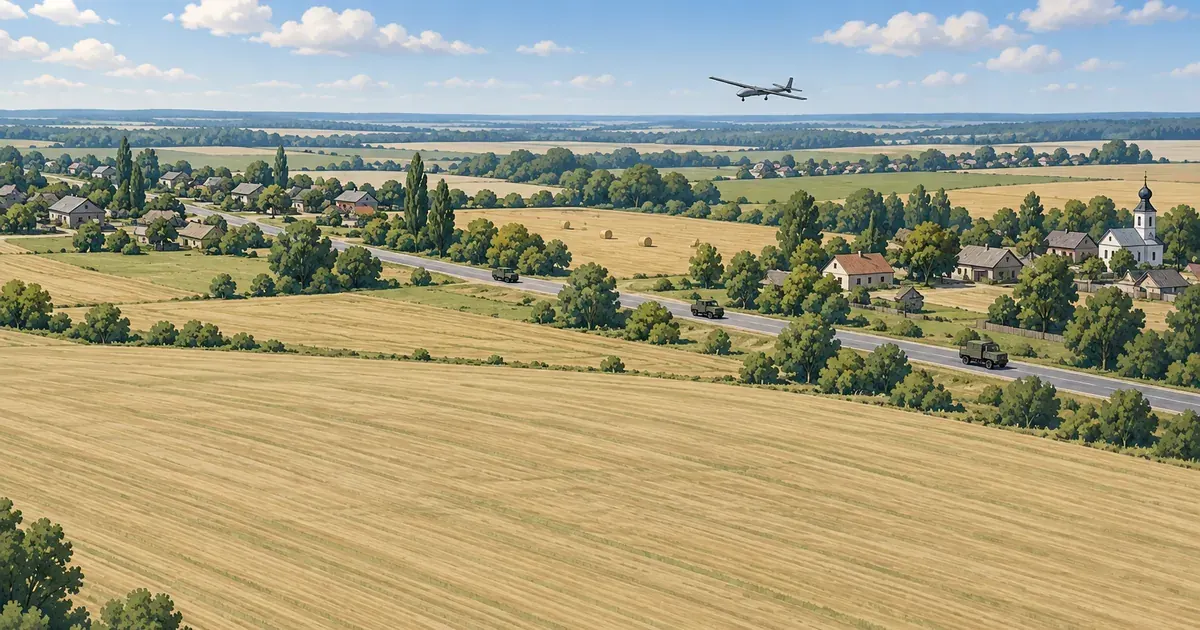
From 6 August 2024 to March 2025, Ukraine and Russia fought in Kursk Oblast, Russia, in what Wikipedia calls the Kursk campaign, with North Korean troops joining the Russian side from November 2024. Vlad Sutea of the Atlantic Council wrote that Russian fibre optic drones, which cannot be jammed by radio, helped make the Ukrainian hold on the area unsustainable, and Ukrainian forces withdrew across the border in March 2025.
What happened
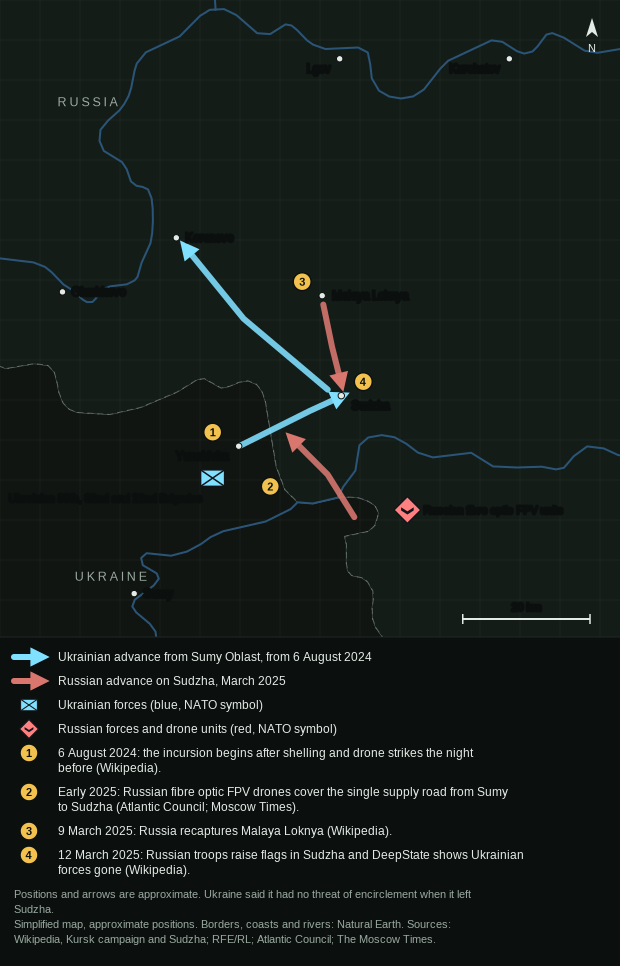
Wikipedia records that the Ukrainian incursion was preceded by artillery shelling and drone strikes on the night of 5 to 6 August 2024 and began at 08:00 Moscow time on 6 August. Wikipedia says the front stabilised in the second half of August, that Russian forces had recaptured about half of that ground by the end of November, and that Russian troops entered Sudzha on 12 March 2025. It also records criticism that the operation drew Ukrainian forces away from the east and let Russia advance toward Pokrovsk, the subject of the Pokrovsk offensive.
The drones
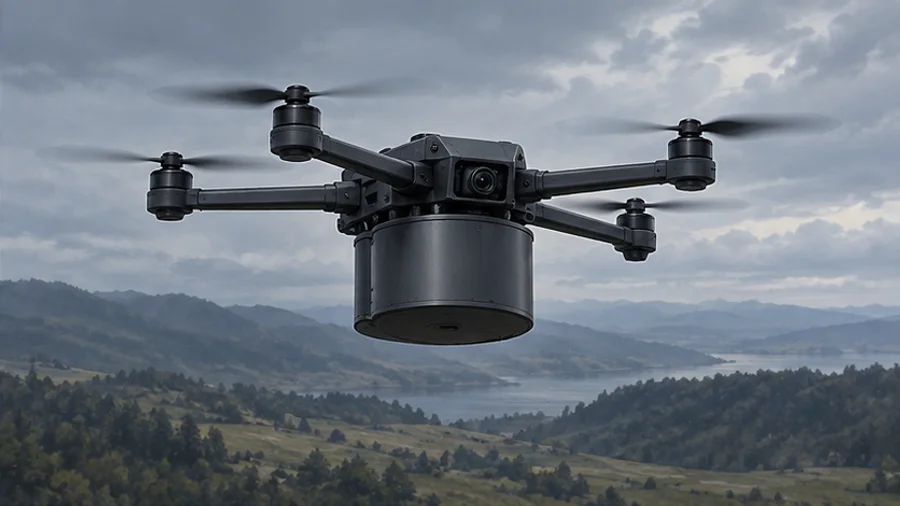
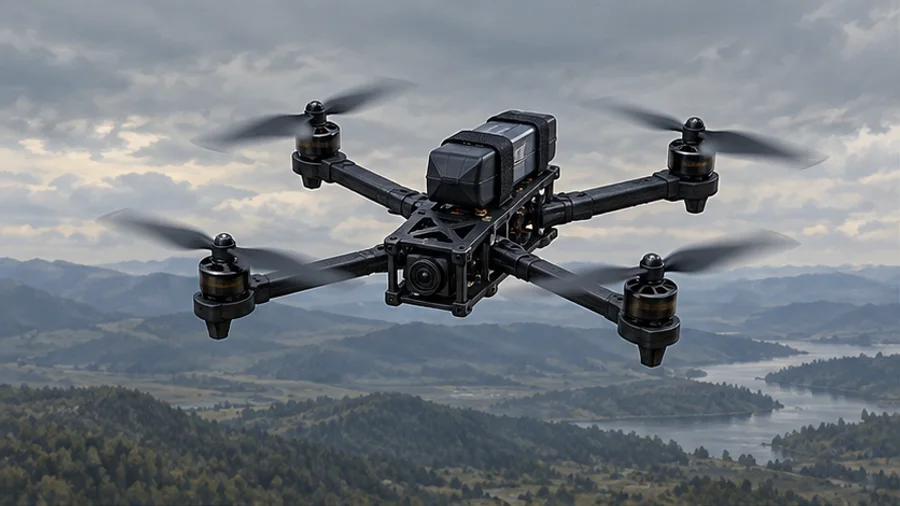
Sutea describes a fibre optic FPV drone as one trailing a cable thinner than a fishing line to its operator, with no radio link to jam, and gives its strike range as over 30 kilometres. Sutea wrote that these drones first appeared at scale in August 2024 in response to the Kursk incursion. Wikipedia states that Russia deployed them after Ukraine showed improved electronic warfare in Kursk. The Moscow Times said Russia put large numbers of fibre optic guided FPV drones on the front. RFE/RL reported that a Russian unit called Rubicon, formally the Rubicon Center of Advanced Unmanned Systems, was set up in the summer of 2024.
How they were used
Sutea wrote that the territory Ukraine held depended on a single supply route from Sumy to Sudzha. RFE/RL reported that a Rubicon unit hit the lines supplying Ukrainian positions in Sudzha. Julian Röpcke of Bild told the Moscow Times that the range of the drones let Russia control that corridor, and Ukrainian military Telegram channels said road travel was impossible. RFE/RL reported that from February Rubicon units went after Ukrainian drone operators. Rob Lee said one Ukrainian brigade reported losing up to 70 percent of its drone operators in a week. DeepStateMap reported that nine Ukrainian drone operators and contractors were shot after surrendering on 10 October 2024, according to Wikipedia.
What effect they had
Lee, a military analyst at the Foreign Policy Research Institute, told RFE/RL that Rubicon was a key reason Russia retook essentially all of Kursk Oblast in February and March. Sutea cited strike videos from Russian war bloggers showing a disproportionate share of Russian fibre optic attacks between August 2024 and September 2025 took place in the Kursk sector, and wrote that Ukraine lost 25 percent more vehicles than Russia there, including Abrams tanks. Michael Kofman assessed that by early February 2025 the salient could not be held because Russia could hinder its supply routes. Steen Kjærgaard said the US halt in intelligence sharing on 5 March also played a major role. Sutea added that fibre optic drones then spread across the front, including the Pokrovsk fighting.
For the classroom
- Why did a single supply road make the Ukrainian position in Sudzha so exposed to fibre optic drones?
- Rob Lee called Rubicon a key reason for the Russian recapture, while Kjærgaard stressed the end of US intelligence sharing. How could each factor be weighed?
- What does the spread of fibre optic drones after Kursk show about how both sides copy tactics?
Play this battle in the simulation
Take either side in the scenario built on this battle, with the same drones on a real map.
Sources
- Wikipedia: Kursk campaign
- Inside Rubicon (RFE/RL, 2025)
- Fiber optic drones have emerged as critical kit for both Russia and Ukraine (Atlantic Council, 2026)
- Ukraine Risks Losing Kursk Foothold as Russia Pushes Forward (The Moscow Times, 2025)
- Wikipedia: Sudzha
- Wikipedia: Sumy
- Wikipedia: Yunakivka
- Wikipedia: Malaya Loknya
- Wikipedia: Korenevo
- Wikipedia: Lgov, Kursk Oblast
- Wikipedia: Kurchatov
- Wikipedia: Glushkovo
Written 2026-10-04.