
Operation Inherent Resolve, early phase
- When
- 8 August 2014 to December 2015
- Where
- Iraq and Syria
- Sides
- US led coalition vs Islamic State
From 8 August 2014 to December 2015, a coalition led by the United States fought the Islamic State of Iraq and the Levant from the air over Iraq and Syria, and armed and unarmed drones flew in it from the start. Wikipedia describes Operation Inherent Resolve as the American name for the international war against the Islamic State. American MQ 1 Predator and MQ 9 Reaper drones and British Reapers struck targets, while the Islamic State flew small reconnaissance drones of its own.
What happened
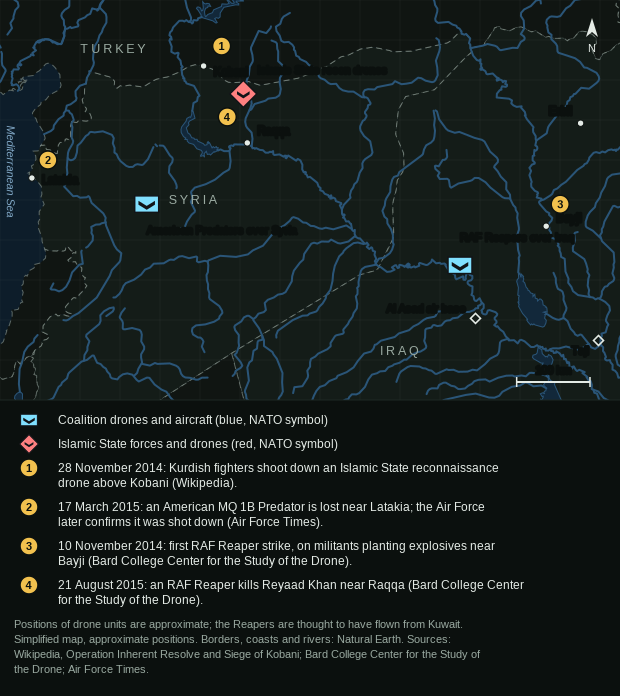
Wikipedia records the first American airstrikes on Islamic State targets in Iraq on 8 August 2014 and the start of the Syrian campaign on 22 September 2014. The British Parliament authorised the use of force in support of the Iraqi government on 26 September 2014, according to the Bard College Center for the Study of the Drone. Wikipedia states that about 80 percent of coalition airstrikes were American, with the rest flown by the United Kingdom, Australia, France, Jordan and others. From 15 September 2014 the Islamic State also besieged the Syrian border town of Kobani, where the coalition struck its positions.
The drones
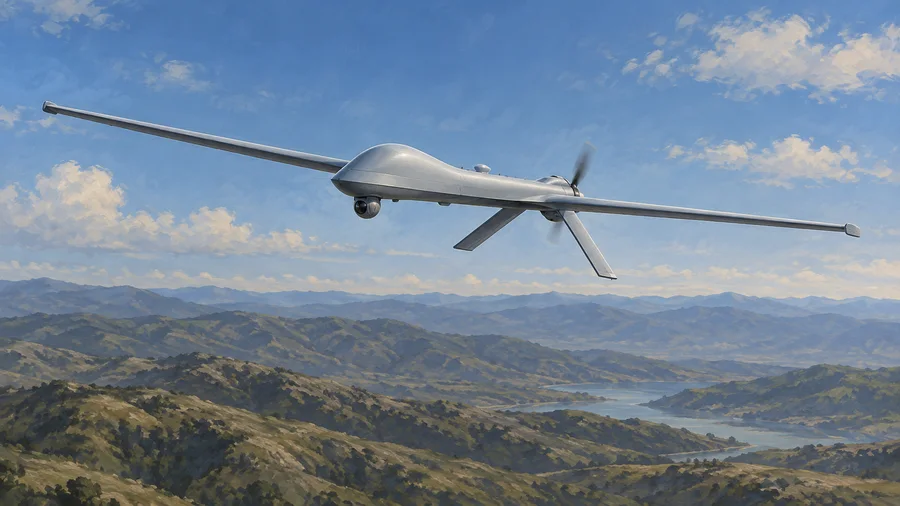
Wikipedia lists the United States aircraft in the operation as MQ 1 Predator and MQ 9 Reaper armed drones, and RQ 4 Global Hawk and Lockheed Martin RQ 170 Sentinel surveillance drones. Air Force Times reported that the Air Force said Predators and Reapers had flown 3,300 sorties and made 875 airstrikes in the campaign as of 16 June 2015. The Bard center, in an article by Dan Gettinger, says the Royal Air Force Reaper carried almost only AGM 114 Hellfire missiles, an American precision missile. An Air Force official said the MQ 1 was designed for a permissive environment. Wikipedia credits the Islamic State with at least five drones.
How they were used
Gettinger wrote that an RAF Reaper made its first strike on 10 November 2014, hitting militants who were planting improvised explosive devices near Bayji, Iraq. Between 5 October 2014 and 16 September 2015, Reapers and Tornado GR4 jets each made 137 engagements. Reapers gave close air support to Iraqi Army troops in 59 engagements and to Kurdish forces in 16. On 17 March 2015 an American MQ 1B Predator was lost near Latakia in Syria. Syrian state media said air defences shot it down; the Air Force later confirmed it was shot down. At Kobani, Wikipedia records that Kurdish fighters shot down an Islamic State reconnaissance drone above the town on 28 November 2014.
What effect they had
Gettinger concluded that drones were integral to the British effort. The most disputed use came on 21 August 2015, when an RAF Reaper killed Reyaad Khan, a British citizen, and Ruhul Amin near Raqqa. Prime Minister David Cameron told Parliament on 7 September that no other means existed to stop a terrorist directing murder in Britain. Two Green Party members of Parliament, backed by Reprieve, challenged the legality, and Jeremy Corbyn disputed it. A United States drone then killed Junaid Hussain near Raqqa. In April 2017 the Intelligence and Security Committee said Khan posed a very serious threat, but it questioned whether Khan's actions amounted to an armed attack and said the deaths of the others in the strike might have been collateral damage.
Related battles
For the classroom
- Why did the Royal Air Force Reaper fly more missions for Iraqi Army troops than for Kurdish forces, according to the Bard center?
- What did the loss of the Predator near Latakia show about the air defences the coalition expected to face?
- How did the Reyaad Khan strike differ from the Reaper missions flown in support of Iraqi and Kurdish ground forces?
Sources
- Wikipedia: Operation Inherent Resolve
- The Air Campaign Against ISIL (Bard College Center for the Study of the Drone, 2015)
- Wikipedia: Siege of Kobani
- Air Force: Lost Predator was shot down in Syria (Air Force Times, 2015)
- Drone strike that killed Reyaad Khan not transparent (Al Jazeera, 2017)
Written 2026-10-04.