
Operation Pedestal radio controlled SM.79
- When
- 12 August 1942
- Where
- Western Mediterranean, off Algeria
- Sides
- Italy vs United Kingdom and United States
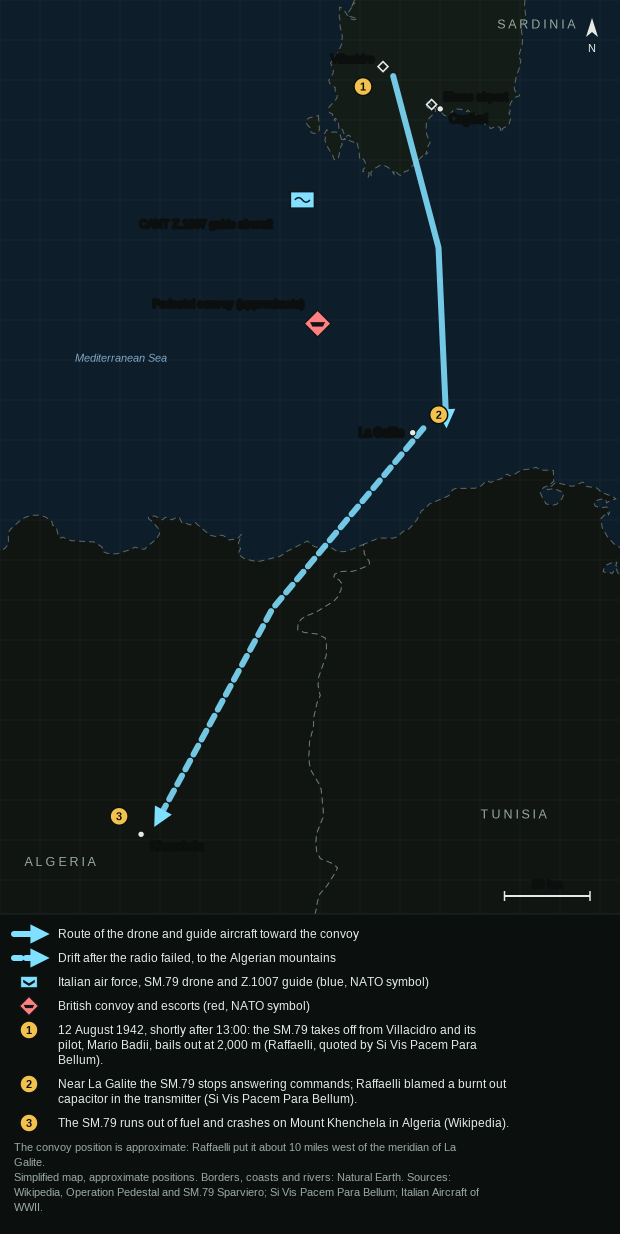
On 12 August 1942, during Operation Pedestal, the Italian air force sent a radio controlled Savoia Marchetti SM.79 loaded with a 1,000 kg bomb toward the British carriers escorting a Malta convoy. Wikipedia names the sides in Pedestal as the United Kingdom, the United States and Malta against Italy and Germany. A pilot took off, set the course and bailed out, and a CANT Z.1007 guide aircraft was to steer the bomber by radio. The transmitter failed, and the SM.79 flew on until it crashed in the mountains of Algeria.
What happened
Wikipedia records that the Pedestal convoy sailed from Britain on 3 August 1942 and entered the Mediterranean on the night of 9 and 10 August. It carried 14 merchant ships, including the tanker Ohio, and the carrier Eagle was sunk on 11 August. Wikipedia describes the biggest air attack on the convoy as coming around noon on 12 August from aircraft based in Sardinia. Its third wave included two Re.2001 fighter bombers and a special radio controlled SM.79, directed by General Ferdinando Raffaelli from a Cant Z.1007bis. The two fighter bombers both hit the carrier Victorious, and one bomb killed six sailors. Ohio reached Malta on 15 August.
The drones
The standard SM.79 is a three engine bomber 16.2 m long with a 20.2 m wingspan, and Wikipedia gives its range as 2,600 km. The Italian defence blog Si Vis Pacem Para Bellum, drawing on Raffaelli's own account, calls the converted aircraft the Aereo Radio Pilotato, or ARP. It says Raffaelli began the project in 1940 and that the ARP carried a 1,000 kg bomb on a special release hook. It had an autopilot, and the guide aircraft followed about 4,000 m behind it. The ARP was painted yellow so the guide crew could see it, and the mission was nicknamed "canarino", Italian for canary.
How they were used
According to Raffaelli's account, quoted by the same blog, the ARP took off from Villacidro in Sardinia shortly after 13:00 on 12 August. The pilot, Mario Badii, bailed out over the airfield at 2,000 m. The Z.1007bis, with a crew of four including Raffaelli, took over the controls and followed, while Fiat G.50 escorts took off, and two joined the group. The planned attack ran east of the island of La Galite and then north toward the convoy from the south, ending with a glide onto the sea so that the bomb would reach a hull near the waterline.
What effect they had
Raffaelli wrote that the aircraft stopped answering commands as La Galite came into view. Raffaelli blamed a burnt out capacitor in the transmitter that could not be replaced in flight. The SM.79 kept flying steadily, the guide crew released the escorts and then let it go, and it crashed in the Algerian mountains. Wikipedia says it ran out of fuel and hit Mount Khenchela, and the blog puts the impact at 1,800 m. No hit on any ship is recorded. The Italian Aircraft of WWII blog dates the attempt to 13 August and calls it the first operational use of a radio controlled flying bomb. Raffaelli then pressed for a cheaper machine, the Ambrosini A.R., tested from June 1943; five were built and none was used in action.
For the classroom
- Why did the plan need a pilot for take off, and what did the guide aircraft have to keep in sight?
- Raffaelli's account blames one failed component. Why is a single radio link a weak point for a weapon controlled from a second aircraft?
- Two sources give 12 and 13 August for the attempt. How could a historian decide between them?
Sources
- Wikipedia: Operation Pedestal
- Wikipedia: Savoia Marchetti SM.79 Sparviero
- Wikipedia: CANT Z.1007 Alcione
- Le operazioni su Malta e nel Mediterraneo: l'SM 79 e il primo tentativo italiano di attacco con aereo senza pilota (Si Vis Pacem Para Bellum, 2020)
- Ambrosini A.R. Assalto Radioguidato (Italian Aircraft of WWII, 2015)
Written 2026-10-04.