
Siege of Marawi
- When
- 23 May to 23 October 2017
- Where
- Marawi, Philippines
- Sides
- Philippine armed forces vs Maute Group and Abu Sayyaf
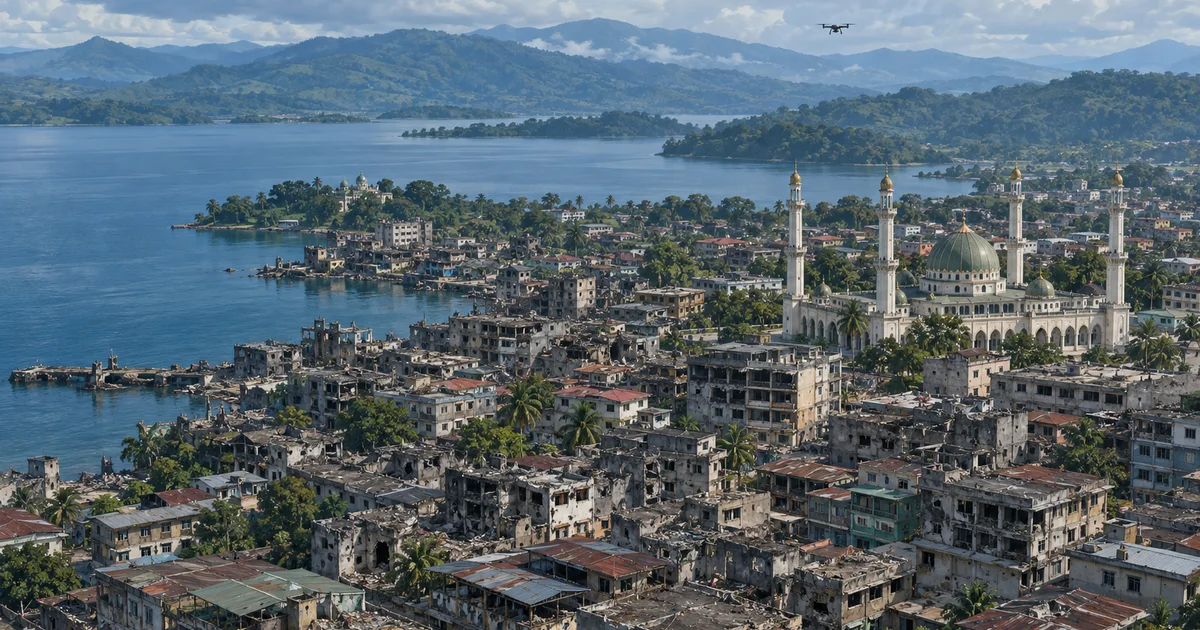
From 23 May to 23 October 2017, the armed forces of the Philippines fought militants loyal to the Islamic State, led by the Maute group and Abu Sayyaf, for control of the city of Marawi on Mindanao. MWI describes small-drone reconnaissance by both sides. This establishes documented observation roles, not a complete inventory proving that every mission was unarmed. Wikipedia names the sides as the Philippines and the Islamic State, including the Maute group and Abu Sayyaf.
What happened
Wikipedia names Isnilon Hapilon of Abu Sayyaf and Omar Maute as the militant leaders and records a government victory after five months, with the city retaken on 23 October. It lists 168 government troops and 978 militants killed and about 200,000 residents displaced. Amnesty International reported in November 2017 that at least 25 civilians were killed by the militants, that extensive bombing of militant held areas wiped out entire neighbourhoods and killed civilians, and that government forces detained and mistreated some civilians fleeing the city. Official figures cited by Amnesty put civilian deaths at 47; Wikipedia gives 87, including 40 who died of illness.
The drones
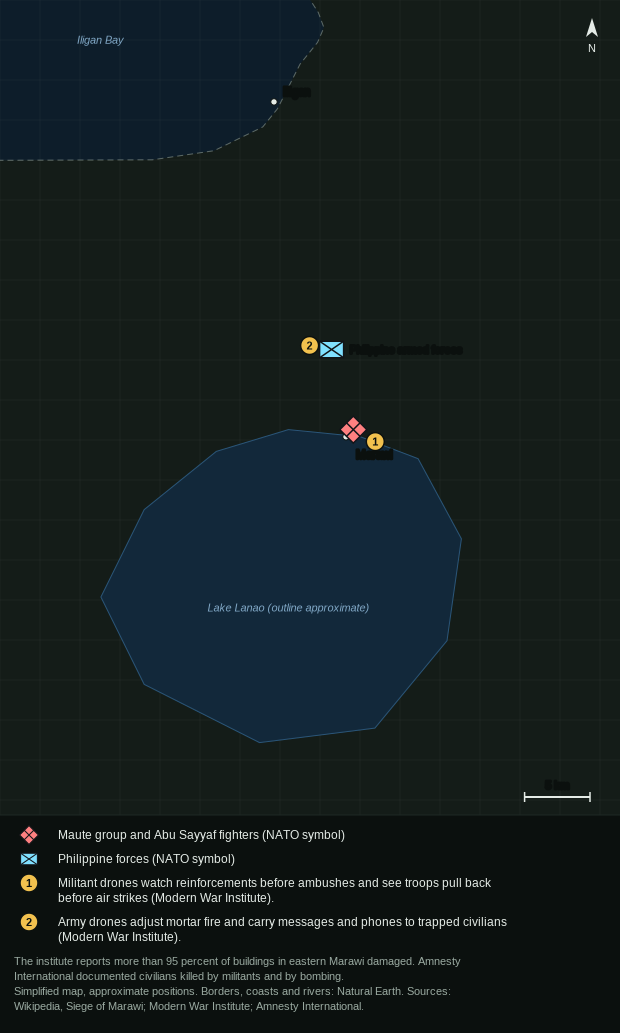
Wikipedia notes that the Philippine Army used the RQ 11 Raven, delivered in January 2017. Wikipedia describes the Raven as a hand launched aircraft about 0.91 m long with a 1.37 m wingspan, weighing 1.9 kg, with an endurance of 60 to 90 minutes and a range of about 10 km. Defense News reported in June 2017 that United States special operations forces supported Philippine troops with a P 3C Orion surveillance aircraft and the RQ 20 Puma, a small drone used for tactical reconnaissance. The militants also flew drones, according to the Modern War Institute at West Point.
How they were used
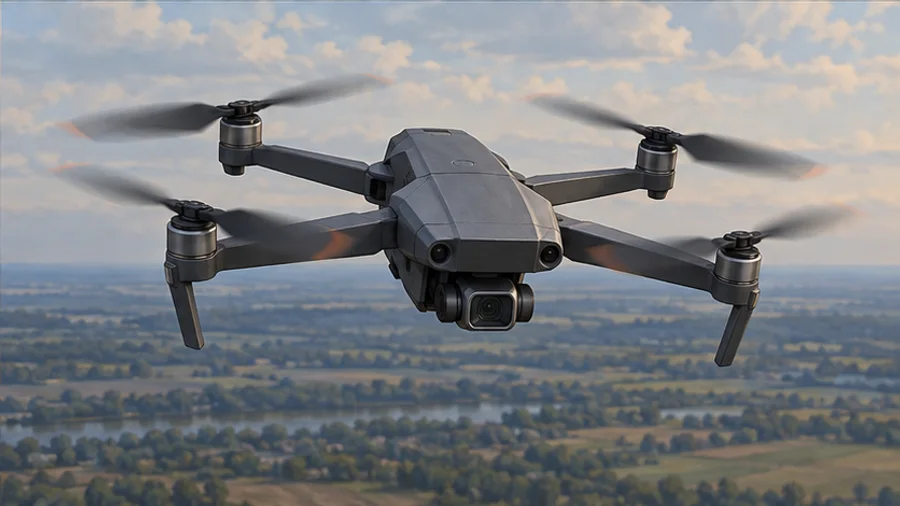
In its case study of the battle, the Modern War Institute writes that militant fighters used drones to watch Philippine reinforcements and then moved quickly to ambush them. They also watched troops pull back before air strikes and reoccupied the cleared buildings before ground forces could advance. Philippine units used drones to watch where mortar rounds landed so that fire could be adjusted. The institute also reports that the army used drones carrying written messages and mobile phones to find and talk with civilians trapped in militant held areas.
What effect they had
The battle was fought mostly by ground troops, artillery and air strikes, and the drones served as eyes for both sides. In the institute's account, militant drones helped set up ambushes and retake cleared buildings, while government drones supported mortar spotting and contact with trapped civilians. The damage to the city was severe: the institute reports that more than 95 percent of the structures in eastern Marawi were damaged and that three years after the battle about 120,000 former residents were still displaced.
For the classroom
- MWI documents observation by both sides. What information did that provide, and what could observation alone not establish?
- Why might a drone be a useful way to contact civilians trapped inside a combat zone?
- Compare the documented drone roles at Marawi with those reported at Mosul. What evidence would be needed to establish the full mission inventory in either battle?
Play this battle in the simulation
Take either side in the scenario built on this battle, with the same drones on a real map.
Sources
- Wikipedia: Siege of Marawi
- Urban Warfare Case Study 8: Battle of Marawi (Modern War Institute)
- Philippines: Battle of Marawi leaves trail of death and destruction (Amnesty International, 2017)
- US aircraft in Philippines in battle against ISIS (Defense News, 2017)
- Wikipedia: AeroVironment RQ 11 Raven
Written 2026-10-03.