
Zelenopillia rocket attack
- When
- 11 July 2014
- Where
- Zelenopillia, Luhansk Oblast
- Sides
- Russia vs Ukraine
- Drones
- Orlan-10
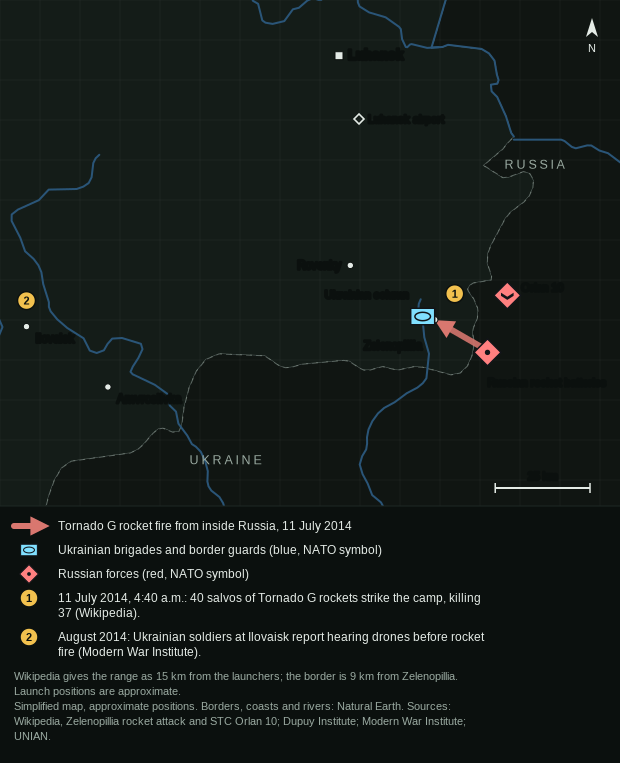
On 11 July 2014, during the war in Donbas, Russian forces fired Tornado G rockets from inside Russia onto a Ukrainian camp near Zelenopillia in Luhansk Oblast, and Orlan 10 drones were part of the Russian force. Wikipedia names the sides as Ukraine and Russia and records 37 Ukrainian soldiers and border guards killed. Analysts writing for the Dupuy Institute and the Modern War Institute describe the strike as an early example of drones directing rocket fire onto troops in near real time.
What happened
Wikipedia records that at 4:40 a.m. on 11 July 2014 Russian forces fired 9K51M Tornado G rockets in 40 salvos at an armoured column of the Ukrainian Ground Forces camped in a field near Zelenopillia, about 15 km from the launchers. The village lies on the highway to Luhansk, 9 km from the Russian border. The Dupuy Institute lists battalions of the 24th and 72nd Mechanised Brigades and the 79th Airmobile Brigade, deployed to cut supply lines to separatist forces, and says the barrage lasted about three minutes. The ATO press centre reported the strike at 04:30, according to UNIAN.
The drones
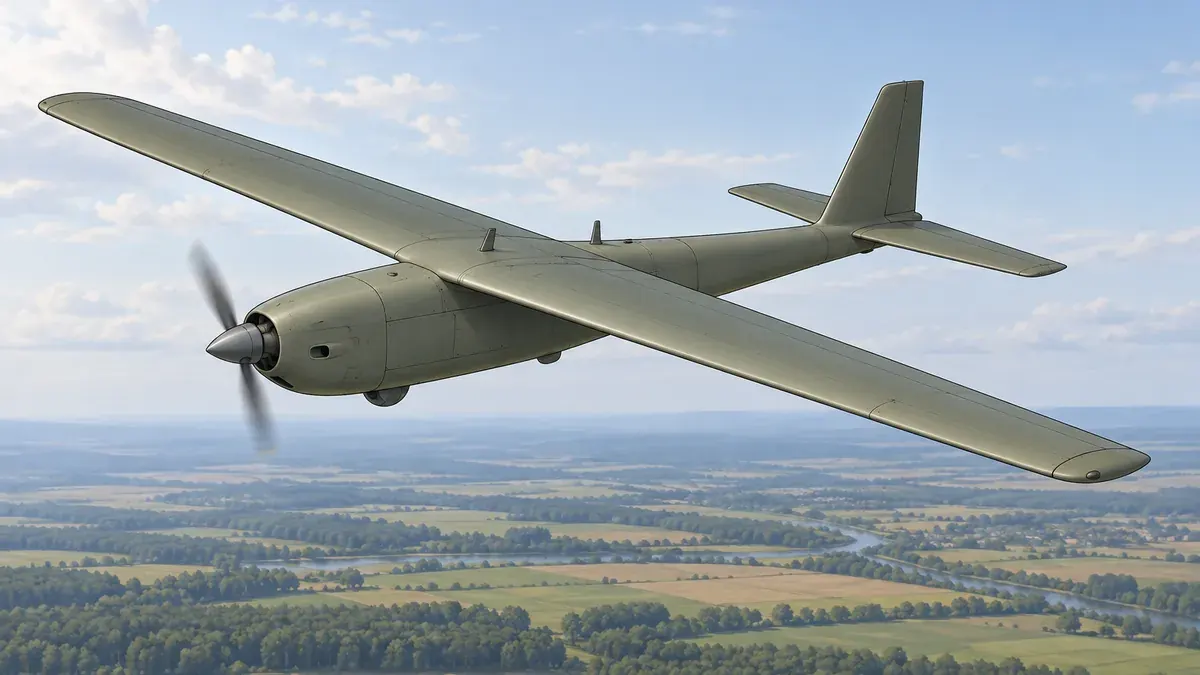
Wikipedia lists the Orlan 10 as a reconnaissance drone built by the Special Technology Center in Saint Petersburg. It weighs up to 15 kg at takeoff, flies at up to 150 km/h, has a combat range of 110 km and an endurance of 16 hours, and is launched from a folding catapult. Wikipedia says systems usually deploy two or three aircraft: one for reconnaissance at 1,000 to 1,500 m, one for electronic warfare and one as a data relay. For the attack itself, Wikipedia lists two Orlan 10 drones on the Russian side. The rockets came from the Tornado G, which the Dupuy Institute describes as an upgraded BM 21 Grad launcher introduced in 2011.
How they were used
Amos Fox of the Modern War Institute wrote that the buzzing of tactical drones and cyber attacks on Ukrainian communications came before the strike, and that rockets and artillery fell shortly after the drones arrived. The Dupuy Institute says analysts saw a mix of air delivered mines, top down anti tank submunitions and thermobaric fuel air explosives. Wikipedia records that Ukrainian forces shot down an Orlan 10, number 10212, near Zelenopillia in July 2014, and a second near Amvrosiivka. Wikipedia adds that the Minsk agreements banned aerial reconnaissance by drones.
What effect they had
The Ukrainian Defence Ministry reported 19 killed and 93 wounded, UNIAN reported. Wikipedia cites an investigation a year later that counted 30 soldiers and 7 border guards killed and over 100 wounded, among them Colonel Ihor Momot of the State Border Guard Service. Materiel losses equalled two battalions of vehicles and tanks, and a soldier of the 79th Brigade wrote that its first battalion was almost destroyed. Wikipedia says the United States Department of the Treasury imposed new sanctions on Russia after videos matched launch sites inside Russia. Fox wrote that the strike caused anxiety in the US Army, and the Dupuy Institute says it led the Army Capabilities Integration Center, then led by Lieutenant General H.R. McMaster, to start the Russian New Generation Warfare Study. The Orlan 10 has since been used in Syria and in Russia's 2022 invasion, Wikipedia records.
Related battles
For the classroom
- What did the Orlan 10 add to the Tornado G launchers that the rockets alone could not provide?
- Why did drones arriving shortly before the rockets give the camp so little warning?
- Why would a column camped in a field be exposed to a drone that flew at 1,000 to 1,500 m?
Sources
- Wikipedia: Zelenopillia rocket attack
- Wikipedia: STC Orlan 10
- The Russian Artillery Strike That Spooked The U.S. Army (Dupuy Institute, 2017)
- The Russian Ukrainian War: Understanding the Dust Clouds on the Battlefield (Modern War Institute, 2017)
- Year ago: ATO troops near Zelenopillya burnt to the ground by Russian Grads (UNIAN, 2015)
Written 2026-10-04.