
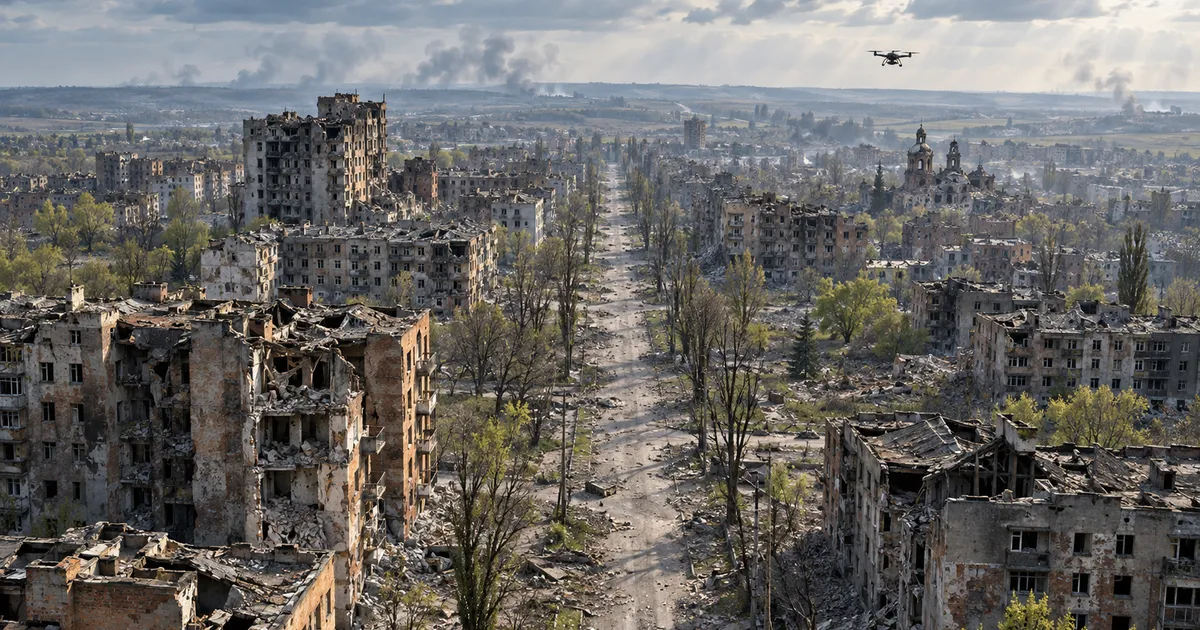
The Battle of Bakhmut
Bakhmut, Donetsk Oblast, Ukraine · 1 August 2022 to 20 May 2023
Information as of October 2026
Read the battle page: Battle of Bakhmut
Learning objectives
- Explain how the authored reconnaissance drones reveal contacts for automatic artillery engagement, and compare recorded infantry and gun losses. This comparison does not establish the real force ratio or prove why the historical defence held.
- Explain the authored supply abstraction using supply-counter losses, the cutoff indicator and effects on gun ammunition, vehicle movement and drone turnaround. Holding a named road or district is not itself a coded measure of strategic sustainment.
- Compare the authored enemy recon and Lancet arrivals with your quadcopter observation, munition drops and FPV launches. Use recorded contacts and losses; this does not establish the real proportion of missions or historical adoption dates.
Run time and a good result
Default run clock: 9 minutes 20 seconds at 1×, excluding pauses, briefing and discussion. Time controls change elapsed play time.
Objective: Hold the western approaches of Bakhmut, from Khromove and the Litak area to the T0504 road toward Ivanivske, through all five waves. The two roads west to Chasiv Yar are your supply line.
The Battle of Bakhmut: Hold the western approaches of Bakhmut, from Khromove and the Litak area to the T0504 road toward Ivanivske, through all five waves. The two roads west to Chasiv Yar are your supply line. Prevent an unopposed enemy occupation of the marked zone lasting 8 continuous simulation seconds; retain a fighting force until the episode ends. The authored limit is 560 simulation seconds across 5 stages. Compare objective progress, time, losses, drone expenditure and recorded civilian harm with a second run. A strong classroom result also explains the source evidence and reconstruction estimates; it does not verify a historical casualty count.
Timings
For 60 minutes, brief for 10, complete all five authored waves with pauses at the three decision points within a 25 minute exercise slot, and review for 25. If only three waves are used, label the exercise incomplete and do not compare it with a completed objective. For 90 minutes, compare two complete runs using different drone allocations or pre-run postures. For 180 minutes, give syndicates both command sides, add Realistic reports and compare modeled outcomes with the attributed historical accounts.
| Session | Plan |
|---|---|
| 45 minutes | Brief: 10 min; Run: 15 min; Collect: 5 min; Review: 15 min |
| 60 minutes | Before questions: 5 min; Brief: 10 min; Run: 20 min; Collect: 5 min; Debrief and after questions: 15 min; Discussion: 5 min |
| 90 minutes | Before questions: 5 min; Brief: 10 min; Run 1: with drones: 20 min; Run 2: without drones: 15 min; Collect: 5 min; Compare and discuss: 25 min; After questions: 10 min |
| 180 minutes | Before questions: 10 min; Brief and staff roles: 15 min; Run 1: with drones: 25 min; Run 2: without drones: 20 min; Break: 10 min; Run 3: syndicates: 30 min; Collect: 10 min; Seminar replay and debrief: 40 min; After questions: 10 min; Close: 10 min |
Staff roles
- commander
- Set the pre-run posture and available standing orders, allocate drone observation across the authored approaches, and report the western hold zone at each stage. Individual district-holding or withdrawal orders are unavailable.
- intelligence
- Track where each wave enters the map, which units are Wagner and which are Russian Armed Forces, and when the enemy reconnaissance drone is overhead.
- fires
- Observe artillery engagements and ammunition, report Lancet exposure, and recommend available artillery standing orders. Individual battery movement and gun-target assignments are automatic.
- droneOps
- Plan the use of quadcopters for spotting, munition drops and FPV strikes across all five waves, and report how many drones you keep in reserve for the last assault.
Opposing staff objective
With the Wagner Group attacking beside you, take the western approaches of Bakhmut and cut both roads to Chasiv Yar before the last wave ends.
Decision points
- In the authored opening, compare spending a ready FPV with using a reconnaissance quadcopter for observation. Record the automatic infantry and artillery response; this model choice does not verify the historical opening chronology.
- In the authored January stage, new attacks arrive from the north as well as the east. Compare drone allocation and standing orders across those approaches; ground reinforcements and movement occur automatically.
- In the authored February–March stage, compare drone observation and available standing orders around the western hold zone and supply approaches. Discuss a proposed ground withdrawal as a classroom option outside the available unit controls.
Before and after questions
Which roles do the model’s reconnaissance and armed quadcopters perform?
- Provided direct strikes as the principal substitute for artillery
- Performed coordinated FPV strikes as the principal activity throughout
- Supported supply delivery as the alternative to ground transport
- Reconnaissance quadcopters revealed artillery contacts while armed quadcopters dropped small munitions in the model
Answer D: In the model, reconnaissance quadcopters reveal contacts and armed quadcopters drop small munitions. Observed contacts can support automatic artillery engagement. These roles do not establish the proportion of real missions, FPV adoption dates or either side’s daily shell expenditure.
What role did RUSI's May 2023 report describe for Orlan-10 reconnaissance aircraft supporting Russian artillery?
- Its main contribution was independent damage assessment after completed strikes
- It supported Russian target observation and strike systems
- Its main contribution was persistent observation separate from artillery coordination
- Its main contribution was local communications relay for ground manoeuvre
Answer B: Watling and Reynolds describe Orlan-10 observation supporting command posts and artillery batteries. This is their theatre-wide May 2023 account, not proof of every Bakhmut engagement. The report also describes Lancets conducting their own reconnaissance; they are not universally dependent on an Orlan.
How should you treat the casualty figures for Bakhmut?
- Identify the claimant, date and supporting evidence
- Use the latest official estimate as settled
- Prefer the estimate from the best-equipped side
- Average opposing estimates into a single total
Answer A: The packet contains materially different casualty claims. Record who made each estimate, when, its scope and supporting evidence; averaging incompatible claims does not independently verify a total.
What geographic significance does CNN’s March 2023 analysis attribute to Bakhmut?
- The city's political significance outweighed consideration of transport connections
- Nearby Soledar determined value without considering the wider road network
- An assessment of roads and wider geographic effects
- The AZOM plant determined value without considering the wider geography
Answer C: CNN discusses the city’s road connections and possible geographic effects if western high ground were taken, while warning against overstating its strategic importance. This is a dated analyst assessment, not proof that the eventual capture guaranteed those effects.
What civilian population estimate did the Donetsk regional administration give CNN on 1 March 2023?
- Most residents had departed before December 2022
- About 4,500 remained, including 48 children
- Most residents had relocated nearby to Chasiv Yar
- About 4,000 remained with utilities largely restored
Answer B: Administration spokeswoman Tetiana Ignatchenko told CNN about 4,500 civilians, including 48 children, remained. She urged evacuation and said supplies had been provided. This is her dated estimate, not a verified population census or a later casualty total.
Discussion
- Count the authored gun counters and compare otherwise matching runs with and without the player’s drones. Enemy drones remain. How did recorded losses and objective progress change, and why is that not a verified five-to-one historical artillery ratio?
- The simulation places reconnaissance and loitering munitions alongside artillery. RUSI describes Orlan observation supporting guns and Lancets also conducting their own reconnaissance. Which relationships did the model represent, and which historical claims would need separate evidence?
- Using the authored waves, compare objective progress, elapsed time and losses on both sides, with civilian harm recorded separately. What further political, operational and source evidence would be needed to judge the historical battle’s value?
- In a 31 May 2023 Ukrinform interview, Mayor Oleksii Reva reported 204 residents killed since the start of the war. How does the run's civilian-harm log differ from a historical casualty count, and what can each establish?
Debrief rubric
- Strong
- Meets the objective or explains why it was not met; uses the published sources and run evidence, separates known facts from assumptions, compares both sides’ losses and cost exchange, and evaluates precautions against civilian harm.
- Adequate
- Describes the objective and main decisions, identifies at least one source and model limitation, reports losses and harm, and gives a reasoned change for a second run.
- Weak
- Reports only victory or points, treats teaching settings as real performance, gives unsupported historical claims, or omits uncertainty and civilian harm.
Published readings
- Michael Kofman, Carnegie: Assessing Russian Military Adaptation in 2023 (8 October 2024; Bakhmut fires advantage)
- ISW (via Critical Threats): Russian Offensive Campaign Assessment, 20 February 2023
- DFRLab, Atlantic Council: Russian War Report, DFRLab confirms Russia's push to encircle Bakhmut (11 February 2023)
Complete source list
- Wikipedia: Battle of Bakhmut
- Wikipedia: Bakhmut
- Wikipedia: Battle of Soledar
- Wikipedia: Battle of Chasiv Yar
- Wikipedia: Chasiv Yar
- Wikipedia: Khromove
- Wikipedia: Ivanivske, Donetsk Oblast
- Wikipedia: Yahidne, Donetsk Oblast
- Wikipedia: Opytne, Bakhmut Raion, Donetsk Oblast
- Wikipedia: Ivanhrad
- Wikipedia: Berkhivka
- Wikipedia: Klishchiivka
- Wikipedia: Wagner Group
- Wikipedia: Robert Brovdi (Magyar's Birds drone unit)
- Wikipedia: ZALA Lancet
- Wikipedia: Orlan-10
- Michael Kofman, Carnegie: Assessing Russian Military Adaptation in 2023 (8 October 2024; Bakhmut fires advantage)
- ISW (via Critical Threats): Russian Offensive Campaign Assessment, 20 February 2023
- DFRLab, Atlantic Council: Russian War Report, DFRLab confirms Russia's push to encircle Bakhmut (11 February 2023)
- OSW Centre for Eastern Studies: Fierce battles for Bakhmut, day 350 of the war (9 February 2023)
- CNN: Bakhmut, as Russian fighters are edging into the city, here is what you need to know (1 March 2023)
- CNN: Vital supply bridge to Ukraine's Bakhmut blown up overnight by Russian forces (3 March 2023)
- The National: Ukrainian troops under mounting pressure in Bakhmut, UK says (4 March 2023)
- Meduza: The state of the war's various fronts, Ukraine continues the defence of Bakhmut (11 March 2023)
- Al Jazeera: Wagner advance in Bakhmut as Russian offensive appears to weaken (17 March 2023)
- GOV.UK Home Office: Proscribed terrorist groups or organisations (accessible version)
- RUSI: Meatgrinder, Russian Tactics in the Second Year of Its Invasion of Ukraine (Watling and Reynolds, 19 May 2023), printed page 12
- Ukrinform — interview with Bakhmut mayor Oleksii Reva, 31 May 2023 (Ukrainian)