
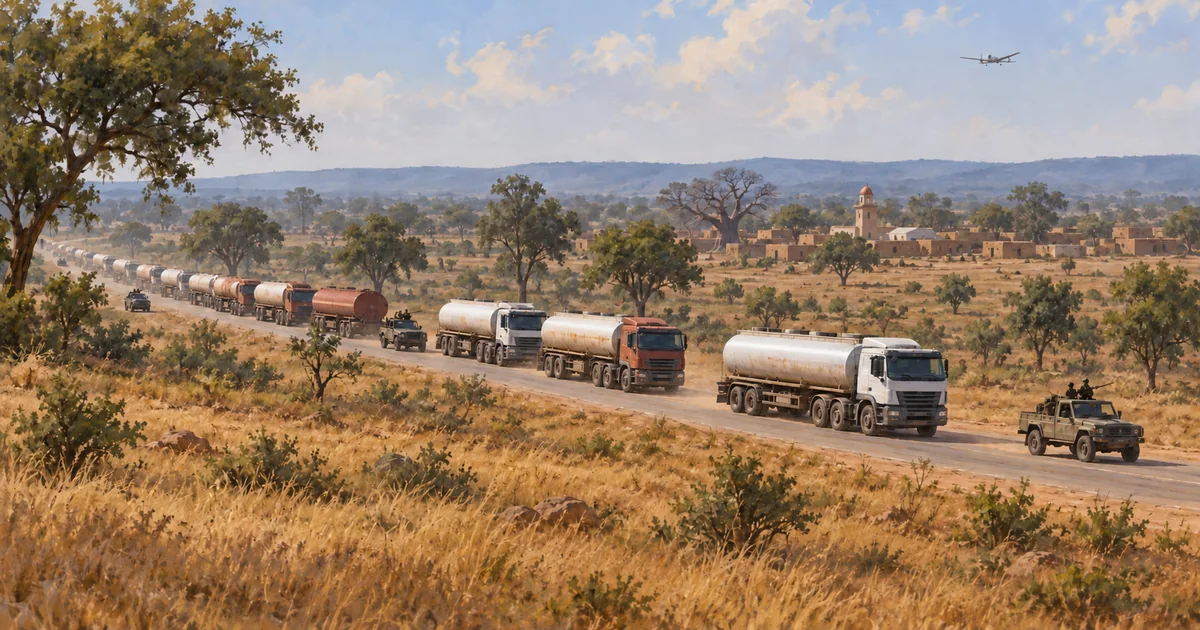
Kolondieba fuel convoy air support
Kolondieba corridor, Sikasso Region, Mali · 6 November 2025
Information as of 6 October 2026
A separate battle article is awaiting source review. Use this lesson's published readings and complete source list.
Learning objectives
- Distinguish military escort protection from attacks on civilian commerce.
- Explain how local convoy support can coexist with a continuing blockade.
- Assess the limits of period drone evidence and official outcome claims.
Run time and a good result
Default run clock: 3 minutes 0 seconds at 1×, excluding pauses, briefing and discussion. Time controls change elapsed play time.
Objective: Put four armed JNIM groups out of action during the convoy support mission. The score covers military threats only; it does not count civilian tankers or prove that the blockade was lifted.
Kolondieba fuel convoy air support: Put four armed JNIM groups out of action during the convoy support mission. The score covers military threats only; it does not count civilian tankers or prove that the blockade was lifted. Put at least 4 represented opposing units out of action; decoys do not count. The authored limit is 180 simulation seconds across 1 stage. Compare objective progress, time, losses, drone expenditure and recorded civilian harm with a second run. A strong classroom result also explains the source evidence and reconstruction estimates; it does not verify a historical casualty count.
Timings
For 60 minutes brief for 10 minutes, run once and discuss the result. For 90 minutes compare a second run with different priorities. For 180 minutes pause at the decision points, compare source accounts and discuss the civilian harm record.
| Session | Plan |
|---|---|
| 45 minutes | Brief: 10 min; Run: 15 min; Collect: 5 min; Review: 15 min |
| 60 minutes | Before questions: 5 min; Brief: 10 min; Run: 20 min; Collect: 5 min; Debrief and after questions: 15 min; Discussion: 5 min |
| 90 minutes | Before questions: 5 min; Brief: 10 min; Run 1: with drones: 20 min; Run 2: without drones: 15 min; Collect: 5 min; Compare and discuss: 25 min; After questions: 10 min |
| 180 minutes | Before questions: 10 min; Brief and staff roles: 15 min; Run 1: with drones: 25 min; Run 2: without drones: 20 min; Break: 10 min; Run 3: syndicates: 30 min; Collect: 10 min; Seminar replay and debrief: 40 min; After questions: 10 min; Close: 10 min |
Staff roles
- commander
- Set a bounded military damage goal.
- intelligence
- Track armed groups and preserve uncertainty about civilian traffic.
- fires
- Review military identifications and proximity to populated places.
- droneOps
- Record the assumed TB2 sorties separately from the sourced campaign history.
Decision points
- Opening mission: which armed groups threaten the military escort?
- Mid mission: how do you assess a sighting near civilian road traffic?
- Debrief: what would prove that a convoy passed rather than only that a strike occurred?
Before and after questions
What does the FAMa statement establish about the 6 November Kolondieba mission?
- An official report of convoy air support and strikes.
- Independent confirmation of every reported local strike.
- A verified TB2 model and local sortie allocation.
- A documented end to the blockade around Bamako.
Answer A: The statement attributes successful strikes to FAMa aerial assets. It supplies neither independent verification nor a drone model, local loss tally or end to the blockade.
A run disables four represented JNIM groups. What does its objective result mean?
- The civilian convoy completed its journey to Bamako.
- The model's limited military damage goal was reached.
- The wider fuel blockade ended across southern Mali.
- The entire local JNIM force was confirmed destroyed.
Answer B: The model requires four armed groups out of action. Its score excludes civilian tankers and cannot establish convoy passage or the end of the blockade.
How should the three TB2 sorties in this Kolondieba run be recorded?
- As the official local aircraft and flight inventory.
- As verified losses from the wider drone campaign.
- The TB2 type and three sorties are authored assumptions within broader period drone evidence
- As observed flights from a published convoy roster.
Answer C: The briefing labels the TB2 model and three sorties as assumptions. The official mission statement reports aerial assets without identifying their model.
Which finding belongs in a separate civilian consequences assessment of the fuel blockade?
- Four groups disabled within the convoy support model.
- The assumed TB2 allocation for the local morning mission.
- The illustrative vehicles assigned to the military escort.
- School closures associated with the wider fuel shortage.
Answer D: Human Rights Watch links the fuel shortage to school and university closures. This wider civilian disruption is separate from local military losses.
How should the 180-second Kolondieba run and its six-hour battle scale be interpreted?
- As authored compression of one reported morning mission.
- As the official duration measured during the convoy flight.
- As the verified elapsed time for all six convoy attacks.
- As the observed length of the September fuel blockade.
Answer A: The statement dates strikes to the morning of 6 November without giving an exact duration. The model's durationSeconds of 180 and timeScale of 6 are authored settings.
Discussion
- Why does success in one mission fail to establish the end of a blockade?
- How does education disruption reveal civilian consequences beyond the road?
- Which facts are reported and which have been estimated in this run?
Debrief rubric
- Strong
- Meets the objective or explains why it was not met; uses the published sources and run evidence, separates known facts from assumptions, compares both sides’ losses and cost exchange, and evaluates precautions against civilian harm.
- Adequate
- Describes the objective and main decisions, identifies at least one source and model limitation, reports losses and harm, and gives a reasoned change for a second run.
- Weak
- Reports only victory or points, treats teaching settings as real performance, gives unsupported historical claims, or omits uncertainty and civilian harm.
Facilitator notes
Assess historical source analysis through the cited readings, answers and discussion. Run metrics describe the simulated run; they do not verify historical claims or demonstrate that a source-analysis objective has been met.
Published readings
- Bellingcat: Mali Under Siege (3 December 2025)
- ACLED: Africa Overview, November 2025
- Malian Armed Forces via Information Gouvernementale: Kolondieba air support (6 November 2025)
Complete source list
- Wikipedia: Mali fuel blockade
- Bellingcat: Mali Under Siege (3 December 2025)
- ACLED: Africa Overview, November 2025
- Malian Armed Forces via Information Gouvernementale: Kolondieba air support (6 November 2025)
- Human Rights Watch: Education shuttered (28 October 2025)
- ISS Africa: Roadblocks and regional economies (6 October 2025)
- Le Monde: Drones in the Sahel (23 July 2025)