
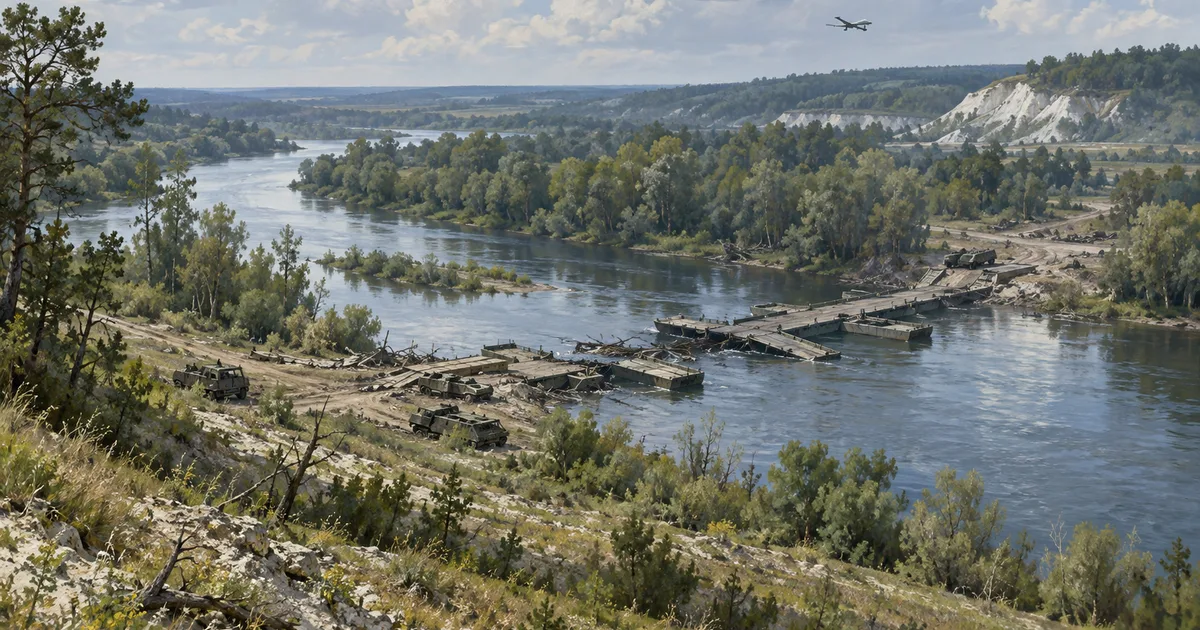
The Siverskyi Donets Crossings
Bilohorivka, Serebrianka and Dronivka, on the Siverskyi Donets, Luhansk and Donetsk Oblasts, Ukraine · 5 to 13 May 2022
Information as of September 2026
Read the battle page: Battle of the Siverskyi Donets
Learning objectives
- Compare observation and losses around the modeled river crossings with DFRLab’s imagery analysis, identifying the crossing-construction and engineering details that this simulation does not reproduce.
- Describe how reconnaissance supplies contacts for automatic artillery engagement in the model, and distinguish its completed contact-to-kill timings from an independently verified historical detection sequence.
- Evaluate how finite reconnaissance flights and artillery ammunition affect the three modeled waves; explain why the compressed run is not a reconstruction of several days of battery relocation.
Run time and a good result
Default run clock: 6 minutes 0 seconds at 1×, excluding pauses, briefing and discussion. Time controls change elapsed play time.
Objective: Break the Russian crossings. Put at least 17 of the Russian units out of action over the three crossing attempts, and do not let them settle on the south bank between Dronivka and Bilohorivka. Use your reconnaissance drones to find the pontoon groups through the smoke and give your artillery targets.
The Siverskyi Donets Crossings: Break the Russian crossings. Put at least 17 of the Russian units out of action over the three crossing attempts, and do not let them settle on the south bank between Dronivka and Bilohorivka. Use your reconnaissance drones to find the pontoon groups through the smoke and give your artillery targets. Put at least 17 represented opposing units out of action; decoys do not count. The authored limit is 360 simulation seconds across 3 stages. Compare objective progress, time, losses, drone expenditure and recorded civilian harm with a second run. A strong classroom result also explains the source evidence and reconstruction estimates; it does not verify a historical casualty count.
Timings
For 60 minutes, brief for 10, run with a pause at each wave for 30 and review for 20; for 90 minutes, disable your side’s drones and compare detected contacts and recorded artillery kills; for 180 minutes, assign the allowed Russian and Ukrainian perspectives to separate syndicates and compare objective, time, losses and civilian harm.
| Session | Plan |
|---|---|
| 45 minutes | Brief: 10 min; Run: 15 min; Collect: 5 min; Review: 15 min |
| 60 minutes | Before questions: 5 min; Brief: 10 min; Run: 20 min; Collect: 5 min; Debrief and after questions: 15 min; Discussion: 5 min |
| 90 minutes | Before questions: 5 min; Brief: 10 min; Run 1: with drones: 20 min; Run 2: without drones: 15 min; Collect: 5 min; Compare and discuss: 25 min; After questions: 10 min |
| 180 minutes | Before questions: 10 min; Brief and staff roles: 15 min; Run 1: with drones: 25 min; Run 2: without drones: 20 min; Break: 10 min; Run 3: syndicates: 30 min; Collect: 10 min; Seminar replay and debrief: 40 min; After questions: 10 min; Close: 10 min |
Staff roles
- commander
- Choose reconnaissance flights and available target and artillery orders across the three waves. Report progress toward putting 17 modeled enemy units out of action, and distinguish that objective from whether the enemy reaches the south-bank zone.
- intelligence
- Track detected vehicle columns and infantry near the modeled crossing areas, distinguishing confirmed contacts from inference about the next approach. Bridge construction itself is not simulated.
- fires
- Report the three batteries’ automatic engagements and remaining shells, explain the high-value-only order, and flag strikes near modeled populated areas. No battery movement or selected-target firing command is available.
- droneOps
- Allocate the six quadcopters across the waves, compare time with and without reconnaissance coverage, and report remaining and returning aircraft; continuous coverage is a classroom aim, not a guaranteed outcome.
Opposing staff objective
Force the Siverskyi Donets. Bring your pontoon groups to the river at Dronivka, Bilohorivka and between Bilohorivka and Serebrianka, cross, and take a foothold on the south bank before the defenders can wear your force down.
Decision points
- At the first modeled wave, compare sending reconnaissance west with retaining flights for later contacts. Record what is observed; the artillery positions and ground movement are controlled by the model.
- At the second wave, compare reconnaissance over the river approach with observation of the vehicle column. Decide whether artillery should engage all detected unit types or high-value targets only; bridges and engineers are not separately targetable units.
- Before the last wave, compare remaining reconnaissance flights and artillery ammunition. Would changing the artillery’s high-value-only order alter the run’s observations or losses? Battery relocation is not an available command.
Before and after questions
How did DFRLab verify the published footage of the failed May 2022 crossing?
- Checked one eyewitness account without comparing the depicted landscape
- Geolocated drone images and crosschecked the scene against satellite imagery
- Used the ministry's caption as sufficient proof of the location
- Used equipment counts as sufficient proof of when footage originated
Answer B: DFRLab located the drone images near Bilohorivka and compared them with May 12 satellite imagery. This verifies the scene; it does not establish the initial detection sequence.
In this crossing exercise, which combination creates concentrated exposure?
- River width alone determines whether defenders can observe vehicles
- Crossing daylight alone determines the degree of vehicle exposure
- Bridge size alone determines whether aerial observation is effective
- Scheduled reinforcements arrive together near the modeled crossings, concentrating their exposure to defenders
Answer D: Scheduled reinforcements appear together in the modelled crossing areas. Actual bridge construction and vehicle queues are abstractions rather than independently simulated engineering processes.
What information opportunity do successive phases create in this classroom crossing model?
- Repeated attempts gave defenders time to observe patterns
- Changed arrival locations made previously observed contacts equally reliable
- Prior observations could substitute for checking the next phase
- Reduced bridging assets necessarily reduced uncertainty about arriving units
Answer A: The model presents successive phases and retains observations between them. This gives students material for comparing patterns; it does not verify an exact historical attempt count or a commander's learning.
What can the crossing imagery establish more securely than a precise personnel casualty total?
- A personnel total can be calculated directly from damaged vehicles
- Intact nearby vehicles establish that their crews avoided any casualties
- Visible equipment damage without settling a precise personnel casualty total
- Unseen personnel losses can be excluded from the casualty estimate
Answer C: DFRLab geolocated damage imagery and reported separate visual equipment estimates. Vehicle damage cannot by itself settle personnel casualties, which require additional evidence.
What did the UN account describe about the Bilohorivka school attacked in May 2022?
- It was bombed while being used to support bridge construction
- It was bombed while civilians sheltered in its basement
- It was bombed after reported evacuation reduced the civilian presence
- It was bombed before residents moved into its basement shelter
Answer B: UN News describes people sheltering at the school when it was attacked. Its casualty report remains attributed; UNICEF expressly stated uncertainty about child casualties.
Discussion
- Compare the after action review’s time from spotting to engagement and from engagement to a recorded kill. Which entries can you relate to artillery engagements in the combat log, and why is this not a measurement of the first shell landing on a pontoon group?
- The model compresses the case into three waves. Compare that design with DFRLab’s verified imagery and its limits on confirming reported attempts; why should the simulation’s wave count not be cited as a historical count?
- UN News reported the Secretary-General’s condemnation of an attack on a Bilohorivka school where people were sheltering. Which civilian risks does the model’s populated-area rule represent, and which shelter, casualty and precaution details does it omit?
- DFRLab distinguishes geolocated imagery from attributed estimates of equipment losses. How should a staff officer present those estimates and their uncertainty without turning them into an independently verified personnel total?
Debrief rubric
- Strong
- Meets the objective or explains why it was not met; uses the published sources and run evidence, separates known facts from assumptions, compares both sides’ losses and cost exchange, and evaluates precautions against civilian harm.
- Adequate
- Describes the objective and main decisions, identifies at least one source and model limitation, reports losses and harm, and gives a reasoned change for a second run.
- Weak
- Reports only victory or points, treats teaching settings as real performance, gives unsupported historical claims, or omits uncertainty and civilian harm.
Published readings
- ISW: Russian Offensive Campaign Assessment, May 14 (14 May 2022)
- Atlantic Council DFRLab: Russian War Report, drone footage confirms failed Russian military pontoon crossing (13 May 2022)
- The Guardian: Ukraine repels Russia’s attempt to cross Donbas river, and drives invaders away from Kharkiv | Ukraine
Complete source list
- Wikipedia: Battle of the Siverskyi Donets
- Wikipedia: 74th Separate Guards Motor Rifle Brigade
- Wikipedia: 17th Heavy Mechanized Brigade
- Wikipedia: Bilohorivka, Luhansk Oblast
- Wikipedia: Dronivka
- Wikipedia: Serebrianka, Donetsk Oblast
- Wikipedia: Hryhorivka, Siversk urban hromada, Bakhmut Raion, Donetsk Oblast
- Wikipedia: Serebryansky Forest
- Wikipedia: Bilohorivka school bombing
- Wikipedia: Luhansk Oblast campaign
- ISW: Russian Offensive Campaign Assessment, May 14 (14 May 2022)
- Atlantic Council DFRLab: Russian War Report, drone footage confirms failed Russian military pontoon crossing (13 May 2022)
- The Guardian: Ukraine repels Russia’s attempt to cross Donbas river, and drives invaders away from Kharkiv | Ukraine
- The New York Times: A doomed river crossing shows the perils of entrapment (25 May 2022)
- The New York Times: Growing evidence of a military disaster on the Donets pierces a pro Russian bubble (15 May 2022)
- The Telegraph: A bridge too far for Russian invaders (12 May 2022)
- Forbes: The Russians lost nearly an entire battalion trying to cross a river in eastern Ukraine (11 May 2022)
- CNN: Siverskyi Donets, a Donbas river in eastern Ukraine is hindering both sides in the war (12 May 2022)
- Ukrinform: Defeat near Bilohorivka, enemy lost almost 1,000 soldiers and 100 vehicles (16 May 2022, Ukrainian claim)
- Militarnyi: In Bilohorivka, the invaders lost more than 70 units of equipment after forcing the river (Ukrainian claim)
- US Army: Russian river crossing failure during the Battle of the Siverskyi Donets
- CEOBS: Examples of environmental harm in Ukraine, Bilohorivka river crossing
- UN News: Ukraine, UN chief condemns school attack; welcomes new evacuees from Mariupol (May 2022)
- BBC News: Ukraine war, 60 people killed after bomb hits school, Zelensky says (8 May 2022)
- NPR: More than 60 are feared dead in the bombing of a Ukrainian school (8 May 2022)