
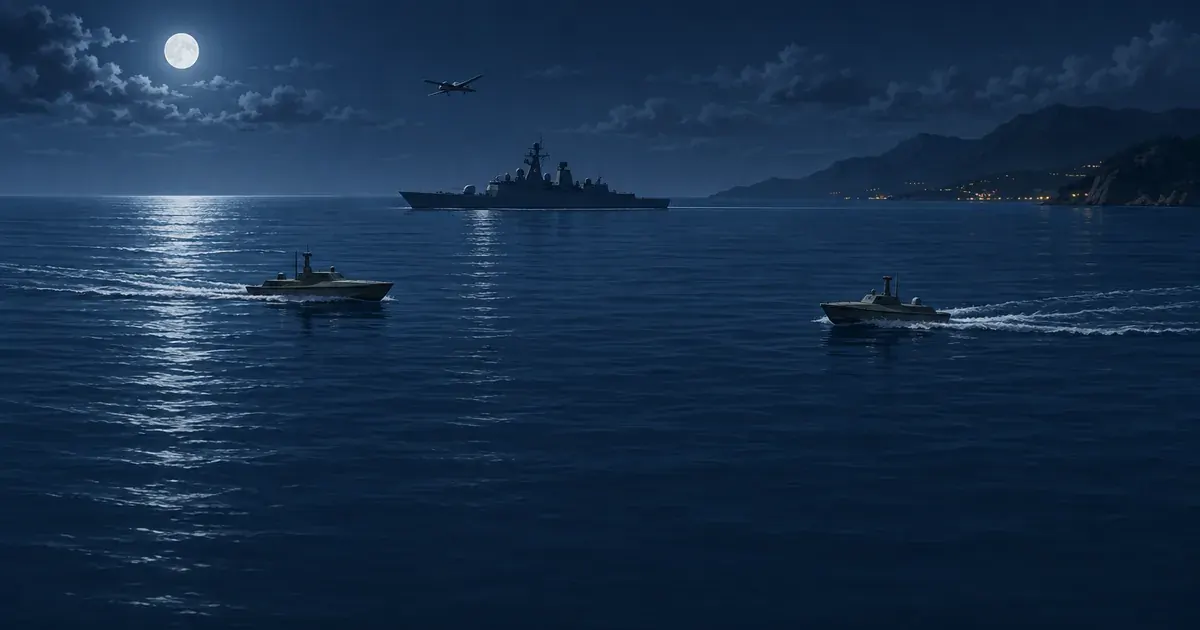
A Navy Without Ships
Off western Crimea, from Lake Donuzlav to Sevastopol · 2023 to 2024
Read the battle page: Black Sea naval drone campaign
Learning objectives
- Explain how a side with almost no warships used sea drones to threaten a fleet, and why several boats attacking at once can overwhelm a ship’s guns.
- Compare the value of what each side risks in this scenario, using the cost tally in the after action review.
- Distinguish the run's ship-loss objective from wider campaign outcomes discussed by Sutton and Williams, including fleet relocation and grain-shipping access.
Run time and a good result
Default run clock: 2 minutes 30 seconds at 1×, excluding pauses, briefing and discussion. Time controls change elapsed play time.
Objective: Sink or disable two of the four warships off Crimea’s west coast, between Lake Donuzlav, Sevastopol and the southern coast.
A Navy Without Ships: Sink or disable two of the four warships off Crimea’s west coast, between Lake Donuzlav, Sevastopol and the southern coast. Put at least 2 opposing warships out of action. The authored limit is 150 simulation seconds across 1 stage. Compare objective progress, time, losses, drone expenditure and recorded civilian harm with a second run. A strong classroom result also explains the source evidence and reconstruction estimates; it does not verify a historical casualty count.
Timings
For 60 minutes, brief for 10, run it once with the three pauses for 20 and review for 30, leaving time for the strategic effect described in the lesson; for 90 minutes, have pairs run it twice, once sending boats singly and once in massed waves, and compare boats spent per ship; for 180 minutes, add a run with stronger enemy air defence, then have one syndicate brief the fleet commander’s view of what went wrong.
| Session | Plan |
|---|---|
| 45 minutes | Brief: 10 min; Run: 15 min; Collect: 5 min; Review: 15 min |
| 60 minutes | Before questions: 5 min; Brief: 10 min; Run: 20 min; Collect: 5 min; Debrief and after questions: 15 min; Discussion: 5 min |
| 90 minutes | Before questions: 5 min; Brief: 10 min; Run 1: with drones: 20 min; Run 2: without drones: 15 min; Collect: 5 min; Compare and discuss: 25 min; After questions: 10 min |
| 180 minutes | Before questions: 10 min; Brief and staff roles: 15 min; Run 1: with drones: 25 min; Run 2: without drones: 20 min; Break: 10 min; Run 3: syndicates: 30 min; Collect: 10 min; Seminar replay and debrief: 40 min; After questions: 10 min; Close: 10 min |
Staff roles
- commander
- Choose which ship each wave of sea drones goes for and how many boats to hold back, and report progress against the aim of sinking or disabling two of the four ships.
- intelligence
- Watch the air defence at Cape Chersonesus and the jamming unit on the west coast of Crimea, and report which ships sit under their cover.
- fires
- With no artillery on this map, keep a tally of which ship each boat was sent against and whether it hit, and report how many boats each ship has cost.
- droneOps
- Launch the Magura and Sea Baby boats and the TB2, note whether boats arrive together or one by one, and report every boat lost before it reached a ship.
Opposing staff objective
Keep at least three of the four warships afloat until time runs out, using the air defence at Cape Chersonesus and the jamming on the west coast against the sea drones.
Decision points
- Before the first launch: warships at sea are always visible, so what do you still need to know before committing the sea drones, and can the single TB2 tell you?
- When the first boats close on the ships: are you sending them one at a time or together, and how many will you keep back for a second attack?
- When a warship is sunk or disabled: do you turn the remaining boats on the nearest ship, or on the one sitting furthest from the air defence on the coast?
Before and after questions
According to RUSI, how were Ukraine’s explosive sea drones steered to their targets?
- Through cables connected to coastal control stations
- Through relays carried by nearby crewed boats
- RUSI describes satellite links such as Starlink steering the explosive sea drones
- Through relays carried by nearby TB2 aircraft
Answer C: RUSI reports the uncrewed boats, packed with explosives, were steered over satellite links such as Starlink.
What equipment-cost comparison does the historical sea-drone lesson ask students to examine?
- A low-cost boat threatens a high-cost warship
- The boat's purchase price represents the entire campaign cost
- Ship replacement value represents the defenders' expenditure per engagement
- Reported damage value substitutes for the actual equipment losses
Answer A: Compare like-for-like equipment estimates: the cited small-boat costs are much lower than those of major warships. A favourable potential exchange does not imply certain hits, zero defensive cost or repeat use of an explosive boat.
According to RUSI, what did Russia do with almost all its major Black Sea Fleet assets?
- Concentrated them in Crimea’s Lake Donuzlav
- Retained them in defended Sevastopol harbour
- Deployed them nearer the Odesa blockade
- Relocated them eastward to Novorossiysk harbour
Answer D: RUSI reports relocation of almost all major fleet assets to Novorossiysk. Its analysis concerns several combined effects; the simulated ship-loss counter measures only part of that campaign.
In this simulation’s simplified ship-defence model, why can concurrent approaching boats be harder to engage than one boat?
- Each approaching boat increases the defender's engagement accuracy
- Concurrent contacts strain the modelled defensive engagement
- Target selection resets defensive cooldown between successive engagements
- A detected contact guarantees a successful defensive engagement
Answer B: The model limits concurrent defensive engagements. That teaching simplification is not a claim that every real warship can aim only one gun or engage only one contact.
How does Brian Glyn Williams's July 2024 analysis describe the Russian navy's early use of sea control?
- Blockading Ukrainian ports and launching missile strikes
- Escorting grain shipping as part of agreed transit arrangements
- Protecting coastal facilities while avoiding attacks on commercial access
- Concentrating on local defence rather than influencing port access
Answer A: Williams's article in The Conversation describes missile attacks on Ukrainian cities and a blockade of Ukrainian ports. This is the author's published analysis; the question does not certify a complete list of fleet missions or a particular missile type.
Discussion
- How many sea drones did each sunk or disabled ship cost you, and did sending them together change that number?
- Try a run without drones: with no ships or other forces of your own, nothing can reach the fleet. What does that tell you about how a side without a navy can still contest the sea?
- Sutton describes relocation of major Russian fleet assets, while Williams connects several campaign developments with grain-shipping access. How do these attributed strategic outcomes differ from the ship-loss objective measured in this run?
- From the fleet commander’s perspective, propose protection or formation changes as a classroom discussion. State which would require controls outside this run, whose ship movement is automatic; do not treat the proposal as a command the player can issue.
Debrief rubric
- Strong
- Meets the objective or explains why it was not met; uses the published sources and run evidence, separates known facts from assumptions, compares both sides’ losses and cost exchange, and evaluates precautions against civilian harm.
- Adequate
- Describes the objective and main decisions, identifies at least one source and model limitation, reports losses and harm, and gives a reasoned change for a second run.
- Weak
- Reports only victory or points, treats teaching settings as real performance, gives unsupported historical claims, or omits uncertainty and civilian harm.
Published readings
- RUSI: Uncrewed platforms critical to Ukraine’s success in the Black Sea
- The Conversation: How Ukraine, with no navy, defeated the Black Sea Fleet
- Naval Technology: Magura V5 forces fleet retreat
Complete source list
- RUSI: Uncrewed platforms critical to Ukraine’s success in the Black Sea
- The Conversation: How Ukraine, with no navy, defeated the Black Sea Fleet
- Naval Technology: Magura V5 forces fleet retreat
- Wikipedia: Russian corvette Ivanovets
- Wikipedia: Lake Donuzlav
- USNI Proceedings: Ukraine’s Magura Naval Drones, Black Sea Equalizers