
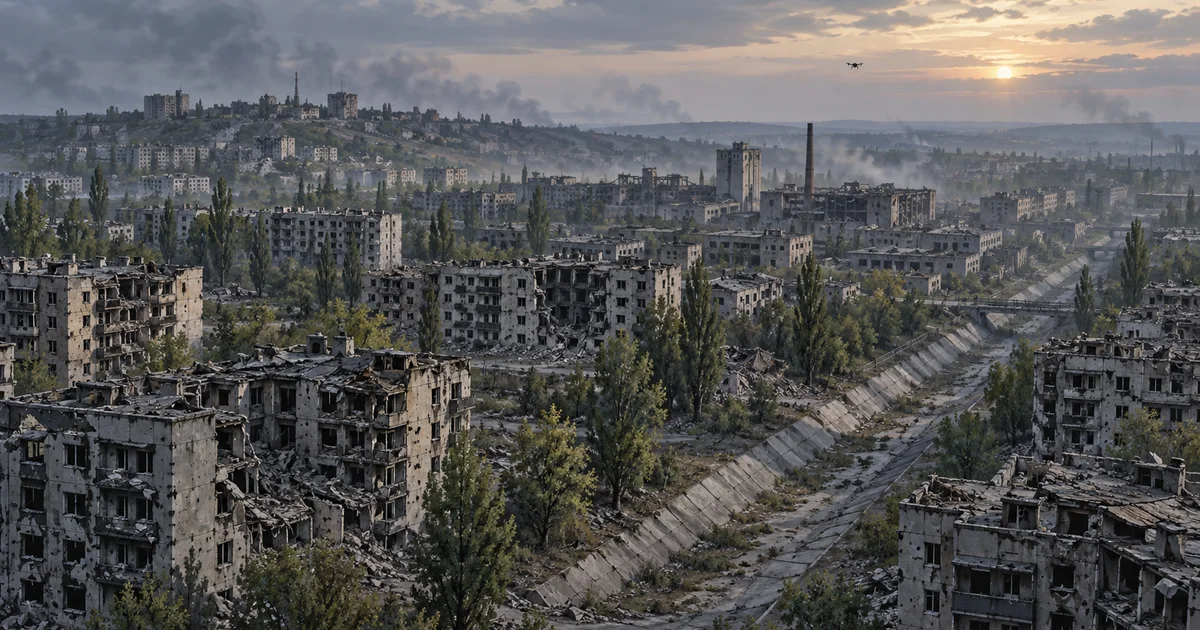
The Battle of Chasiv Yar
Chasiv Yar, Bakhmut Raion, Donetsk Oblast, Ukraine · 4 April 2024 to 31 July 2025
Information as of October 2026
Read the battle page: Battle of Chasiv Yar
Learning objectives
- Compare observation, terrain and crossing losses around the modeled canal, and identify which features of the historical Siverskyi Donets Donbas Canal are simplified or absent.
- Assess the modeled hold objective across four waves using time held, losses on both sides and civilian harm separately. A defender can meet the objective; neither an inevitable defeat nor a specific historical result is prescribed.
- Compare the model's radio and fibre-optic control assumptions, distinguishing radio-control jamming from other causes of aircraft loss.
Run time and a good result
Default run clock: 8 minutes 0 seconds at 1×, excluding pauses, briefing and discussion. Time controls change elapsed play time.
Objective: You cannot stop this assault, and by the end Russia claims the town and Ukraine holds only its western edge. Your aim is to slow it and make it cost: hold the west of Chasiv Yar, the high ground around the refractory plant and the western blocks, through all four waves, and put as many assault groups out of action as you can at the canal. Keep your drone teams and guns alive; they are what stops the crossings. Civilians stay in the town in every wave.
The Battle of Chasiv Yar: You cannot stop this assault, and by the end Russia claims the town and Ukraine holds only its western edge. Your aim is to slow it and make it cost: hold the west of Chasiv Yar, the high ground around the refractory plant and the western blocks, through all four waves, and put as many assault groups out of action as you can at the canal. Keep your drone teams and guns alive; they are what stops the crossings. Civilians stay in the town in every wave. Prevent an unopposed enemy occupation of the marked zone lasting 8 continuous simulation seconds; retain a fighting force until the episode ends. The authored limit is 480 simulation seconds across 4 stages. Compare objective progress, time, losses, drone expenditure and recorded civilian harm with a second run. A strong classroom result also explains the source evidence and reconstruction estimates; it does not verify a historical casualty count.
Timings
For 60 minutes, brief for 10, allow 25 for the first two waves with pauses if the run reaches them, and review for 25; for 90 minutes, allow a full four-wave run and compare available posture, flight and order settings; for 180 minutes, assign the allowed Ukrainian and Russian perspectives and compare results with attributed historical claims and dated civilian estimates. Runs can end before every wave.
| Session | Plan |
|---|---|
| 45 minutes | Brief: 10 min; Run: 15 min; Collect: 5 min; Review: 15 min |
| 60 minutes | Before questions: 5 min; Brief: 10 min; Run: 20 min; Collect: 5 min; Debrief and after questions: 15 min; Discussion: 5 min |
| 90 minutes | Before questions: 5 min; Brief: 10 min; Run 1: with drones: 20 min; Run 2: without drones: 15 min; Collect: 5 min; Compare and discuss: 25 min; After questions: 10 min |
| 180 minutes | Before questions: 10 min; Brief and staff roles: 15 min; Run 1: with drones: 25 min; Run 2: without drones: 20 min; Break: 10 min; Run 3: syndicates: 30 min; Collect: 10 min; Seminar replay and debrief: 40 min; After questions: 10 min; Close: 10 min |
Staff roles
- commander
- Choose the briefing posture and available drone, artillery and rules-of-engagement orders. Before each new wave, report actual objective-zone occupancy, losses and reserves; ground-unit movement and local withdrawals are automatic.
- intelligence
- Track where each wave enters, where assault groups gather before a crossing, and when the Orlan 10 is overhead.
- fires
- Report the two batteries’ automatic engagements, shells and supply-unit survival, and compare artillery orders. The model’s resupply rule does not simulate access along the T0504 road or manual assignment of a battery to a crossing point.
- droneOps
- Plan the use of quadcopters, FPV, fibre optic and heavy bomber drones across all four waves, and report how many you keep in reserve for the last assault.
Opposing staff objective
Take Chasiv Yar. Clear the Kanal microdistrict, cross the Siverskyi Donets Donbas Canal and drive Ukrainian forces out of the west of the town, around the refractory plant, before the last wave ends. Your Orlan 10 finds targets; your FPV and, later, fibre optic drones clear the way for each assault group.
Decision points
- During the first modeled wave, compare using quadcopters to provide contacts with spending FPV flights early. Record confirmed contacts, remaining flights and automatic artillery engagements rather than assuming the historical assault sequence.
- When the second wave begins, report the actual contact picture and objective-zone occupancy in your run. Compare changing drone priority or keeping the existing orders; there is no manual infantry counterattack or retreat command.
- At the later waves, compare remaining drones, artillery shells and supply-unit survival. Which available flight and order choices changed the modeled hold result? Pipe infiltration and a commanded withdrawal from the plant are not simulated.
Before and after questions
What feature of the canal creates a constraint in the scenario’s defence model?
- Canal depth determines exposure without considering the available crossing locations
- Limited modeled crossings concentrate the attackers' passage and exposure to the defending systems
- Canal length determines exposure independently of the defending forces’ locations
- Canal alignment determines exposure independently of the attackers’ observed approaches
Answer B: The model concentrates passage at limited crossings. This is a classroom representation of terrain constraints, not proof that every real crossing was continuously observed or engaged.
What canal feature did ISW’s 1 August 2024 geolocation identify at a Russian advance?
- Across a pontoon bridge assembled under direct fire
- From an airborne landing beyond the defended canal
- Through an area where the canal ran underground
- Across the exposed bed after upstream drainage
Answer C: ISW geolocated an advance across an underground canal section north of Zhovtnevyi. It separately noted that claims of positions in Zhovtnevyi and Novyi had not yet been visually confirmed.
What made fibre optic FPV drones different from ordinary radio controlled ones over Chasiv Yar?
- The cable improves endurance by supplying power from the launcher
- Cable control bypassed interference with the radio link
- The cable improves identification by reducing the carried payload weight
- The cable improves survivability by enabling routes without operator steering
Answer B: A physical control cable bypasses radio-link interference. It does not confer immunity to all electronic effects, physical damage, detection, terrain or other failures.
On 31 July 2025 Russia said it had captured Chasiv Yar. How should a student treat that claim?
- Repeated reporting establishes confirmation even when reports share one source
- Attribute it, record the denial and examine corroboration
- The capture claim establishes control despite reports of continued fighting
- A dated official claim outweighs conflicting observations from other sources
Answer B: The Kyiv Independent records Russia’s capture claim, Zelensky’s denial and DeepState’s July 30 map showing Ukrainian-held southern and western areas. Present the claim, response and independently assessed evidence with their dates; this report does not settle all later control changes.
How many people did Chaus report remaining in the Chasiv Yar community on 22 November 2024?
- Approximately 3,000 residents remained
- Approximately 1,500 residents remained
- Approximately 304 residents remained
- Approximately zero residents remained
Answer C: Censor.NET's 22 November 2024 report attributes 304 remaining people in the Chasiv Yar community to Serhii Chaus, speaking on Hromadske Radio. This is a dated official estimate, not an independent census or a count for all later stages of the battle.
Discussion
- What in the model delayed crossing or allowed enemy units into the objective zone? Compare these observations with the readings, keeping attributed historical claims separate from the run’s compressed time and automatic ground movement.
- Compare a clear-weather run with a separately selected fog run or a recorded instructor weather inject. How did visibility and contacts change? The model does not reproduce historical movement through the canal’s pipes.
- The 31 July 2025 report records Russia’s capture claim, Zelensky’s denial and qualified geolocation assessments. Which statements are party claims, which rest on independently located images, and what remains uncertain?
- In an AFP interview published on 22 January 2025, Dmytro Zaporozhets cited an administration estimate of 229 residents, mostly elderly people, people with disabilities and carers. How should that attributed, dated estimate inform discussion of civilian precautions, and which population details does the model omit?
Debrief rubric
- Strong
- Meets the objective or explains why it was not met; uses the published sources and run evidence, separates known facts from assumptions, compares both sides’ losses and cost exchange, and evaluates precautions against civilian harm.
- Adequate
- Describes the objective and main decisions, identifies at least one source and model limitation, reports losses and harm, and gives a reasoned change for a second run.
- Weak
- Reports only victory or points, treats teaching settings as real performance, gives unsupported historical claims, or omits uncertainty and civilian harm.
Published readings
- Critical Threats and ISW: Russian Offensive Campaign Assessment, April 22, 2024
- Critical Threats and ISW: Russian Offensive Campaign Assessment, October 21, 2024
- Critical Threats and ISW: Russian Offensive Campaign Assessment, December 30, 2024
Complete source list
- Wikipedia: Battle of Chasiv Yar
- Wikipedia: Chasiv Yar
- Wikipedia: Kalynivka, Bakhmut Raion, Donetsk Oblast
- Wikipedia: 225th Separate Assault Regiment (Ukraine)
- Wikipedia: 41st Mechanized Brigade (Ukraine)
- Wikipedia: July 2022 Chasiv Yar missile strike
- Wikipedia: Baba Yaga (aircraft)
- Critical Threats and ISW: Russian Offensive Campaign Assessment, April 22, 2024
- Critical Threats and ISW: Russian Offensive Campaign Assessment, October 21, 2024
- Critical Threats and ISW: Russian Offensive Campaign Assessment, December 30, 2024
- FDD's Long War Journal: As Ukrainian forces flow to Kharkiv, Russia inches forward at Chasiv Yar (24 May 2024)
- Ukrainska Pravda: About 25,000 Russians trying to storm Chasiv Yar (22 April 2024)
- CNN: Russia captures part of Chasiv Yar, opening door to further advances (4 July 2024)
- Forbes: It took Russia three months and thousands of lives to capture one isolated Ukrainian neighborhood (4 July 2024)
- Kyiv Independent: Russian troops have not gained foothold across canal in Chasiv Yar, Ukraine's military says
- Kyiv Independent: Ukraine's 24th brigade bolsters defense of Chasiv Yar, says fighting extremely difficult
- Espreso: Inside the 9 month defense of Chasiv Yar by Ukraine's 24th Brigade
- Kyiv Independent: Ukrainian troops withdraw from, launch attack on Chasiv Yar refractory plant, military says
- Ukrainska Pravda: Russia gathers forces in pipes of Siverskyi Donets Donbas canal to break through Chasiv Yar (16 January 2025)
- Ukrainska Pravda: A night with Baba Yaga, we follow an attack drone crew on a combat mission (10 April 2025)
- Militarnyi: Ukrainian troops shot down Orlan 10 drone using FPV drone near Chasiv Yar
- Euromaidan Press: Ukraine found a way to beat Russia's unjammable drones. It doesn't work anymore (24 May 2025)
- CNN: Russia's drone revolution heaps pressure on Ukrainian defenses (22 November 2025)
- US News, reporting Reuters: Russia claims capture of Chasiv Yar after 16 month battle (31 July 2025)
- Kyiv Independent: Russian fakes, Zelensky says Ukraine still defending Chasiv Yar, denies Moscow claims of capture (31 July 2025)
- Meduza: A city destroyed. Russia says it controls Ukraine's Chasiv Yar after 16 months of fighting (1 August 2025)
- Al Jazeera: Russia eyes Ukraine's fortress belt after fall of Chasiv Yar (6 August 2025)
- Yahoo News: Russia has lost over 20,000 soldiers in Bilohorivka, Chasiv Yar and Toretsk in Donetsk Oblast in 11 months, DeepState
- Kyiv Independent: Russia throws thousands of troops to capture Chasiv Yar. Why is it so important? (April 2024)
- Euromaidan Press: Some 530 Ukrainian civilians trapped in Chasiv Yar due to Russian heavy shelling (24 July 2024)
- Euronews: Russian shelling in Ukraine's eastern Donetsk region kills at least five (31 August 2024)
- The Defense Post: Over 200 civilians still in Ukraine's frontline Chasiv Yar, army (22 January 2025)
- OHCHR: 43rd periodic report on the human rights situation in Ukraine (9 December 2025)
- Wikipedia: Khromove
- Wikipedia: Bohdanivka, Bakhmut Raion, Donetsk Oblast
- Institute for the Study of War: Russian Offensive Campaign Assessment, August 1, 2024
- The Moscow Times: Chasiv Yar falls to Russian forces after nearly a year of intense fighting (29 January 2025)
- Censor.NET:304 people remain in Chasiv Yar community, Head of CMA Chaus (22 November 2024)