
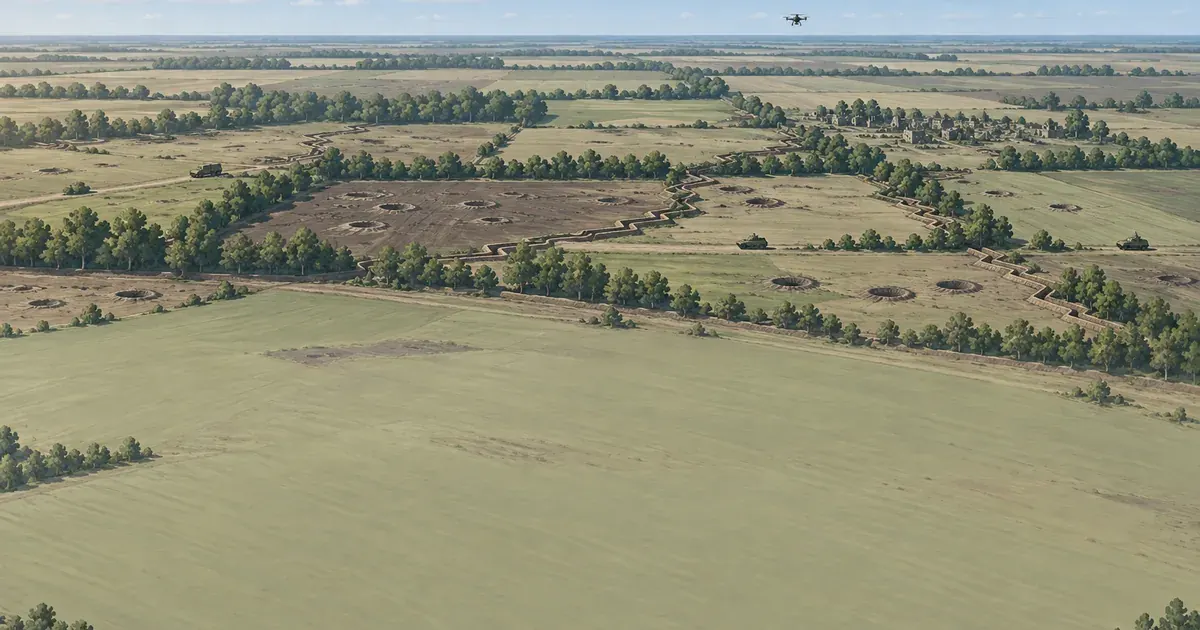
The Kill Zone
Kostiantynivka, Donetsk Oblast, Ukraine · August to October 2025
Information as of September 2026
Read the battle page: Battle of Kostiantynivka
Learning objectives
- Describe how continuous observation changes exposure and movement in the authored hold-zone run; distinguish its assumed observation area and automatic ground movement from real front-line measurements.
- Compare modeled jamming effects on radio-linked and fibre-optic drones, and how interception changes the enemy drones remaining overhead. Do not infer that every historical Lancet required a particular reconnaissance drone.
- Evaluate the choice between dispersed, standard and concentrated postures when holding a trench line under continuous drone attack.
Run time and a good result
Default run clock: 2 minutes 30 seconds at 1×, excluding pauses, briefing and discussion. Time controls change elapsed play time.
Objective: Hold Kostiantynivka until time runs out, from the trench line between the city and Chasiv Yar.
The Kill Zone: Hold Kostiantynivka until time runs out, from the trench line between the city and Chasiv Yar. Prevent an unopposed enemy occupation of the marked zone lasting 8 continuous simulation seconds; retain a fighting force until the episode ends. The authored limit is 150 simulation seconds across 1 stage. Compare objective progress, time, losses, drone expenditure and recorded civilian harm with a second run. A strong classroom result also explains the source evidence and reconstruction estimates; it does not verify a historical casualty count.
Timings
For 60 minutes, brief for 10, run it once with the three pauses for 25 and review for 25; for 90 minutes, add a run without drones and compare where losses came from; for 180 minutes, give syndicates different postures and rules of engagement, add a run with reports from units set to Realistic so observers inside enemy jamming go silent, and compare time held and civilian harm across the class. These are classroom session budgets including pauses and discussion; the unpaused authored run is 150 seconds. No drones removes the selected player side's drones, not every enemy drone.
| Session | Plan |
|---|---|
| 45 minutes | Brief: 10 min; Run: 15 min; Collect: 5 min; Review: 15 min |
| 60 minutes | Before questions: 5 min; Brief: 10 min; Run: 20 min; Collect: 5 min; Debrief and after questions: 15 min; Discussion: 5 min |
| 90 minutes | Before questions: 5 min; Brief: 10 min; Run 1: with drones: 20 min; Run 2: without drones: 15 min; Collect: 5 min; Compare and discuss: 25 min; After questions: 10 min |
| 180 minutes | Before questions: 10 min; Brief and staff roles: 15 min; Run 1: with drones: 25 min; Run 2: without drones: 20 min; Break: 10 min; Run 3: syndicates: 30 min; Collect: 10 min; Seminar replay and debrief: 40 min; After questions: 10 min; Close: 10 min |
Staff roles
- commander
- Set the pre-run posture and during-run standing orders, and report the modeled hold zone, remaining units and time. Individual ground-unit movement is automatic; continued resistance beyond the run is not a measured result.
- intelligence
- Count enemy recon drones overhead and infantry groups crossing the open ground, and report which of your units the enemy has probably found.
- fires
- Watch what your two batteries engage and how many shells remain, report every Lancet that targets them, and flag any strike close to Kostiantynivka, where civilians still live.
- droneOps
- Balance the quadcopter, FPV, fibre optic, bomber, recon and interceptor drones across a long run, and report losses to jamming and how many of each type remain.
Opposing staff objective
Attack from Chasiv Yar, Bakhmut and the south east, break through the trench line and take Kostiantynivka before time runs out.
Decision points
- Before the first launch, compare using interceptor cards against airborne reconnaissance drones with retaining them for later aircraft. Allocate ground-attack drone types separately; interceptors cannot strike infantry.
- When the first fibre optic drones arrive: your jamming unit cannot stop them, so what do you change in target priority or in how you use your own fibre optic drones?
- When modeled Lancet attacks threaten your artillery, compare intercepting airborne enemy drones with ground-target priority and the high-value-only artillery standing order. The run does not establish that every Lancet attack depends on a particular reconnaissance drone.
Before and after questions
The lesson describes drones retaining control despite radio-link jamming. Which control method explains that distinction?
- Their altitude reduces exposure to the jammer
- Their flight timing avoids effective jammer coverage
- Their autonomy removes reliance on operator control
- A physical control cable carries signals past interference with the radio link
Answer D: A physical control cable bypasses radio-link interference. It does not make a drone immune to all electronic effects, physical damage, terrain, detection or other failure modes.
Which Russian attack pattern did RUSI describe in its November 2024 to January 2025 field observations?
- Small infantry groups attempted dispersed infiltration
- Large tank columns attempted concentrated road advances
- Airborne groups attempted landings behind defending lines
- Armoured formations attempted advances after prolonged barrages
Answer A: RUSI describes small infantry attacks in its sampled formations, while also documenting vehicle-supported and larger actions. This is a bounded field observation, not a whole-front rule.
In this simulation, what can be reduced when an interceptor removes an opposing reconnaissance drone?
- The local interference applied to opposing drone control links
- The artillery accuracy automatically assigned to the opposing force
- The reconnaissance information available about opposing ground unit positions
- The opposing aircraft inventory available for later scheduled launches
Answer C: Removing reconnaissance can reduce modelled observations. Other sensors, search and fallback guesses remain; it does not guarantee artillery safety or imply every real Lancet needs a separate spotter.
An interceptor price is quoted per aircraft, while an Orlan estimate is quoted per system. What must come before a cost-exchange claim?
- Compare both prices without changing their published accounting basis
- Compare equivalent unit costs before claiming a favourable exchange
- Treat the lower published figure as the complete defending cost
- Treat the higher published figure as the complete attacking cost
Answer B: The original comparison mixes a unit price with a system estimate. Establish a comparable accounting basis before calculating an exchange; support equipment, crew costs and uncertainty can change the comparison.
What civilian-presence finding did the Donetsk Regional State Administration report for Kostiantynivka on 7 January 2026?
- The estimate concerned residents already evacuated elsewhere
- The estimate concerned recently arrived displaced residents
- The estimate concerned residents across the province
- The estimates recorded thousands still resident
Answer D: The administration estimated 2,800 residents remained and described evacuation as extremely difficult. This is a dated official estimate, not a live population count.
Discussion
- When did the review first record exposure or damage to your artillery? Compare another pre-run posture or drone allocation, and distinguish observed model changes from an unproven historical concealment claim.
- Compare a run with your drones enabled with one using the No drones variant, which removes your side's drones rather than the enemy's. Report losses and the modeled hold-zone result without inferring an independently verified historical counterfactual.
- Compare standard and strict rules of engagement near the model's populated area. Report blocked strikes and civilian harm separately from equipment losses and points; strict mode is a model restriction, not a guarantee of legal compliance or complete civilian safety.
- Which resupply and reinforcement processes does this short run represent, and which would require a different model or historical evidence? Do not extrapolate its minutes of ammunition use into a verified plan for weeks.
Debrief rubric
- Strong
- Meets the objective or explains why it was not met; uses the published sources and run evidence, separates known facts from assumptions, compares both sides’ losses and cost exchange, and evaluates precautions against civilian harm.
- Adequate
- Describes the objective and main decisions, identifies at least one source and model limitation, reports losses and harm, and gives a reasoned change for a second run.
- Weak
- Reports only victory or points, treats teaching settings as real performance, gives unsupported historical claims, or omits uncertainty and civilian harm.
Published readings
- Forbes: RUSI report, drones now destroying two thirds of Russian targets (Feb 2025)
- NSDC of Ukraine (Ukrainian government figures, treat as claims): Defence industry results 2025, FPV drones
- US Army: Historical armor losses
Complete source list
- Forbes: RUSI report, drones now destroying two thirds of Russian targets (Feb 2025)
- NSDC of Ukraine (Ukrainian government figures, treat as claims): Defence industry results 2025, FPV drones
- US Army: Historical armor losses
- Wikipedia: Battle of Kostiantynivka
- Wikipedia: Kostiantynivka
- Wikipedia: Battle of Chasiv Yar
- ISW (via Critical Threats): Russian Offensive Campaign Assessment, 25 September 2026
- ISW (via Critical Threats): Russian Offensive Campaign Assessment, 20 September 2026