
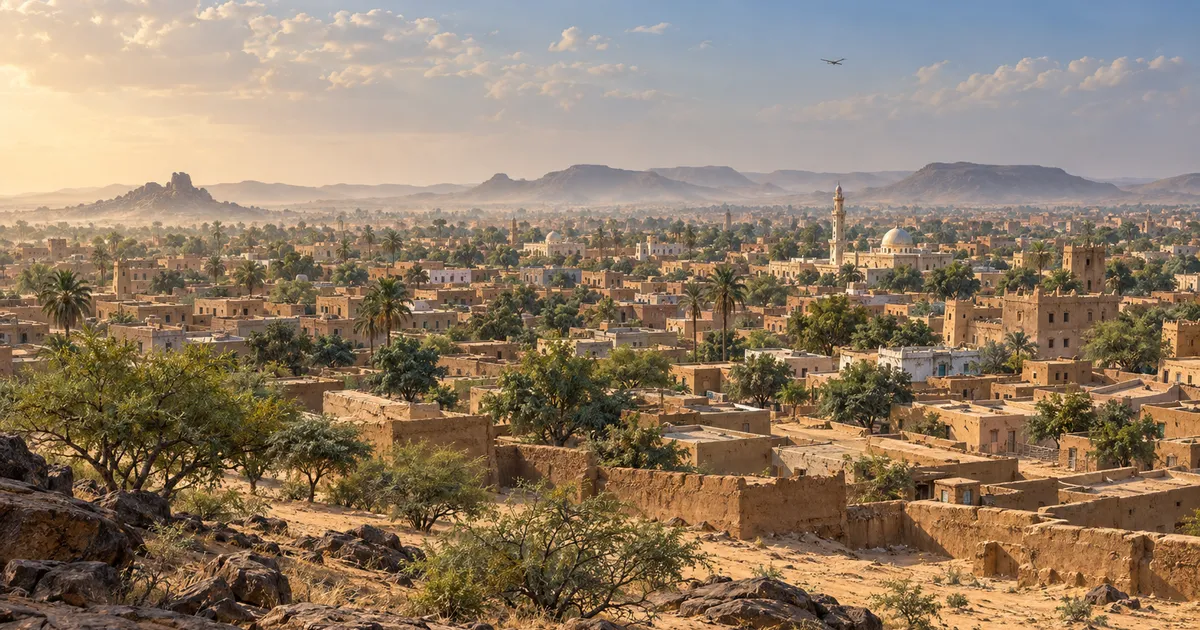
The Siege of El Fasher
El Fasher, North Darfur, Sudan · 10 May 2024 to 26 October 2025
Information as of September 2026
Read the battle page: Siege of El Fasher
Learning objectives
- Compare the modeled encirclement with Yale’s documented community destruction and berm observations, keeping each report’s date and geographic coverage distinct.
- Analyse how a defender with few drones and one air defence unit decides what to watch and what to strike when the attacker can approach from every side over several stages.
- Evaluate the obligations of both sides toward the civilians inside a besieged city, using the findings of the WHO, UNICEF, the UN human rights office and the Yale Humanitarian Research Lab.
Run time and a good result
Default run clock: 9 minutes 10 seconds at 1×, excluding pauses, briefing and discussion. Time controls change elapsed play time.
Objective: Hold the 6th Infantry Division headquarters zone through all five stages of the siege, from May 2024 to the final assault of October 2025. Use your few drones to find and strike RSF artillery and assault groups before they reach the zone, and avoid strikes in the built up areas where civilians remain.
The Siege of El Fasher: Hold the 6th Infantry Division headquarters zone through all five stages of the siege, from May 2024 to the final assault of October 2025. Use your few drones to find and strike RSF artillery and assault groups before they reach the zone, and avoid strikes in the built up areas where civilians remain. Prevent an unopposed enemy occupation of the marked zone lasting 8 continuous simulation seconds; retain a fighting force until the episode ends. The authored limit is 550 simulation seconds across 5 stages. Compare objective progress, time, losses, drone expenditure and recorded civilian harm with a second run. A strong classroom result also explains the source evidence and reconstruction estimates; it does not verify a historical casualty count.
Timings
For 60 minutes, brief for 10, run it once with a pause at each new stage for 30 and review for 20; for 90 minutes, run it again with a different choice of which approach to watch and compare when the headquarters zone came under attack; for 180 minutes, have half the syndicates command the RSF, compare how each side used its drones and how many civilian harm events each run caused, and close with a reading of the Yale Humanitarian Research Lab alert on the berm and the UN human rights office findings on Zamzam camp.
| Session | Plan |
|---|---|
| 45 minutes | Brief: 10 min; Run: 15 min; Collect: 5 min; Review: 15 min |
| 60 minutes | Before questions: 5 min; Brief: 10 min; Run: 20 min; Collect: 5 min; Debrief and after questions: 15 min; Discussion: 5 min |
| 90 minutes | Before questions: 5 min; Brief: 10 min; Run 1: with drones: 20 min; Run 2: without drones: 15 min; Collect: 5 min; Compare and discuss: 25 min; After questions: 10 min |
| 180 minutes | Before questions: 10 min; Brief and staff roles: 15 min; Run 1: with drones: 25 min; Run 2: without drones: 20 min; Break: 10 min; Run 3: syndicates: 30 min; Collect: 10 min; Seminar replay and debrief: 40 min; After questions: 10 min; Close: 10 min |
Staff roles
- commander
- Set the pre-run posture and available standing orders, allocate drone flights across the modeled approaches, and report each sector and the headquarters hold zone at stage changes. Ground-unit movement is automatic.
- intelligence
- Track RSF groups and artillery by direction and stage, and keep SAF and RSF claims apart from what independent investigators such as the Yale Humanitarian Research Lab confirmed.
- fires
- Observe artillery engagements, recommend the available artillery and rules-of-engagement standing orders, and flag civilian risk before a drone launch. Individual gun-target assignment and ground-unit positioning are automatic.
- droneOps
- Plan Mohajer-6, TB2 and quadcopter flights so that the main approaches are watched at each stage, and report how many drones remain before each new stage.
Opposing staff objective
Take the 6th Infantry Division headquarters zone by the end of the final assault in October 2025, with no defender left in it. Your drones and artillery must clear the way for the ground assault groups closing in from the north, east and south.
Decision points
- In this authored scenario stage, at the start, May 2024: RSF groups gather on every side, with their artillery to the east. Do you spend your few quadcopter flights watching the east, where the strength is, or the north and south roads, where the camps are?
- In the authored stage that adds TB2 drones, compare spending their available strikes now with retaining them for later scripted waves. What does the run record about observation, losses and unused stocks?
- In the authored final stage, compare drone allocation and standing orders as the headquarters hold zone comes under pressure. Which approach receives less observation, and what civilian risk do the launches create? Ground units move automatically.
Before and after questions
What limitation on drone effects does the lesson’s siege account emphasise?
- Aerial damage establishes that the encirclement has weakened sufficiently
- Aircraft totals identify control over each ground supply route
- Greater aerial reach did not itself restore ground supply access or end the encirclement
- Greater strike reach compensates for reduced ground supply access
Answer C: The lesson distinguishes reach from control of ground and supply access. The exercise does not establish a counterfactual claim about whether drones could have changed every aspect of the siege.
Why did RSF attacks on 41 farming communities around El Fasher matter to the siege?
- They supplied food on which the city depended
- They provided the city’s principal air-defence positions
- They housed the city’s principal drone maintenance facilities
- They controlled river crossings used for military reinforcement
Answer A: Yale HRL assesses that at least 41 farming communities were intentionally razed between 31 March and 12 June 2024. Its remote-sensing study finds reduced subsequent agricultural activity. This supports concern about food production; it is an attributed research assessment, not a complete measure of all food reaching the city.
Why does the briefing tell you to avoid strikes in the built up areas of El Fasher?
- Military presence permits treating nearby civilian exposure as secondary
- Building cover supports lowering the assumed civilian harm probability
- Reported departures establish low civilian presence without renewed checks
- Residents and civilian facilities remained exposed to strikes
Answer D: Yale HRL’s 22 September 2025 report identifies severe damage to Al-Safiya Mosque consistent with an air-delivered munition and cites reports of at least 78 deaths. It calls the incident an apparent drone strike. Civilian risk remains central; this source does not independently establish every hospital total or the specific operator.
How should a staff officer handle party claims alongside independent investigative findings?
- Treat the latest spokesman’s account as conclusive
- Distinguish party claims from independent investigative findings
- Treat government-side reporting as sufficient independent corroboration
- Discount satellite evidence without direct ground confirmation
Answer B: Separate party statements from documented investigative findings and record each source’s method, date and scope. UN News attributes the October three-day death total to OHCHR; Amnesty reports survivor interviews and verified open-source evidence. Neither source independently establishes every claim made by either belligerent.
What did the Yale Humanitarian Research Lab say the RSF's earthen berm around El Fasher did?
- It primarily reduced exposure to observation from approaching ground forces
- It primarily separated civilian traffic from the principal military approaches
- Restricted the population’s ability to escape the siege
- It primarily secured food distribution routes serving the displacement camps
Answer C: Yale HRL’s 28 August 2025 alert identifies more than 31 km of berms and assesses that they restrict escape and goods entering the city. Construction was ongoing. This report does not establish the packet’s later 57 km figure; later measurements require their own dated evidence.
Discussion
- Yale HRL assessed that at least 41 farming communities were razed between 31 March and 12 June 2024. Its August 2025 berm report assessed restrictions on movement and escape. Distinguish those dated findings from legal conclusions, then discuss civilian access to food, water and safe departure during a siege.
- The UN reported at least 70 patients and relatives killed in the 24 January 2025 hospital attack. Yale's September mosque report analysed damage and cited 78 reported deaths. Neither casualty total alone identifies the attacker. How should a review separate observed damage, casualty reports, operator attribution and responsibility for protecting civilians?
- Compare Amnesty’s survivor and open-source investigation with the OHCHR findings reported by UN News. What does each method establish, what remains uncertain, and how should evidence about an incident be distinguished from evidence identifying a commander’s responsibility?
- Compare the defenders’ drone use, remaining ground units and hold-zone result across the authored stages. Which historical claims about the siege can the run test, and which require evidence outside the model?
Debrief rubric
- Strong
- Meets the objective or explains why it was not met; uses the published sources and run evidence, separates known facts from assumptions, compares both sides’ losses and cost exchange, and evaluates precautions against civilian harm.
- Adequate
- Describes the objective and main decisions, identifies at least one source and model limitation, reports losses and harm, and gives a reasoned change for a second run.
- Weak
- Reports only victory or points, treats teaching settings as real performance, gives unsupported historical claims, or omits uncertainty and civilian harm.
Facilitator notes
This historical scenario includes sourced findings of mass killing following the city’s fall. Explain before the run that civilian harm is reported separately from equipment losses and points, and that any harm-bearing ranked run follows every harm-free run. The simulation cannot substitute for an investigation. Instructors can choose another scenario for a class.
Published readings
- OHCHR: Three days of terror with no safe refuge: RSF offensive on Zamzam IDP camp, El Fasher (11–13 April 2025; December 2025 report, paragraphs 5 and 16)
- OHCHR: Three days of terror with no safe refuge: RSF offensive on Zamzam IDP camp, El Fasher (11–13 April 2025; December 2025 report, paragraphs 5 and 16) — readable ecoi.net copy
- Yale Humanitarian Research Lab: Human Security Alert, RSF walls in El Fasher's population to prevent escape (2025)
Complete source list
- Wikipedia: Siege of El Fasher
- Wikipedia: El Fasher massacre
- Wikipedia: Zamzam camp
- Wikipedia: Zamzam and Abu Shouk refugee camp massacres
- Wikipedia: Darfur Joint Protection Force
- Wikipedia: El Fasher
- Wikipedia: El Fasher Airport
- Wikipedia: Timeline of the Sudanese civil war (2024)
- Wikipedia: Timeline of the Sudanese civil war (2025)
- Wikipedia: Rapid Support Forces
- Wikipedia: Qods Mohajer-6
- OHCHR: Three days of terror with no safe refuge: RSF offensive on Zamzam IDP camp, El Fasher (11–13 April 2025; December 2025 report, paragraphs 5 and 16)
- OHCHR: Three days of terror with no safe refuge: RSF offensive on Zamzam IDP camp, El Fasher (11–13 April 2025; December 2025 report, paragraphs 5 and 16) — readable ecoi.net copy
- Yale Humanitarian Research Lab: Human Security Alert, RSF walls in El Fasher's population to prevent escape (2025)
- OHCHR: Hundreds killed in RSF attacks in Sudan's North Darfur (April 2025)
- OHCHR: UN report details horrific patterns of violations committed during RSF takeover of Zamzam IDP camp (December 2025)
- Amnesty International: A refuge destroyed, RSF violations in Darfur's Zamzam camp for internally displaced persons (December 2025)
- ACAPS: Sudan, displacement from Zamzam camp (2025)
- CBS News: Satellite images reveal mass killing is continuing in Sudan, Yale researchers say (2025)
- CBS News: Sudan civil war escalates as RSF forces reportedly push into beleaguered army stronghold of El Fasher (2025)
- ABC News: Blood visible from space in Sudan shows evidence of Darfur genocide, analysts say (2025)
- EUAA: Sudan, security situation 2025, Darfur, actors involved and territorial control
- AllAfrica: Sudan, 'Colombian commander slain' as RSF attack on North Darfur capital repelled (August 2025)
- Al Jazeera: The drones being used in Sudan, 1,000 attacks since April 2023 (3 February 2026, using ACLED data)
- Euronews: Turkish defence firm accused of violating sanctions with Sudan weapons supplies | Euronews
- Dabanga: Yale HRL report, Chinese UAVs identified at RSF controlled South Darfur airport (17 January 2025)
- Amnesty International: Advanced Chinese weaponry provided by UAE identified in breach of arms embargo (7 May 2025)
- UN Independent International Fact Finding Mission for the Sudan, report A/HRC/63/23 (1 September 2026)
- ACLED: How has Sudan's drone war adapted to shifting supply lines? (4 June 2026)
- Federal Register: Foreign Terrorist Organization designation of Sudanese Muslim Brotherhood (16 March 2026)
- GOV.UK: Proscribed terrorist groups or organisations (updated 7 July 2026)
- GovInfo: H.R. 8301, RSF Terrorist Designation Act (introduced 15 April 2026)
- UN News: Sudan’s people subject to relentless drone strikes in El Obeid (3 July 2026), citing OHCHR findings on El Fasher
- Yale HRL/NASA Harvest/Arizona State University: Impact of Systematic Razing of Agricultural Communities Around El-Fasher (10 March 2026)
- Yale HRL: RSF Walls-In El-Fasher’s Population to Prevent Escape (28 August 2025)
- Yale HRL: Confirmed, 19 September Strike on Al-Safiya Mosque (22 September 2025)
- UNICEF: At least 17 children reportedly killed in attack on Dar al-Arqam displacement centre (12 October 2025)
- Amnesty International: RSF atrocities in El Fasher, new investigation (1 July 2026)
- WHO: WHO condemns killings of patients and civilians amid escalating violence in El Fasher, Sudan (29 October 2025)
- United Nations: Secretary-General spokesperson statement on Saudi Teaching Hospital (27 January 2025; reported toll)
- OHCHR: RSF final offensive and capture of besieged El Fasher, 24–30 October 2025 (13 February 2026 report, paragraph 40)