
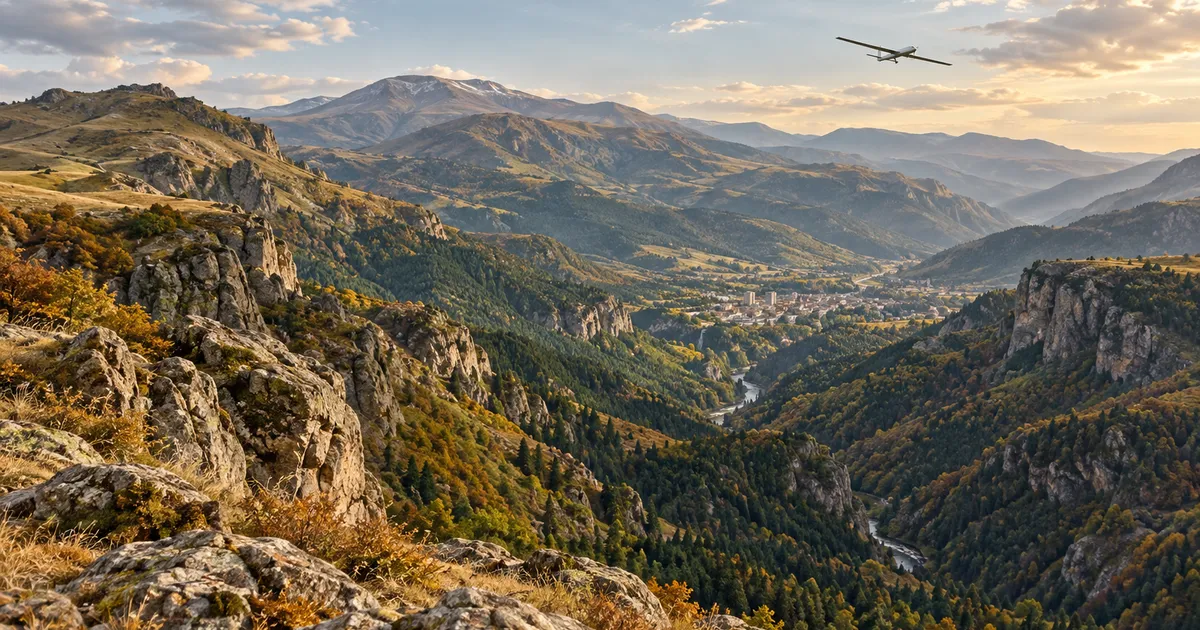
The Heights above Jermuk
Jermuk, Vayots Dzor Province, Armenia, on the border with the Kalbajar District of Azerbaijan · 13 to 14 September 2022
Information as of September 2026
Battle index: September 2022 Azerbaijani attack on Armenia
Learning objectives
- Compare observed contacts and losses around the authored mountain and town positions, and explain the model's terrain-cover assumptions. A successful run does not establish that commanding heights determined the historical outcome.
- Compare the attacker's use of artillery, an armed drone and loitering munitions with a defender who has artillery and a little air defence but no drones.
- Separate the two governments' reported positions, equipment losses and casualties from independently verified findings. Explain the UN briefing's explicit inability to verify the reported specifics.
Run time and a good result
Default run clock: 2 minutes 50 seconds at 1×, excluding pauses, briefing and discussion. Time controls change elapsed play time.
Objective: Take the heights east of Jermuk, between the border and the town, and hold them with no Armenian unit left inside the marked zone when the ceasefire comes. Your Bayraktar TB2 can find and strike positions and guns on the slopes; keep the Harop loitering munitions for Armenian air defence. Jermuk, Kechut and Gndevaz are full of civilians, and the forests around the town catch fire, so check every target before you strike.
The Heights above Jermuk: Take the heights east of Jermuk, between the border and the town, and hold them with no Armenian unit left inside the marked zone when the ceasefire comes. Your Bayraktar TB2 can find and strike positions and guns on the slopes; keep the Harop loitering munitions for Armenian air defence. Jermuk, Kechut and Gndevaz are full of civilians, and the forests around the town catch fire, so check every target before you strike. Occupy the marked zone with at least one combat unit and no opposing combat unit for 8 continuous simulation seconds. The authored limit is 170 simulation seconds across 1 stage. Compare objective progress, time, losses, drone expenditure and recorded civilian harm with a second run. A strong classroom result also explains the source evidence and reconstruction estimates; it does not verify a historical casualty count.
Timings
For 60 minutes, brief for 15, run it once as Azerbaijan for 25 and review for 20; for 90 minutes, add a second run in which the class commands Armenia and compare where each side's drones and guns made the difference; for 180 minutes, give syndicates different plans for both sides, run them, then spend the last hour comparing each government's public claims in the sources with what happened in the runs.
| Session | Plan |
|---|---|
| 45 minutes | Brief: 10 min; Run: 15 min; Collect: 5 min; Review: 15 min |
| 60 minutes | Before questions: 5 min; Brief: 10 min; Run: 20 min; Collect: 5 min; Debrief and after questions: 15 min; Discussion: 5 min |
| 90 minutes | Before questions: 5 min; Brief: 10 min; Run 1: with drones: 20 min; Run 2: without drones: 15 min; Collect: 5 min; Compare and discuss: 25 min; After questions: 10 min |
| 180 minutes | Before questions: 10 min; Brief and staff roles: 15 min; Run 1: with drones: 25 min; Run 2: without drones: 20 min; Break: 10 min; Run 3: syndicates: 30 min; Collect: 10 min; Seminar replay and debrief: 40 min; After questions: 10 min; Close: 10 min |
Staff roles
- commander
- Set the pre-run posture and available standing orders, allocate drone observation and strikes, and report progress in the authored heights zone and remaining time. Individual infantry and armoured-group movement is automatic.
- intelligence
- Track which Armenian positions, guns and air defence units have been found, and keep a separate list of each side's claims that the run does not confirm.
- fires
- Observe artillery engagements and ammunition, recommend available standing orders, and flag drone launches near the authored towns, reservoir or forest. Individual gun-target assignments are unavailable.
- droneOps
- Plan the TB2 search over the slopes and the Harop strikes on air defence, and report every drone lost.
Opposing staff objective
Hold at least one position on the heights east of Jermuk until the ceasefire on 14 September. Your companies are spread thin across steep ground; use your artillery near Jermuk and Kechut against attackers on the slopes, and keep your air defence alive, because it is the only answer you have to the drones overhead. You have no drones of your own in this scenario.
Decision points
- Before the first move on the night of 12 to 13 September: do you send the TB2 to find the Armenian positions on the heights, or to find the air defence and guns near Jermuk first?
- When your infantry is on the slopes and Armenian artillery near Kechut opens fire: do you spend a Harop on the air defence or use the TB2 against the guns, knowing both sit close to villages and forest?
- Near the end of the authored scenario, compare remaining drone stocks, observed defenders and progress toward the heights take zone. Which available launches and standing orders do you change? Individual ground advances and withdrawal are automatic.
Before and after questions
How should a student handle the conflicting national accounts recorded in the UN's15 September 2022 briefing?
- Present both figures as independently confirmed territorial changes
- Interpret the figures as showing no Armenian losses
- Interpret the figures as describing the entire frontier
- Attribute conflicting figures and state verification limits clearly
Answer D: The UN briefing recounts conflicting national reports and explicitly says the UN could not verify their specifics. Students should separate reported claims from independently established findings.
What information and engagement contribution do drones add in this classroom model?
- Substituting aerial observation for information about ground supply capacity
- Drones add modeled visibility and conditional strikes against positions difficult to observe from the ground
- Inferring artillery survivability from its currently observed ground positions
- Establishing target identity from observation without comparing available evidence
Answer B: Drones contribute to model visibility and conditional strikes. The UN record reports drone use, while leaving specifics unverified; neither proves the exact view of historical observers.
What allocation problem does the model illustrate for a defender with few air-defence units?
- Prioritise protection among exposed positions
- Allocate resources using distance alone
- Treat concealment as adequate protection
- Preserve coverage at earlier positions
Answer A: Limited model assets cannot provide uniform coverage of every position. The classroom task is to explain trade-offs and uncertainty, not to recommend real deployments.
Why did Armenia's representative describe the Kechut reservoir allegation as a wider civilian concern?
- Reservoir capacity established limited consequences from the reported strike locations
- Distance from housing justified excluding wider environmental effects from assessment
- The alleged strikes raised human and environmental harm concerns
- Reported departures justified assuming negligible exposure around the affected infrastructure
Answer C: The original UN record quotes Armenia's representative alleging reservoir strikes with potential human and environmental consequences. The allegation is recorded, rather than independently confirmed by the UN.
What did the UN briefer say about verifying the parties' reports at the15 September 2022 meeting?
- The briefing treated national reports as independently corroborated incident findings
- The United Nations could not verify the reported specifics
- The briefing used agreement between casualty reports as sufficient confirmation
- The briefing resolved the allegations using a completed legal assessment
Answer B: The Assistant Secretary-General expressly said the UN was not in a position to verify or confirm the reports' specifics. This is a dated institutional limit, not proof that no independent investigation exists.
Discussion
- Armenia called the fighting an attack on its territory; Azerbaijan said it responded to provocations and mines. How should a staff officer present two such accounts in a briefing, and what evidence would settle them?
- At the UN Security Council meeting, Armenia alleged shelling of Jermuk and strikes against the Kechut reservoir. The UN did not verify the reported specifics. How should a briefing distinguish those allegations from confirmed damage, and address civilian and environmental risk?
- The defender had no drones in this scenario. What did that cost them, and what could a defender in the mountains do instead?
- AP reported that an earlier Russia-brokered ceasefire quickly failed and that an Armenian official announced a new truce effective on 14 September 2022. How would you distinguish an announced agreement from observed cessation of fighting, and what can a run's ending establish?
Debrief rubric
- Strong
- Meets the objective or explains why it was not met; uses the published sources and run evidence, separates known facts from assumptions, compares both sides’ losses and cost exchange, and evaluates precautions against civilian harm.
- Adequate
- Describes the objective and main decisions, identifies at least one source and model limitation, reports losses and harm, and gives a reasoned change for a second run.
- Weak
- Reports only victory or points, treats teaching settings as real performance, gives unsupported historical claims, or omits uncertainty and civilian harm.
Published readings
- Eurasianet: Azerbaijan launches wide ranging attacks against Armenia (Joshua Kucera and Ani Mejlumyan, 13 September 2022)
- Carnegie Europe: More Storm Clouds Gather Over Armenia, Azerbaijan (Thomas de Waal, 22 September 2022)
- The Jerusalem Post: Attacks on Armenia represent dangerous escalation (Seth J. Frantzman, 13 September 2022)
Complete source list
- Wikipedia: September 2022 Armenia-Azerbaijan clashes
- Wikipedia: Jermuk
- Wikipedia: Kechut
- Wikipedia: Gndevaz
- Wikipedia: Gndevank
- Wikipedia: Vayots Dzor Province
- Wikipedia: Arpa River
- Wikipedia: Kalbajar District
- Wikipedia: Bayraktar TB2
- Wikipedia: IAI Harop
- Wikipedia: S-300 missile system
- Eurasianet: Azerbaijan launches wide ranging attacks against Armenia (Joshua Kucera and Ani Mejlumyan, 13 September 2022)
- Carnegie Europe: More Storm Clouds Gather Over Armenia, Azerbaijan (Thomas de Waal, 22 September 2022)
- The Jerusalem Post: Attacks on Armenia represent dangerous escalation (Seth J. Frantzman, 13 September 2022)
- Deseret News: Why is Azerbaijan attacking Armenia?
- CNN: Russia claims ceasefire reached between Armenia and Azerbaijan after fighting erupts along border (13 September 2022)
- Reuters: Azerbaijan and Armenia ceasefire fails within minutes, media (13 September 2022)
- Reuters: Armenia's PM says 49 soldiers died in clashes with Azerbaijan (13 September 2022)
- AP: Armenian security official says Armenia and Azerbaijan have agreed on a cease fire to end two days of fighting (14 September 2022)
- AP: Armenia, Azerbaijan agree on cease fire to end fighting (Avet Demourian, 15 September 2022)
- European Parliament Think Tank: Armenia and Azerbaijan, between war and peace (2023)
- Journal of International Criminal Justice: Justice for the Victims of the Nagorno-Karabakh Conflict (Sheila Paylan and Sareta Ashraph, 13 January 2026)
- UN Security Council: S/PV.9132, verbatim meeting record (15 September 2022; speaker claims and UN verification limits)
- Armenia Human Rights Defender: Ad hoc report on attacks of 13–15 September 2022 (published 16 September; paragraph 19, regional displacement)
- Public Radio of Armenia: 7,600 persons displaced in Armenia, Human Rights Defender reports (16 September 2022)