
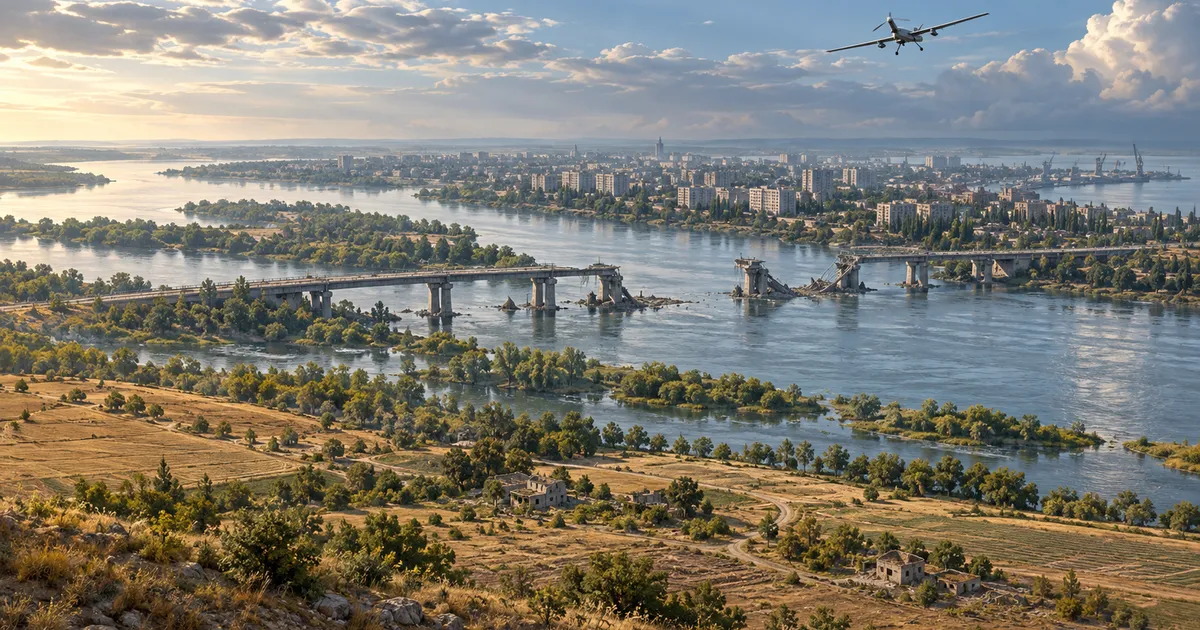
The Kherson Counteroffensive
Kherson, Snihurivka, Davydiv Brid and Beryslav, Kherson and Mykolaiv oblasts, Ukraine · 29 August to 11 November 2022
Information as of September 2026
Battle index: 2022 Kherson counteroffensive
Learning objectives
- Compare source accounts of crossing disruption with the authored supply-counter losses. The run’s cutoff mechanism depends on supply counters; it does not simulate ferry or pontoon carrying capacity or demonstrate the historical effect of each bridge strike.
- Compare otherwise matching runs with and without the player’s drones, using losses, elapsed time and objective progress in each authored stage. The option leaves enemy drone activity in place and does not remove all observation from the battlefield.
- Compare the effects of the authored Orlan-10, Lancet and Shahed arrivals on observed contacts and losses. Artillery movement and firing are automatic; discuss proposed battery relocation separately from the run’s available launch and standing-order controls.
Run time and a good result
Default run clock: 7 minutes 20 seconds at 1×, excluding pauses, briefing and discussion. Time controls change elapsed play time.
Objective: Take Kherson by the end of the operation. Use your guns and drone spotters to break the Russian line at the Inhulets bridgehead, Snihurivka and Kyselivka, push down the Dnieper toward Beryslav, and clear every Russian combat unit from the city zone. More brigades arrive in October and November.
The Kherson Counteroffensive: Take Kherson by the end of the operation. Use your guns and drone spotters to break the Russian line at the Inhulets bridgehead, Snihurivka and Kyselivka, push down the Dnieper toward Beryslav, and clear every Russian combat unit from the city zone. More brigades arrive in October and November. Occupy the marked zone with at least one combat unit and no opposing combat unit for 8 continuous simulation seconds. The authored limit is 440 simulation seconds across 4 stages. Compare objective progress, time, losses, drone expenditure and recorded civilian harm with a second run. A strong classroom result also explains the source evidence and reconstruction estimates; it does not verify a historical casualty count.
Timings
For 60 minutes, brief for 10, complete the run with a pause at each authored wave within 30 minutes, and review for 20. For 90 minutes, add a run without drones and compare the reviews. For 180 minutes, give syndicates different drone-observation priorities on the authored approaches and one syndicate the Russian side, then compare the class results. Ground-axis changes are classroom proposals, not individual unit controls.
| Session | Plan |
|---|---|
| 45 minutes | Brief: 10 min; Run: 15 min; Collect: 5 min; Review: 15 min |
| 60 minutes | Before questions: 5 min; Brief: 10 min; Run: 20 min; Collect: 5 min; Debrief and after questions: 15 min; Discussion: 5 min |
| 90 minutes | Before questions: 5 min; Brief: 10 min; Run 1: with drones: 20 min; Run 2: without drones: 15 min; Collect: 5 min; Compare and discuss: 25 min; After questions: 10 min |
| 180 minutes | Before questions: 10 min; Brief and staff roles: 15 min; Run 1: with drones: 25 min; Run 2: without drones: 20 min; Break: 10 min; Run 3: syndicates: 30 min; Collect: 10 min; Seminar replay and debrief: 40 min; After questions: 10 min; Close: 10 min |
Staff roles
- commander
- Set the pre-run posture and available standing orders, allocate drone flights across the authored approaches, and report progress toward Kherson and remaining time. Individual ground-axis changes and unit movement are automatic.
- intelligence
- Track which Russian guns, air defence and reserves have been found, report each Orlan-10 over your forces, and say when Russian units fall back.
- fires
- Observe the batteries and HIMARS counter’s automatic engagements and ammunition, recommend available artillery standing orders, and report Lancet exposure. The run does not offer individual battery movement or gun-target assignment.
- droneOps
- Plan where each quadcopter flies, keep spotters over the next objective ahead of the troops, and report every drone lost and how.
Opposing staff objective
Hold Kherson through every wave. Your units on the right bank depend on crossings under rocket attack, so use Orlan-10 spotters, Lancets and Shaheds to slow the Ukrainian advance and keep a combat unit in the city zone until the end.
Decision points
- At the opening on 29 August: you attack on four axes with few drones. Where do you send your quadcopters first, toward the bridgehead at Andriivka, Snihurivka, or the guns behind Kyselivka, and why?
- In the authored October stage, observe where new brigades arrive automatically and compare drone observation along the Dnieper approach with observation around the modeled Beryslav guns. Individual brigade advance or waiting orders are unavailable.
- When a modeled Lancet threatens an artillery counter, compare available drone launches and artillery standing orders. Discuss a proposed battery withdrawal as a classroom option outside the run’s individual movement controls.
Before and after questions
In RUSI's retrospective account, why did contested Dnipro crossings matter for Russian troops near Kherson?
- Crossing disruption primarily reduced opportunities for observing Ukrainian troop movement
- Crossing disruption primarily affected withdrawals rather than continuing resupply needs
- Contested Dnipro crossings constrained Russian resupply rates while effective Russian defence still continued
- Stored supplies justified disregarding the remaining capacity of contested crossings
Answer C: RUSI describes constrained resupply across contested Dnipro crossing points. It also describes continued effective Russian defence, so constrained supply should not be read as a complete cutoff.
In this model, what does locating opposing artillery provide?
- An opportunity to engage the located guns
- Confidence that the located guns remain stationary
- Confidence that return fire no longer threatens observers
- Confidence that the contact needs no further confirmation
Answer A: Finding a contact creates an opportunity for engagement, not a guarantee of destruction or protection from return fire. The correct option distinguishes information from assured effects.
Which constraints does RUSI describe on Ukrainian strike UAVs as Russian coverage improved in 2022?
- Aircraft allocation to maritime missions principally restricted strike access inland
- Seasonal weather rather than hostile coverage principally restricted strike access
- Reduced ground advances rather than hostile coverage principally restricted strikes
- Russian electronic warfare and air defence restricted strike access
Answer D: RUSI describes increasingly systematic EW and air-defence coverage restricting strike-UAS access. This is a broad first-period finding, not a Kherson-specific sortie count or proof of one exclusive cause.
What civilian movement did Reuters directly observe at Oleshky on22 October 2022?
- Families returned by boat into Kherson after warnings were lifted
- People arrived by boat from Kherson with personal belongings
- Civilian departures had ended before the occupation authorities renewed warnings
- Authorities organised inland movements without using the river boat crossings
Answer B: Reuters observed arrivals from Kherson by river boat at Oleshky. This direct observation does not establish a complete total or whether every departure was voluntary.
What reason did General Surovikin give on 9 November for withdrawing Russian troops to the left bank?
- Civilian relocation had removed the need for defence
- A local agreement required abandoning the remaining positions
- Artillery shortages had removed the force's defensive capability
- The right-bank force could not be supplied
Answer D: Reuters reports Surovikin saying Kherson could no longer be supplied and Shoigu ordering withdrawal on9 November. This is the stated rationale, rather than independent verification of every supply condition.
Discussion
- Which Russian unit or crossing did you find first, how long did it take, and how did that change your plan for the next wave?
- Compare your run with drones and a run without them. How did losses, timing and ground gained differ, and in which wave did the drones matter most?
- ISW's 11 November 2022 assessment described footage of civilians greeting Ukrainian troops in Kherson. What civilian-protection concerns should an after-action review examine beyond taking the city, and which are absent from this run's model?
- If you had commanded the Russian side, what would you have changed in posture, air defence or the use of Orlan-10s and Lancets to hold the right bank longer?
Debrief rubric
- Strong
- Meets the objective or explains why it was not met; uses the published sources and run evidence, separates known facts from assumptions, compares both sides’ losses and cost exchange, and evaluates precautions against civilian harm.
- Adequate
- Describes the objective and main decisions, identifies at least one source and model limitation, reports losses and harm, and gives a reasoned change for a second run.
- Weak
- Reports only victory or points, treats teaching settings as real performance, gives unsupported historical claims, or omits uncertainty and civilian harm.
Published readings
- ISW (via Critical Threats): Russian Offensive Campaign Assessment, 29 August 2022
- ISW (via Critical Threats): Russian Offensive Campaign Assessment, 4 October 2022
- ISW (via Critical Threats): Russian Offensive Campaign Assessment, 11 November 2022
Complete source list
- Wikipedia: 2022 Kherson counteroffensive
- Wikipedia: Antonivka Road Bridge
- Wikipedia: Bridges in the Russo-Ukrainian war
- Wikipedia: Liberation of Kherson
- Wikipedia: Southern front of the Russo-Ukrainian war (2022–present)
- Wikipedia: Russian occupation of Kherson Oblast
- Wikipedia: Davydiv Brid
- Wikipedia: Dudchany
- Wikipedia: Darivka, Kherson Raion
- Wikipedia: Snihurivka
- Wikipedia: Kherson
- Wikipedia: Sukhyi Stavok
- Wikipedia: Andriivka, Beryslav Raion, Kherson Oblast
- Wikipedia: Kyselivka, Kherson Oblast
- Wikipedia: Beryslav
- Wikipedia: Nova Kakhovka
- Wikipedia: Inhulets River
- Wikipedia: ZALA Lancet
- Wikipedia: HESA Shahed 136
- Wikipedia: STC Orlan-10
- Wikipedia: Bayraktar TB2
- Wikipedia: AeroVironment Switchblade
- ISW (via Critical Threats): Russian Offensive Campaign Assessment, 29 August 2022
- ISW (via Critical Threats): Russian Offensive Campaign Assessment, 4 October 2022
- ISW (via Critical Threats): Russian Offensive Campaign Assessment, 11 November 2022
- Washington Post: How Ukrainians, targeting by drone, attacked Russian artillery in Kherson (8 October 2022)
- Ukrinform: Ukrainian forces destroy Russia's Mi-24, two Orlan-10s in Kherson region (2022)
- Ukrinform: Ukrainian forces destroy four Iranian kamikaze drones in Mykolaiv region (2022)
- Naval News: Loitering munition strikes Ukrainian gunboat, a first in naval warfare (November 2022)
- Kyiv Independent: Explainer, Iran's cheap, effective Shahed drones and how Russia uses them in Ukraine
- Human Rights Watch: Ukraine, Torture, Disappearances in Occupied South (22 July 2022)
- Human Rights Watch: Ukraine, Russian Torture Center in Kherson (13 April 2023)
- CNN: Kherson detention centers, Russian troops tortured nearly half of those held, international human rights report finds (2 August 2023)