
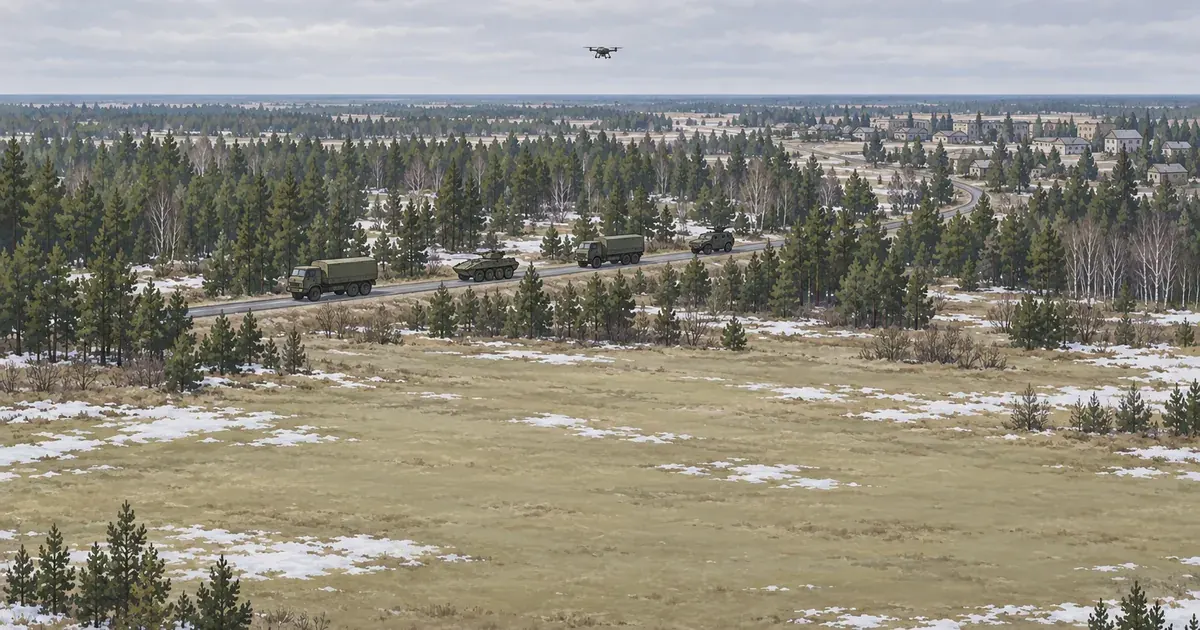
The Road to Kyiv
Hostomel, Bucha, Irpin and Moshchun, north west of Kyiv, Ukraine · March 2022
Read the battle page: Battle of Kyiv (2022)
Learning objectives
- Compare how modeled drone observation reveals supply units and how loss of supply changes vehicle movement, artillery replenishment and drone turnaround in the simulation.
- Assess how the model's rain, terrain and river crossings affect movement and drone flight time; keep this comparison separate from claims about every historical engagement.
- Evaluate the trade off between strict and standard rules of engagement when an enemy column approaches a city where civilians still live.
Run time and a good result
Default run clock: 2 minutes 30 seconds at 1×, excluding pauses, briefing and discussion. Time controls change elapsed play time.
Objective: Keep Russian forces out of Kyiv’s north western districts, east of the Irpin river, until time runs out.
The Road to Kyiv: Keep Russian forces out of Kyiv’s north western districts, east of the Irpin river, until time runs out. Prevent an unopposed enemy occupation of the marked zone lasting 8 continuous simulation seconds; retain a fighting force until the episode ends. The authored limit is 150 simulation seconds across 1 stage. Compare objective progress, time, losses, drone expenditure and recorded civilian harm with a second run. A strong classroom result also explains the source evidence and reconstruction estimates; it does not verify a historical casualty count.
Timings
For 60 minutes, brief for 10, run it once with the three pauses for 25 and review for 25; for 90 minutes, add a run without drones and compare how far the column got; for 180 minutes, add a night run, when only the R18 bombers and the TB2 carry heat sensing cameras, and a run under strict rules of engagement, then compare time held and civilian harm across the class.
| Session | Plan |
|---|---|
| 45 minutes | Brief: 10 min; Run: 15 min; Collect: 5 min; Review: 15 min |
| 60 minutes | Before questions: 5 min; Brief: 10 min; Run: 20 min; Collect: 5 min; Debrief and after questions: 15 min; Discussion: 5 min |
| 90 minutes | Before questions: 5 min; Brief: 10 min; Run 1: with drones: 20 min; Run 2: without drones: 15 min; Collect: 5 min; Compare and discuss: 25 min; After questions: 10 min |
| 180 minutes | Before questions: 10 min; Brief and staff roles: 15 min; Run 1: with drones: 25 min; Run 2: without drones: 20 min; Break: 10 min; Run 3: syndicates: 30 min; Collect: 10 min; Seminar replay and debrief: 40 min; After questions: 10 min; Close: 10 min |
Staff roles
- commander
- Set the posture before the run and the standing orders during it, weigh the supply trucks against the tanks as targets, and report how far the column has come against the time left.
- intelligence
- Track the enemy supply trucks, the jamming unit near the column and each Orlan flight over your lines, and report what the enemy can probably see of you.
- fires
- Watch which targets your two batteries engage and how many shells remain, and report any strike landing close to the city where civilians live.
- droneOps
- Manage the quadcopters, the R18 bombers and the single TB2, report losses to jamming and air defence, and say how much the rain is cutting flight time.
Opposing staff objective
Push from Hostomel and Bucha, and along the M07 from Borodianka, across the Irpin river into Kyiv’s north western districts before time runs out.
Decision points
- Before the first launch: the enemy column comes down the convoy road from the north toward Hostomel, with a second group on the M07 from Borodianka, so do you look first at the tanks leading it or the supply trucks at its rear, and which drone goes where?
- When the first enemy Orlan flies over your positions: your artillery may now be found, so do you set target priority to hit the enemy artillery first or keep your drones on the column?
- When the leading vehicles reach the Irpin river between Irpin and Kyiv: is this where you spend your R18 bombers and the TB2, or do you hold them for the approach to Kyiv’s north western districts?
Before and after questions
In this historical scenario’s logistics model, why can losing fuel trucks affect more than the vehicles directly struck?
- Truck losses primarily reduce the column's local observation coverage
- Truck losses matter mainly through replacement vehicle purchase costs
- Loss of supply reduces fuel available to other vehicles throughout the modeled column
- Truck losses matter primarily because those vehicles lead attacks
Answer C: The model links vehicle activity to supply. Compare the run’s logistics effects with the cited historical account, rather than treating the simplified result as a ranking of real-world targets.
Which combination of obstacles does this simulation represent at the Irpin river?
- Constructed new crossings while moving artillery units westward
- Retained crossings for later planned Ukrainian ground counterattacks
- Assigned crossings to volunteer reconnaissance and drone detachments
- Destroyed crossings and flooded nearby valley ground
Answer D: Flooded ground and damaged crossings restrict movement in this model. RUSI independently describes raised water on the Irpin obstructing the Russian advance; the modeled crossings are not a verified inventory of individual bridge demolitions.
In the briefing, what did small Ukrainian units mainly use drones for?
- Observing targets and supporting artillery fire
- Selecting targets separately from supporting weapon coordination
- Maintaining contact information through the initial observation alone
- Replacing artillery observation with recorded vehicle loss totals
Answer A: Small units used drones to find targets and call in artillery. DroneXL reported Aerorozvidka’s claim that its teams stopped the convoy’s head at night.
What information function does a reconnaissance drone provide to the artillery it supports?
- Improved accuracy derived from the drone's own weapon payload
- Faster observation and transmission of target information
- Reduced observation requirements after the first confirmed target contact
- Improved shell supply derived from continuous aerial position reports
Answer B: The model uses observation to find targets and support correction of fire. The cited RUSI response-time figures concern particular conditions; they do not guarantee a fixed response time for every system.
In this simulation, which R18 equipment enables observation at night?
- The ordinary camera gains equivalent visibility after dark
- Darkness itself improves identification with the ordinary camera
- Thermal cameras provided observation in the darkness
- Existing daylight contacts remain accurate without renewed observation
Answer C: The model’s R18 drone has thermal observation. Its night capability is a simulation rule; this question does not independently verify which aircraft took part in a particular convoy attack.
Discussion
- When did you first find the enemy supply trucks, and what could you have done to find them sooner?
- Compare your run with drones and a run without them: how far did the column get in each, and what did your artillery manage to hit with no drones spotting for it?
- Compare strict and standard rules of engagement in this model as enemy troops approach inhabited areas. What precautions and civilian-harm outcomes, including no recorded harm, appear in each review? Would you make the same choice again?
- The lesson says drones did not win this alone. How much of your result came from the mud, the few roads across the Irpin river and the enemy’s dependence on its supply trucks, and how much from your drones?
Debrief rubric
- Strong
- Meets the objective or explains why it was not met; uses the published sources and run evidence, separates known facts from assumptions, compares both sides’ losses and cost exchange, and evaluates precautions against civilian harm.
- Adequate
- Describes the objective and main decisions, identifies at least one source and model limitation, reports losses and harm, and gives a reasoned change for a second run.
- Weak
- Reports only victory or points, treats teaching settings as real performance, gives unsupported historical claims, or omits uncertainty and civilian harm.
Published readings
- DroneXL: Aerorozvidka says drones halted the convoy
- 19FortyFive: Meet Aerorozvidka
- RUSI: Preliminary Lessons in Conventional Warfighting from Russia’s Invasion of Ukraine: February–July 2022 (30 November 2022)
Complete source list
- Wikipedia: Russian Kyiv convoy
- DroneXL: Aerorozvidka says drones halted the convoy
- 19FortyFive: Meet Aerorozvidka
- Wikipedia: Northern front of the Russian invasion of Ukraine
- Wikipedia: Battle of Moshchun
- Wikipedia: Demydiv, Kyiv Oblast
- Wikipedia: Hostomel Airport (Antonov Airport)
- RUSI: Preliminary Lessons in Conventional Warfighting from Russia’s Invasion of Ukraine: February–July 2022 (30 November 2022)
- Reuters: Russian military convoy north of Kyiv stretches for 40 miles, Maxar
- The Guardian: The drone operators who halted Russian convoy headed for Kyiv
- RUSI: Preliminary Lessons from Ukraine’s Offensive Operations, 2022–23 (July 2024, PDF)