
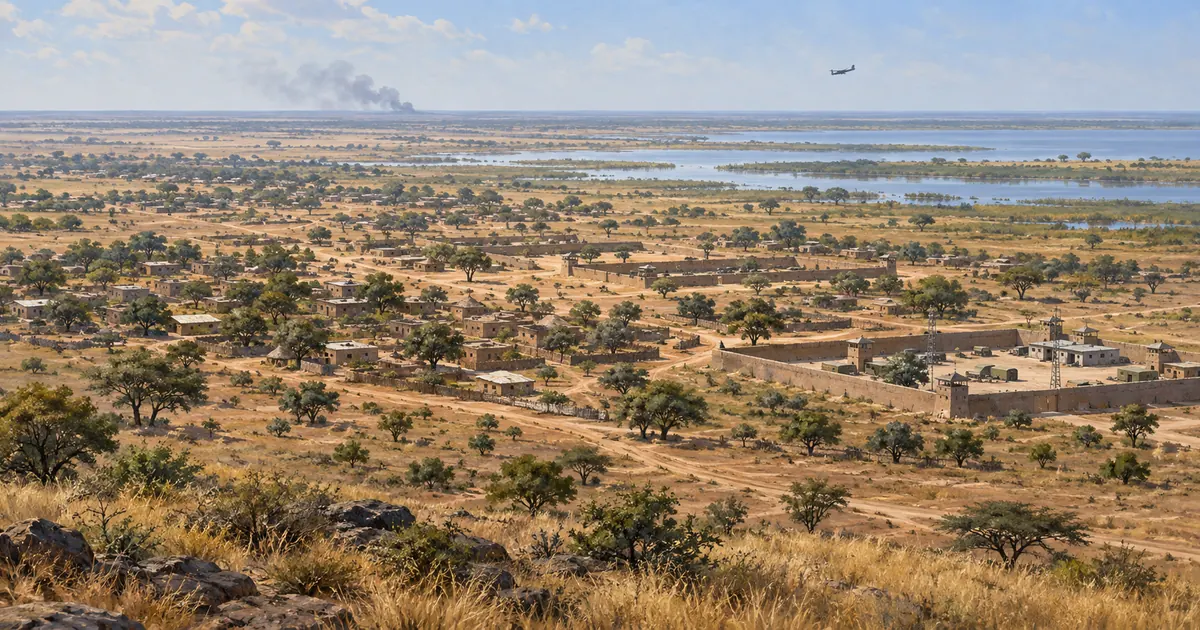
The Baga bases assault
Baga and Doron Baga, Kukawa Local Government Area, Borno State, Nigeria · 26 to 27 December 2018
Information as of October 2026
Battle index: Chad Basin campaign (2018–2020)
Learning objectives
- Explain the loss of both bases and assess the assumed task of preserving limited military functions through withdrawal.
- Distinguish documented drone operations from local simulation assumptions.
- Assess the relationship between observation, military decisions and civilian risk.
Run time and a good result
Default run clock: 4 minutes 0 seconds at 1×, excluding pauses, briefing and discussion. Time controls change elapsed play time.
Objective: Preserve at least one of two portable military coordination or supply functions through withdrawal. Both bases were overrun historically. A surviving function here does not mean an intact base or retained base control.
The Baga bases assault: Preserve at least one of two portable military coordination or supply functions through withdrawal. Both bases were overrun historically. A surviving function here does not mean an intact base or retained base control. Preserve at least 1 represented site functions until the attack ends. The authored limit is 240 simulation seconds across 2 stages. Compare objective progress, time, losses, drone expenditure and recorded civilian harm with a second run. A strong classroom result also explains the source evidence and reconstruction estimates; it does not verify a historical casualty count.
Timings
For 60 minutes, brief, complete one run and review the historical outcome. For 90 minutes, add a second run and compare decisions. For 180 minutes, pause at each dated phase and examine the source record and assumptions.
| Session | Plan |
|---|---|
| 45 minutes | Brief: 10 min; Run: 15 min; Collect: 5 min; Review: 15 min |
| 60 minutes | Before questions: 5 min; Brief: 10 min; Run: 20 min; Collect: 5 min; Debrief and after questions: 15 min; Discussion: 5 min |
| 90 minutes | Before questions: 5 min; Brief: 10 min; Run 1: with drones: 20 min; Run 2: without drones: 15 min; Collect: 5 min; Compare and discuss: 25 min; After questions: 10 min |
| 180 minutes | Before questions: 10 min; Brief and staff roles: 15 min; Run 1: with drones: 25 min; Run 2: without drones: 20 min; Break: 10 min; Run 3: syndicates: 30 min; Collect: 10 min; Seminar replay and debrief: 40 min; After questions: 10 min; Close: 10 min |
Staff roles
- commander
- Set the limited preservation task, review losses at each dated phase and keep the historical loss of both bases clear.
- intelligence
- Separate confirmed reports from estimates and mark civilian locations.
- fires
- Assess military targets and withhold fire when civilian presence is uncertain.
- droneOps
- Record observations, launches and losses, including the limits of assumed availability.
Decision points
- 26 December: can observation distinguish attacking vehicles from fleeing civilians?
- 27 December: which portable coordination or supply function can be preserved through withdrawal as the naval base falls?
- After the run: which parts of the result reflect decisions and which reflect assumed allocations?
Before and after questions
What does preserving one site function establish in the Baga model?
- Control of one intact military base
- Survival of all the garrison staff
- Recovery of all captured equipment
- Meeting a limited preservation goal
Answer D: The model protects one site function. Its briefing defines portable coordination or supply, not intact bases, retained control or a surviving personnel total.
How should the December 2018 Reuters death reports from Baga be interpreted?
- Reuters attributes differing death accounts to residents and the army spokesman without settling the total
- They verify ten civilian deaths locally
- They count all deaths as naval losses
- They establish the final garrison toll
Answer A: Reuters contrasted residents’ accounts with the army spokesman’s report. These attributed reports do not establish a verified civilian death total.
What is the evidence status of the Baga model’s CH-4 cards?
- Verified CH-4 model identification at Baga
- Role proxies with assumed local availability
- Verified local availability in both phases
- Exact historical launch totals for each phase
Answer B: The disclosed assumptions use CH-4 cards as proxies for the smaller Nigerian CH-3 role. Local availability is assumed; specific Baga sorties are not documented.
How should the 240-second Baga run be read against its dated episode?
- It times the complete campaign as four minutes
- It reconstructs actual sortie times for both days
- It compresses the dated 26–27 December episode
- It extends the episode through January recapture
Answer C: The simulation duration is 240 seconds and the briefing bounds the episode to 26–27 December 2018. Run time is compressed model time, not an observed combat duration.
Which use of the Reuters Baga account preserves the civilian-harm scope?
- Add the 2015 massacre toll to the 2018 episode
- Treat the insurgency toll as local civilian deaths
- Treat December reports as a final civilian toll
- Keep earlier massacre deaths outside this episode
Answer D: Reuters discusses the 2015 massacre as background to the December 2018 attack. Earlier deaths cannot supply a civilian toll for this separate episode.
Discussion
- How does preserving a portable military function differ from keeping a base intact or retaining control of it?
- What evidence would be needed to replace each estimated formation and drone allocation?
- How does civilian displacement change what a commander can reliably observe?
- What evidence would be needed to establish surviving staff or stores totals, rather than an assumed preservation task?
Debrief rubric
- Strong
- Meets the objective or explains why it was not met; uses the published sources and run evidence, separates known facts from assumptions, compares both sides’ losses and cost exchange, and evaluates precautions against civilian harm.
- Adequate
- Describes the objective and main decisions, identifies at least one source and model limitation, reports losses and harm, and gives a reasoned change for a second run.
- Weak
- Reports only victory or points, treats teaching settings as real performance, gives unsupported historical claims, or omits uncertainty and civilian harm.
Facilitator notes
Assess historical source analysis through the cited readings, answers and discussion. Run metrics describe the simulated run; they do not verify historical claims or demonstrate that a source-analysis objective has been met.
Published readings
- Robert Postings, The Defense Post, Systemic issues hamper the fight, 25 January 2019
- Reuters via Business Recorder, Militants kill at least 10, 28 December 2018
- Punch, NAF deploys six jets, 30 December 2018
Complete source list
- Wikipedia, Chad Basin campaign, accessed 6 October 2026
- Robert Postings, The Defense Post, Systemic issues hamper the fight, 25 January 2019
- Reuters via Business Recorder, Militants kill at least 10, 28 December 2018
- Punch, NAF deploys six jets, 30 December 2018
- Thomas Joscelyn, Long War Journal, Islamic State arm reportedly seizes Nigerian town, 29 December 2018
- AFP via VOA, Boko Haram envahit deux bases militaires, 27 December 2018
- Channels Television, Air Force Seeks Cordial Civil Military Relations, 12 February 2016