
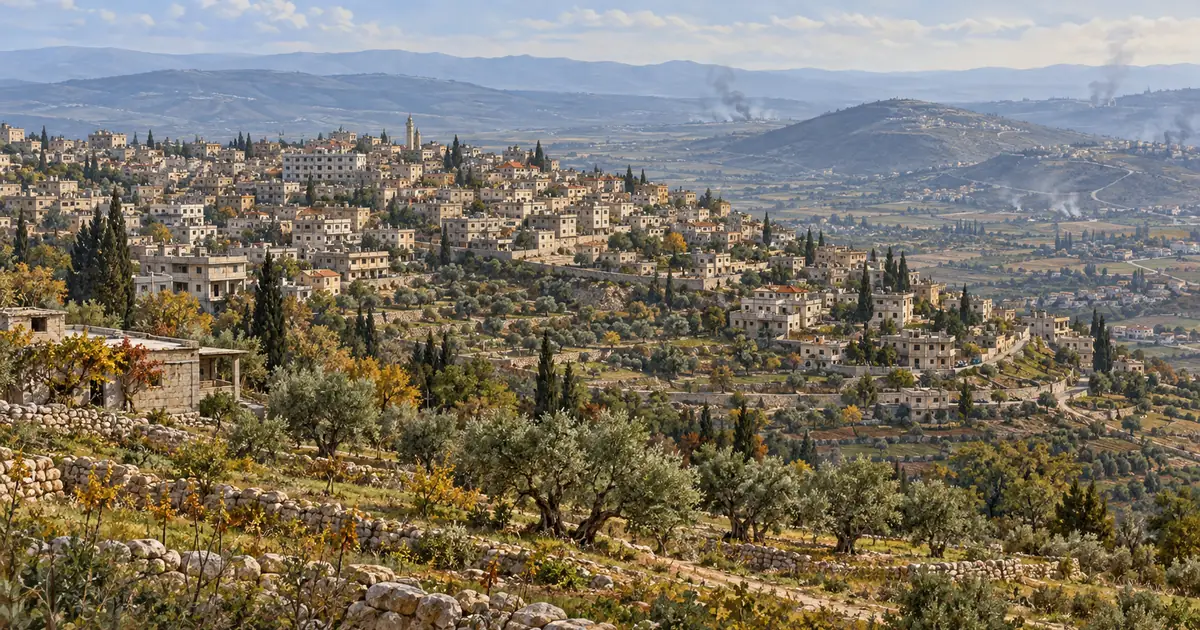
The Renewed Battle for Khiam
Khiam and Marjayoun district, southern Lebanon · 18 to 26 November 2024
Information as of October 2026
Battle pages: Israel–Hezbollah conflict (2023–2024), Israeli invasion of Lebanon (2024–present)
Learning objectives
- Distinguish local force estimates from documented formations.
- Explain how reconnaissance connects ground forces and supporting artillery.
- Evaluate a limited military objective while accounting for civilians.
Run time and a good result
Default run clock: 6 minutes 0 seconds at 1×, excluding pauses, briefing and discussion. Time controls change elapsed play time.
Objective: Disrupt at least four Hezbollah fighting or support groups during the renewed advance. This is a limited military damage goal, not a claim of complete town capture.
The Renewed Battle for Khiam: Disrupt at least four Hezbollah fighting or support groups during the renewed advance. This is a limited military damage goal, not a claim of complete town capture. Put at least 4 represented opposing units out of action; decoys do not count. The authored limit is 360 simulation seconds across 3 stages. Compare objective progress, time, losses, drone expenditure and recorded civilian harm with a second run. A strong classroom result also explains the source evidence and reconstruction estimates; it does not verify a historical casualty count.
Timings
60 minutes: brief 15, run 20, review 25. 90 minutes: add a second run and compare observation coverage. 180 minutes: research the reported outcomes, compare assumptions and present a civilian impact review.
| Session | Plan |
|---|---|
| 45 minutes | Brief: 10 min; Run: 15 min; Collect: 5 min; Review: 15 min |
| 60 minutes | Before questions: 5 min; Brief: 10 min; Run: 20 min; Collect: 5 min; Debrief and after questions: 15 min; Discussion: 5 min |
| 90 minutes | Before questions: 5 min; Brief: 10 min; Run 1: with drones: 20 min; Run 2: without drones: 15 min; Collect: 5 min; Compare and discuss: 25 min; After questions: 10 min |
| 180 minutes | Before questions: 10 min; Brief and staff roles: 15 min; Run 1: with drones: 25 min; Run 2: without drones: 20 min; Break: 10 min; Run 3: syndicates: 30 min; Collect: 10 min; Seminar replay and debrief: 40 min; After questions: 10 min; Close: 10 min |
Staff roles
- commander
- Set the limited military goal and review civilian risk.
- intelligence
- Separate observations from claims and simulation estimates.
- fires
- Connect observed military targets to supporting batteries.
- droneOps
- Maintain observation and report confidence in target identification.
Decision points
- 18 November: where should the first reconnaissance mission observe?
- 20 November: should observation cover the town approaches or supporting fire?
- 26 November: what evidence would justify ending the operation?
Before and after questions
What does the Khiam model’s four-group objective establish?
- Complete control over all of Khiam
- Limited disruption of military groups
- Four verified civilian casualties locally
- Demolition of four residential buildings
Answer B: The simulation sets a threshold of four represented opposing groups. The disclosed threshold measures limited military disruption and does not certify town capture or a casualty count.
How should Shehadeh’s control claim in The National’s Khiam report be used?
- As independent proof of permanent control
- As the model’s verified four-group loss count
- As an attributed assessment at that date
- As confirmation of the town’s later capture
Answer C: The National interviewed Shehadeh, who said Khiam had not fallen. His dated assessment remains attributed; it does not verify a permanent control outcome.
What can the Hermes 900 card establish about Khiam sorties in this model?
- A verified local Hermes 900 sortie count
- Confirmed armed missions over Khiam
- Exact Israeli airframes identified by phase
- A reconnaissance role without local counts
Answer D: The briefing discloses a reconnaissance stand-in, omits armed missions and establishes no local airframe or sortie count. The card is a model role.
What do later Hezbollah counters mean in the Khiam model’s dated phases?
- Previously unrepresented support functions appearing in later contacts while preserving the fixed local allocation
- New reinforcements confirmed at that time
- Extra people added to the fixed allocation
- Eight complete companies entering the town
Answer A: The disclosed fixed local force appears through successive contacts. Later counters represent previously unrepresented support functions and preserve the total allocation.
What scope fits Reuters’ October 2024 interview with Imran Riza?
- An exact death count for the November map
- Campaign context for displacement and damage
- A verified local count of military functions
- A final census of all intact Khiam buildings
Answer B: Riza described displacement and civilian infrastructure damage in Lebanon. The October interview is campaign context, not a November Khiam casualty census.
Discussion
- Does disabling a firing group establish control of a town?
- How should disputed claims change the confidence attached to a briefing?
- What changes when counters represent small detachments instead of battalions?
- How do evacuation and destruction affect civilians who remain or return?
Debrief rubric
- Strong
- Meets the objective or explains why it was not met; uses the published sources and run evidence, separates known facts from assumptions, compares both sides’ losses and cost exchange, and evaluates precautions against civilian harm.
- Adequate
- Describes the objective and main decisions, identifies at least one source and model limitation, reports losses and harm, and gives a reasoned change for a second run.
- Weak
- Reports only victory or points, treats teaching settings as real performance, gives unsupported historical claims, or omits uncertainty and civilian harm.
Facilitator notes
Assess historical source analysis through the cited readings, answers and discussion. Run metrics describe the simulated run; they do not verify historical claims or demonstrate that a source-analysis objective has been met.
Published readings
- The National: Battle for Khiam (25 November 2024, updated 26 November)
- CTP and ISW: Iran Update (19 November 2024)
- CTP and ISW: Iran Update (20 November 2024)
Complete source list
- Wikipedia: 2024 Lebanon war (accessed 6 October 2026)
- The National: Battle for Khiam (25 November 2024, updated 26 November)
- CTP and ISW: Iran Update (19 November 2024)
- CTP and ISW: Iran Update (20 November 2024)
- AP: Hezbollah shoots down an Israeli drone in Lebanon (1 June 2024)
- Reuters: Civilians bear brunt of Lebanon conflict, UN official says (3 October 2024)
- Amnesty International: Hezbollah use of inaccurate weapons (20 December 2024)