
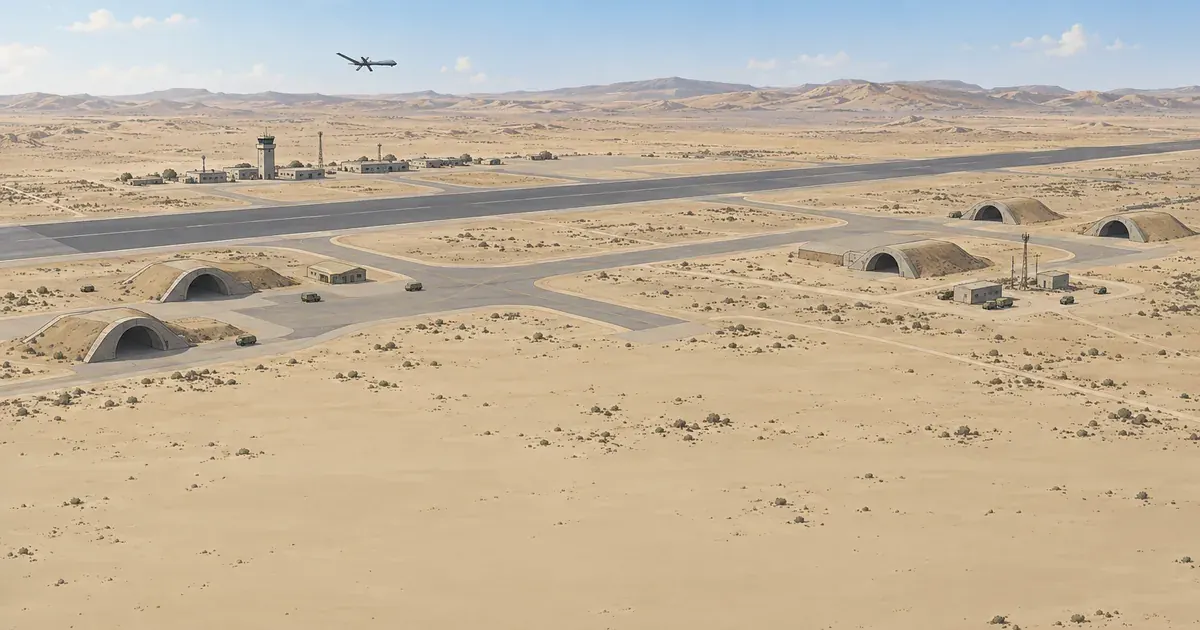
The Drone Duel at al Watiya
Al Watiya Air Base, Jafara plain, north west Libya · May 2020
Read the battle page: Battle of Al-Watiya Airbase
Learning objectives
- Compare the UN Panel’s account of Turkey-supplied TB2s with BBC’s investigated UAE-operated Wing Loong II case. Distinguish these attributed findings from the run’s authored reach and roster; they do not establish that both sides could strike any rear-area site.
- Assess the UN Panel’s reported Pantsir losses and the exposure it describes for retreating forces. Compare that assessment with the authored counter losses, without treating one run as proof of the Panel’s causal explanation.
- Evaluate how investigators attributed drone strikes to a drone type and an operator, and why that matters for accountability.
Run time and a good result
Default run clock: 2 minutes 50 seconds at 1×, excluding pauses, briefing and discussion. Time controls change elapsed play time.
Objective: Capture Al Watiya Air Base, using your drones to destroy its air defence and cut its supply convoys on the road to Badr and Tiji before your ground forces go in.
The Drone Duel at al Watiya: Capture Al Watiya Air Base, using your drones to destroy its air defence and cut its supply convoys on the road to Badr and Tiji before your ground forces go in. Occupy the marked zone with at least one combat unit and no opposing combat unit for 8 continuous simulation seconds. The authored limit is 170 simulation seconds across 1 stage. Compare objective progress, time, losses, drone expenditure and recorded civilian harm with a second run. A strong classroom result also explains the source evidence and reconstruction estimates; it does not verify a historical casualty count.
Timings
For 60 minutes run the briefing, one run and a short debrief; for 90 minutes add a second run with a different target order and two discussion questions; for 180 minutes add the three pause points, all four questions and a close reading of the UN Panel and BBC findings.
| Session | Plan |
|---|---|
| 45 minutes | Brief: 10 min; Run: 15 min; Collect: 5 min; Review: 15 min |
| 60 minutes | Before questions: 5 min; Brief: 10 min; Run: 20 min; Collect: 5 min; Debrief and after questions: 15 min; Discussion: 5 min |
| 90 minutes | Before questions: 5 min; Brief: 10 min; Run 1: with drones: 20 min; Run 2: without drones: 15 min; Collect: 5 min; Compare and discuss: 25 min; After questions: 10 min |
| 180 minutes | Before questions: 10 min; Brief and staff roles: 15 min; Run 1: with drones: 25 min; Run 2: without drones: 20 min; Break: 10 min; Run 3: syndicates: 30 min; Collect: 10 min; Seminar replay and debrief: 40 min; After questions: 10 min; Close: 10 min |
Staff roles
- commander
- Set the pre-run posture and available standing orders, allocate drone flights between the base and authored supply approach, and report progress toward the take zone. Individual ground-assault and withdrawal orders are unavailable.
- intelligence
- Track which Pantsir sites have fired and been seen, and report any air defence that has not yet shown itself.
- fires
- Observe artillery engagements, ammunition and reach against visible contacts, and recommend the available artillery standing order. The run assigns individual gun targets automatically.
- droneOps
- Report each TB2 and Kargu-2 launch and loss, each TB2 return, and any observed enemy Wing Loong flight. Kargu-2 is a single-use loitering munition in this model.
Opposing staff objective
Hold Al Watiya Air Base until time runs out. Keep its Pantsir air defence working and the supply road south west toward Badr and Tiji open.
Decision points
- Before launch: which LNA asset do your TB2s hunt first, and why?
- After your first drone losses: keep pressing the air defence, or switch to the supply convoys?
- Before the modeled ground units approach the base, compare observed air-defence activity and drone losses. Which TB2 launches and standing orders do you choose, and what ground movement occurs automatically?
Before and after questions
Pantsirs could easily shoot down TB2s, yet by spring 2020 they suffered heavy losses. What does that show?
- Early drone success predicts later defensive performance
- Jamming alone explains the changing equipment losses
- Interceptions in late 2019 preceded significant Pantsir losses in the 2020 offensive
- Published weapon specifications explain the changing balance
Answer C: The UN Panel describes interceptions in late 2019 and significant Pantsir losses in the 2020 offensive (S/2021/229, paragraphs 60 and 64). A result in one phase is not a universal performance guarantee.
Why were LNA supply convoys so exposed in spring 2020, according to the UN Panel of Experts?
- Escort arrangements had become the main weakness
- Loss of road access prevented convoy dispersal
- Daylight scheduling exposed otherwise protected convoys
- Loss of Pantsir cover exposed moving convoys
Answer D: The Panel links reduced Pantsir protection to exposure of logistics and retreating units (S/2021/229, paragraphs 63–64).
How did Human Rights Watch link the biscuit factory strike near Tripoli to the UAE?
- It attributed the weapon to its reported operator
- It treated the nationality of manufacture as sufficient proof
- It accepted a claimant's description without examining weapon evidence
- It treated recovery location as proof of operator identity
Answer A: Human Rights Watch found Blue Arrow-7 missile remnants, identified a Wing Loong-II launch platform, and linked the reported operator to the UAE. Its investigation recorded eight civilians killed and 27 wounded. The UAE had not answered HRW’s questions when the report was published.
What capability did the UN Panel report for Kargu munitions, without establishing that they autonomously killed people?
- Attack using coordinates supplied continuously by an operator
- Attack without a continuing operator data link
- Identify hostile radars through continuous external sensor updates
- Select targets only after continuous remote operator confirmation
Answer B: The Panel describes weapons programmed to attack without continuing operator connectivity (paragraph 63). It does not establish an independently verified autonomous killing; capability and proven employment must be distinguished.
Which reach did BBC’s academy-strike investigation document in January 2020?
- Strike a site within the defended Libyan capital
- Hold captured positions after the ground force withdrew
- Replace ground resupply with repeated airborne supply missions
- Maintain accurate contact information without repeated observation flights
Answer A: BBC linked the academy strike in Tripoli to a UAE-operated Wing Loong II. The UN Panel describes GNA control of Tripoli’s urban area. This is a bounded investigated case, not proof that both sides could attack any site or that every operator has been identified.
Discussion
- The cited UN Panel and BBC investigation describe external drone support in specific cases. What does reliance on outside suppliers or operators mean for the claims a staff can substantiate and for accountability?
- The UN Panel says Pantsirs suffered heavy losses even when their crews tried to avoid jamming. What does that suggest about relying on one type of air defence?
- HRW describes a scene visit, employee interviews, weapon remnants and imagery; BBC’s academy investigation compares fragments, platform compatibility, basing and registry evidence. Where does each chain support aircraft-type identification or operator attribution, and what uncertainty remains?
- The UN Panel describes Kargu-2 systems programmed to attack without a continuing operator data connection. Which control and accountability questions follow? This reported capability does not independently establish who selected a particular target or whether anyone was killed autonomously.
Debrief rubric
- Strong
- Meets the objective or explains why it was not met; uses the published sources and run evidence, separates known facts from assumptions, compares both sides’ losses and cost exchange, and evaluates precautions against civilian harm.
- Adequate
- Describes the objective and main decisions, identifies at least one source and model limitation, reports losses and harm, and gives a reasoned change for a second run.
- Weak
- Reports only victory or points, treats teaching settings as real performance, gives unsupported historical claims, or omits uncertainty and civilian harm.
Published readings
- Al Jazeera: Libya’s GNA recaptures strategic al Watiya airbase (18 May 2020)
- Oryx: Disaster at Tarhuna, when Haftar lost another stronghold to the GNA (TB2s, Pantsir losses, al Watiya)
- Middle East Eye: Libya’s GNA retakes major coastline cities (13 April 2020)
Complete source list
- Al Jazeera: Libya’s GNA recaptures strategic al Watiya airbase (18 May 2020)
- Oryx: Disaster at Tarhuna, when Haftar lost another stronghold to the GNA (TB2s, Pantsir losses, al Watiya)
- Middle East Eye: Libya’s GNA retakes major coastline cities (13 April 2020)
- Bulletin of the Atomic Scientists: Was a flying killer robot used in Libya? (on the UN Panel of Experts report)
- ICRC Casebook: Libya, the use of lethal autonomous weapon systems (quotes UN Panel of Experts report S/2021/229)
- Middle East Eye: UAE involved in drone strike that killed 26 Libyan cadets (reporting the BBC Africa Eye investigation)
- Al Jazeera: UAE drone strike on factory near Tripoli killed 8 civilians, says HRW
- Nordic Monitor: UN experts found Turkish Bayraktar drones in Libya were easily destroyed
- Al Jazeera: Timeline, Haftar’s months long offensive to seize Tripoli (19 February 2020)
- Wikipedia: Al-Watiya Air Base
- Wikipedia: Battle of Al-Watiya Airbase
- Arab Center Washington DC: Libya after the Fall of Al-Watiya
- Libya Observer: Libya's GNA forces seize control of Badr and Tiji towns south of Al-Watiya airbase
- UN Panel of Experts on Libya: Final report S/2021/229 (2021, PDF)
- Human Rights Watch: Libya, UAE strike kills eight civilians
- BBC, reproduced by MyJoy: UAE implicated in lethal drone strike in Libya (28 August 2020)
- UN Panel of Experts on Libya: Final report S/2019/914 (2019, PDF, via ecoi.net)
- Al Jazeera: Erdogan, Turkish soldiers gradually being deployed to Libya (6 January 2020)
- Al Jazeera: Libya’s GNA retakes Tripoli airport from Haftar’s forces (3 June 2020)
- Reuters, republished by Arab News: Libya’s Tripoli government seizes last LNA stronghold near capital (5 June 2020)
- Libya Observer: Libyan Air Force destroys seven Russian-made Pantsir-S1 systems in 48 hours (20 May 2020; reports a GNA claim)