
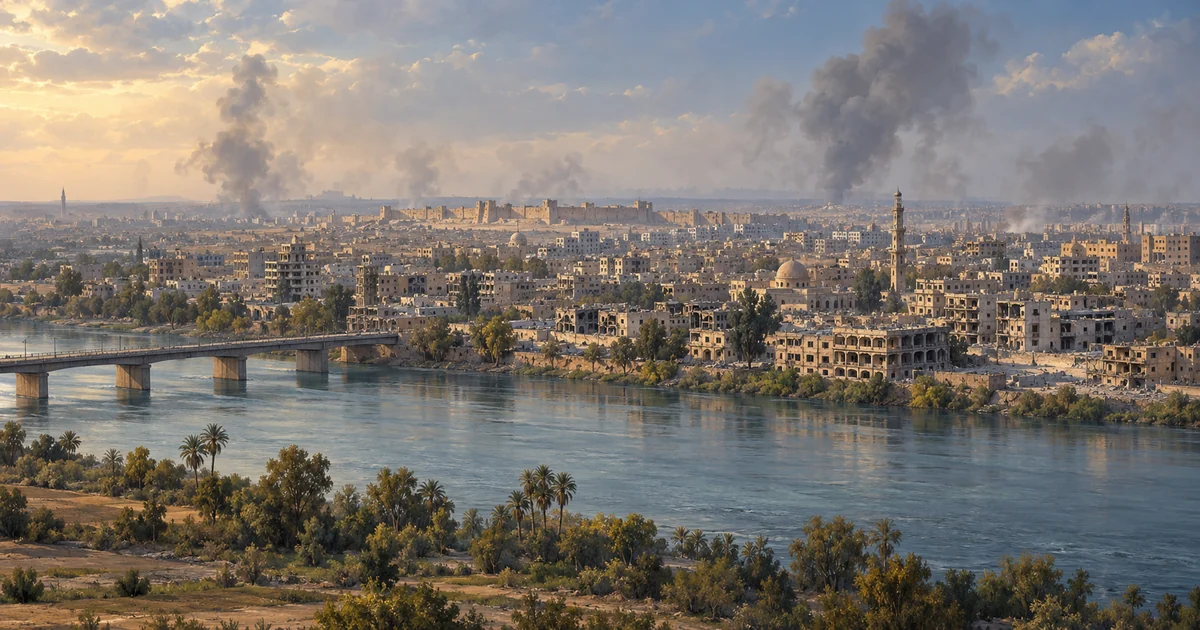
Raqqa: The City Offensive
Raqqa, Syria · 6 June to 17 October 2017
Historical episode, sources reviewed October 2026
Battle pages: Battle of Raqqa (2017), Raqqa campaign (2016–2017)
Learning objectives
- Locate Raqqa between its river and northern approaches.
- Follow four dated stages of the city offensive.
- Distinguish coalition strike drones from small local observation and bombing drones.
Run time and a good result
Default run clock: 7 minutes 0 seconds at 1×, excluding pauses, briefing and discussion. Time controls change elapsed play time.
Objective: Take the marked stadium sector before the episode ends. The SDF captured Raqqa in October.
Raqqa: The City Offensive: Take the marked stadium sector before the episode ends. The SDF captured Raqqa in October. Occupy the marked zone with at least one combat unit and no opposing combat unit for 8 continuous simulation seconds. The authored limit is 420 simulation seconds across 4 stages. Compare objective progress, time, losses, drone expenditure and recorded civilian harm with a second run. A strong classroom result also explains the source evidence and reconstruction estimates; it does not verify a historical casualty count.
Timings
For 60 minutes, brief for 15, run with pauses for 25 and discuss for 20. For 90 minutes, compare the phases. For 180 minutes, compare Raqqa and Mosul.
| Session | Plan |
|---|---|
| 45 minutes | Brief: 10 min; Run: 15 min; Collect: 5 min; Review: 15 min |
| 60 minutes | Before questions: 5 min; Brief: 10 min; Run: 20 min; Collect: 5 min; Debrief and after questions: 15 min; Discussion: 5 min |
| 90 minutes | Before questions: 5 min; Brief: 10 min; Run 1: with drones: 20 min; Run 2: without drones: 15 min; Collect: 5 min; Compare and discuss: 25 min; After questions: 10 min |
| 180 minutes | Before questions: 10 min; Brief and staff roles: 15 min; Run 1: with drones: 25 min; Run 2: without drones: 20 min; Break: 10 min; Run 3: syndicates: 30 min; Collect: 10 min; Seminar replay and debrief: 40 min; After questions: 10 min; Close: 10 min |
Staff roles
- commander
- Track the central sector objective.
- intelligence
- Compare dated reports and the map.
- fires
- Record simulated effects and civilian exposure.
- droneOps
- Compare observation and armed roles.
Decision points
- Opening: which approaches are represented?
- Middle: how does the dated phase change the area held?
- Final: what remains after the military objective is reached?
Before and after questions
Which approach describes Amnesty and Airwars’ Raqqa investigation?
- Derive each death total from destroyed building counts.
- Use coalition acknowledgements as the entire death total.
- Cross-check fieldwork with imagery and other evidence, rather than counting repeated posts as independent corroboration
- Treat shared social posts as separate witness accounts.
Answer C: The investigators cross-checked fieldwork with imagery and other evidence. Repeated posts are not automatically independent corroboration.
What does the briefing’s 1600 field represent for Raqqa civilian deaths?
- Exactly 1600 civilian deaths verified by onsite interviews.
- Over 1600 military deaths attributed to coalition strikes.
- Exactly 1600 civilian deaths acknowledged by the coalition.
- Over 1600 civilian deaths attributed to coalition strikes.
Answer D: The investigation reports more than 1,600 deaths. The lesson presents 1,600 as a lower bound, not an exact total. The cited account does not quantify injuries.
What does a successful stadium capture establish in the Raqqa model?
- The selected stadium sector has met the capture rule.
- City services have recovered across all Raqqa districts.
- All civilian residents can safely return to their homes.
- Every damaged building has become suitable for housing.
Answer A: The take objective concerns one marked sector within 420 seconds. The model’s capture condition does not assess housing, public services or safe return.
What does removal of a Raqqa formation counter mean according to the accuracy notes?
- A verified number of personnel killed in that formation.
- Loss of represented combat function, not a death count.
- A verified number of residents displaced from its sector.
- The complete destruction of every vehicle in its sector.
Answer B: The briefing defines removal as loss of combat function. Its company and battery counters are selected abstractions and cannot be converted into personnel or civilian totals.
Which distinction is central to RAND’s Raqqa assessment?
- Military success establishes that services have recovered.
- Damage to buildings provides the full civilian death toll.
- Military success can coexist with severe civilian harm.
- Coalition casualty admissions resolve disputed death reports.
Answer C: RAND describes the city’s capture alongside severe structural damage and civilian harm. A military result cannot establish that civilian life has recovered.
Discussion
- How does the city capture differ from rebuilding civilian life?
- Why can aerial observation leave important facts uncertain?
- Why must estimates of civilian harm retain their source and scope?
Debrief rubric
- Strong
- Meets the objective or explains why it was not met; uses the published sources and run evidence, separates known facts from assumptions, compares both sides’ losses and cost exchange, and evaluates precautions against civilian harm.
- Adequate
- Describes the objective and main decisions, identifies at least one source and model limitation, reports losses and harm, and gives a reasoned change for a second run.
- Weak
- Reports only victory or points, treats teaching settings as real performance, gives unsupported historical claims, or omits uncertainty and civilian harm.
Facilitator notes
Assess historical source analysis through the cited readings, answers and discussion. Run metrics describe the simulated run; they do not verify historical claims or demonstrate that a source-analysis objective has been met.
Published readings
- UK Ministry of Defence: RAF air strikes in Iraq and Syria, July 2017
- Amnesty International and Airwars: Joint Raqqa investigation, 25 April 2019
- Reuters via VOA: US Backed Syrian Militias Push Into IS Held Raqqa, 10 June 2017
Complete source list
- Wikipedia: Battle of Raqqa 2017, accessed 5 October 2026
- UK Ministry of Defence: RAF air strikes in Iraq and Syria, July 2017
- Amnesty International and Airwars: Joint Raqqa investigation, 25 April 2019
- Reuters via VOA: US Backed Syrian Militias Push Into IS Held Raqqa, 10 June 2017
- Airwars: Raqqa, a city destroyed then forgotten, 12 March 2018
- Reuters via Egypt Independent: Islamic State defeated in its Syrian capital Raqqa, 17 October 2017
- RAND, Michael J. McNerney and colleagues: Understanding Civilian Harm in Raqqa and Its Implications for Future Conflicts, 31 March 2022
- Reuters, Zohra Bensemra: Battle for Raqqa, photo 13, 21 August 2017