
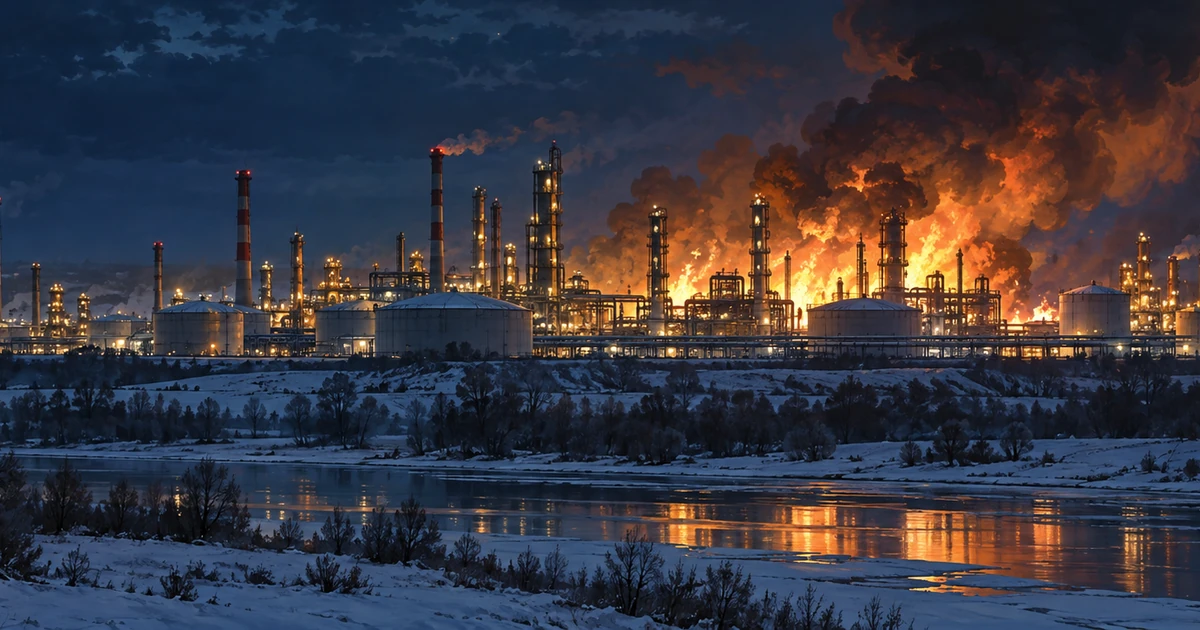
Ryazan: The January Refinery Strike
Southern Ryazan, Ryazan Oblast, Russia · Night of 23 to 24 January 2025
Information as of October 2026
A separate battle article is awaiting source review. Use this lesson's published readings and complete source list.
Learning objectives
- Locate the refinery in southern Ryazan.
- Compare preserve and damage goals.
- Distinguish confirmed effects from attributed claims.
Run time and a good result
Default run clock: 3 minutes 0 seconds at 1×, excluding pauses, briefing and discussion. Time controls change elapsed play time.
Objective: Keep at least two of the three marked refinery sector counters working until the episode ends. The refinery was damaged historically; this is a limited preserve mission.
Ryazan: The January Refinery Strike: Keep at least two of the three marked refinery sector counters working until the episode ends. The refinery was damaged historically; this is a limited preserve mission. Preserve at least 2 represented site functions until the attack ends. The authored limit is 180 simulation seconds across 1 stage. Compare objective progress, time, losses, drone expenditure and recorded civilian harm with a second run. A strong classroom result also explains the source evidence and reconstruction estimates; it does not verify a historical casualty count.
Timings
For 60 minutes, brief for 15, compare both perspectives for 25 and discuss for 20. For 90 minutes, compare repeat runs. For 180 minutes, compare other historical industrial strikes.
| Session | Plan |
|---|---|
| 45 minutes | Brief: 10 min; Run: 15 min; Collect: 5 min; Review: 15 min |
| 60 minutes | Before questions: 5 min; Brief: 10 min; Run: 20 min; Collect: 5 min; Debrief and after questions: 15 min; Discussion: 5 min |
| 90 minutes | Before questions: 5 min; Brief: 10 min; Run 1: with drones: 20 min; Run 2: without drones: 15 min; Collect: 5 min; Compare and discuss: 25 min; After questions: 10 min |
| 180 minutes | Before questions: 10 min; Brief and staff roles: 15 min; Run 1: with drones: 25 min; Run 2: without drones: 20 min; Break: 10 min; Run 3: syndicates: 30 min; Collect: 10 min; Seminar replay and debrief: 40 min; After questions: 10 min; Close: 10 min |
Staff roles
- commander
- Track the limited preserve goal.
- intelligence
- Compare attributed reports.
- fires
- Record simulated effects and civilian context.
- droneOps
- Compare the reported drone role with its proxy.
Opposing staff objective
Disable at least two of the three marked refinery sector counters. This represents documented industrial damage, not the destruction of the whole city.
Decision points
- Opening: where are the industrial area and nearby settlements?
- During the run: how many aggregate site functions remain?
- After the run: what does the historical reporting establish?
Before and after questions
What interpretation fits Reuters’ 27 January report on Ryazan’s shutdown?
- Fire reports establish permanent closure of the refinery.
- The halt establishes destruction of every plant function.
- The halt establishes loss of fuel supply across all Russia.
- Industry sources described equipment damage that stopped processing or dispatch without establishing permanent refinery closure
Answer D: Reuters’ industry sources reported damaged equipment and stopped processing or dispatch. An interruption does not establish permanent closure or destruction of every function.
What must remain for Russia’s stated Ryazan preserve goal to be met?
- Two aggregate site functions remain at the episode end.
- Two individual storage tanks remain at the episode end.
- Two intercepted drones are recorded at the episode end.
- Two days of normal output follow the modelled episode.
Answer A: The protect objective requires two site counters to survive. Three aggregate counters stand for industrial functions, not a tank inventory; the episode lasts 180 seconds.
How should Liutyi and fourteen opportunities be interpreted in Ryazan?
- An identified aircraft model and verified local drone total.
- An assumed proxy and abstract regional flight opportunities.
- A photographed local fleet and verified number of impacts.
- An identified aircraft model and count of national losses.
Answer B: The accuracy notes call Liutyi a proxy for unspecified drones and fourteen opportunities a compressed regional representation. They do not verify local airframes, impacts or losses.
How should the absent Ryazan civilian casualty figures be interpreted?
- The selected record confirms that no civilians were harmed.
- Casualties elsewhere provide this episode’s missing total.
- The selected record establishes no separate casualty total.
- Damaged site counters provide this episode’s injury total.
Answer C: Both civilian casualty fields are null and explicitly limited to the refinery episode. This is missing evidence, not proof of no harm or permission to import another incident’s toll.
How should the claim about Ryazan’s civilian and military fuel role be presented?
- A plant-wide finding independently established by imagery.
- A supply finding established by the model’s site counters.
- A refinery supply finding attributed to Russia’s ministry.
- Kovalenko’s account as attributed by Ukrainska Pravda.
Answer D: Ukrainska Pravda attributes the dual supply role to Kovalenko. Keep that attribution visible; model counters and interception claims do not independently verify it.
Discussion
- What is the difference between damage and total destruction?
- Why does an industrial site have military and civilian significance?
- Which details remain assumptions in this representation?
Debrief rubric
- Strong
- Meets the objective or explains why it was not met; uses the published sources and run evidence, separates known facts from assumptions, compares both sides’ losses and cost exchange, and evaluates precautions against civilian harm.
- Adequate
- Describes the objective and main decisions, identifies at least one source and model limitation, reports losses and harm, and gives a reasoned change for a second run.
- Weak
- Reports only victory or points, treats teaching settings as real performance, gives unsupported historical claims, or omits uncertainty and civilian harm.
Facilitator notes
Assess historical source analysis through the cited readings, answers and discussion. Run metrics describe the simulated run; they do not verify historical claims or demonstrate that a source-analysis objective has been met.
Published readings
- Reuters: Ukrainian drones hit big Russian oil refinery at Ryazan, 24 January 2025
- Ukrainska Pravda, Iryna Balachuk: Drones hit oil refinery in Ryazan and military plant in Bryansk, 24 January 2025
- Ukrainska Pravda, Valentyna Romanenko: Ukrainian UAVs hit one of Russia largest oil refineries, 24 January 2025
Complete source list
- Wikipedia: Ryazan refinery, war history section, accessed 5 October 2026
- Reuters: Ukrainian drones hit big Russian oil refinery at Ryazan, 24 January 2025
- Ukrainska Pravda, Iryna Balachuk: Drones hit oil refinery in Ryazan and military plant in Bryansk, 24 January 2025
- Ukrainska Pravda, Valentyna Romanenko: Ukrainian UAVs hit one of Russia largest oil refineries, 24 January 2025
- Kyiv Independent, Martin Fornusek: Massive drone strike targets Russian refinery and plants, 24 January 2025
- Reuters via Global Banking and Finance Review: Ryazan refinery halts operations after drone strikes, 27 January 2025