
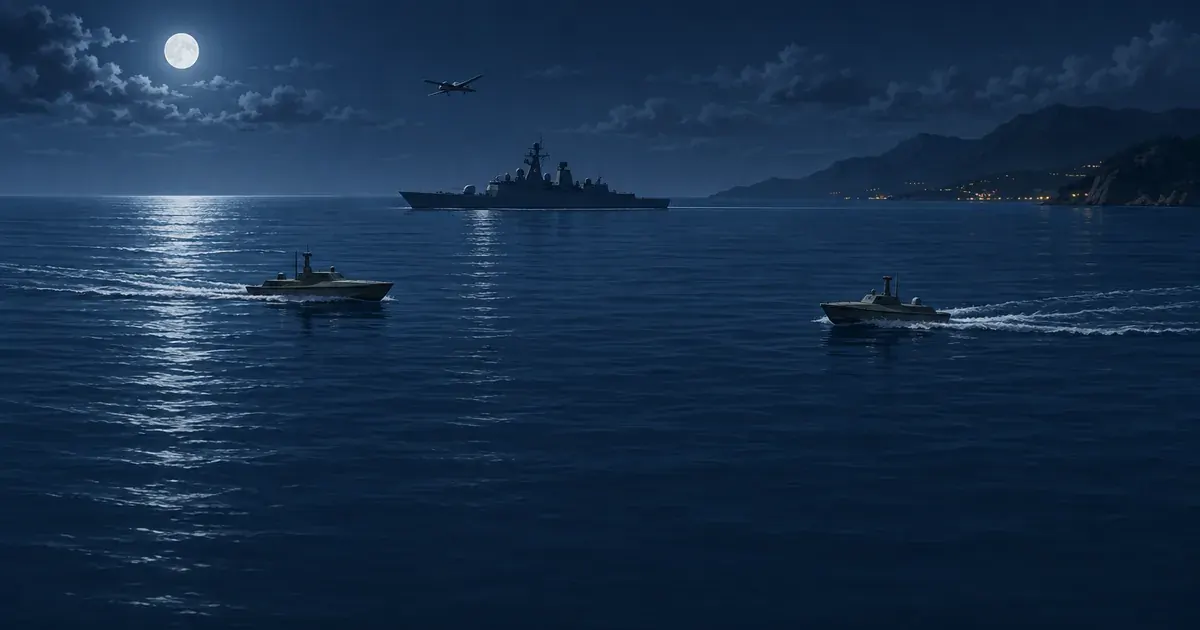
Sevastopol: Drones at Sea
Sevastopol, Russian occupied Crimea, Ukraine · 29 October 2022
Information as of October 2026
Battle pages: 2022 drone attack on the Sevastopol Naval Base, Crimea attacks (2022–present)
Learning objectives
- Locate the separate harbour inlets and distinguish sea from aerial drones.
- Compare the damage Russia acknowledged with later Ukrainian claims.
- Distinguish a limited damage objective from sinking a vessel.
Run time and a good result
Default run clock: 3 minutes 0 seconds at 1×, excluding pauses, briefing and discussion. Time controls change elapsed play time.
Objective: Keep both represented warships in action until time expires. You command the air defence response.
Sevastopol: Drones at Sea: Keep both represented warships in action until time expires. You command the air defence response. Preserve at least 2 represented warships until the attack ends. The authored limit is 180 simulation seconds across 1 stage. Compare objective progress, time, losses, drone expenditure and recorded civilian harm with a second run. A strong classroom result also explains the source evidence and reconstruction estimates; it does not verify a historical casualty count.
Timings
For 60 minutes, brief for 15, run with pauses for 25 and review for 20. For 90 minutes, repeat from the other side. For 180 minutes, compare the reporting and physical map.
| Session | Plan |
|---|---|
| 45 minutes | Brief: 10 min; Run: 15 min; Collect: 5 min; Review: 15 min |
| 60 minutes | Before questions: 5 min; Brief: 10 min; Run: 20 min; Collect: 5 min; Debrief and after questions: 15 min; Discussion: 5 min |
| 90 minutes | Before questions: 5 min; Brief: 10 min; Run 1: with drones: 20 min; Run 2: without drones: 15 min; Collect: 5 min; Compare and discuss: 25 min; After questions: 10 min |
| 180 minutes | Before questions: 10 min; Brief and staff roles: 15 min; Run 1: with drones: 25 min; Run 2: without drones: 20 min; Break: 10 min; Run 3: syndicates: 30 min; Collect: 10 min; Seminar replay and debrief: 40 min; After questions: 10 min; Close: 10 min |
Staff roles
- commander
- Track the limited objective.
- intelligence
- Distinguish observed footage from official claims.
- fires
- Record simulated effects and civilian exposure.
- droneOps
- Separate sea and aerial flights in the record.
Opposing staff objective
Put one represented warship out of action for the engagement. This is a limited damage objective, not a claim that a ship sank.
Decision points
- Opening: which reported drone counts are attributed to Russia?
- During the run: what does a counter going out of action represent?
- Review: which parts of the historical outcome remain disputed?
Before and after questions
How should the reported seven sea drones and nine aerial drones be described?
- As Russian Ministry of Defence counts reported by The War Zone.
- As independently verified totals established from every attack video.
- As Ukrainian inventory figures covering the full Black Sea campaign.
- As the number of distinct drone models identified in harbour footage.
Answer A: The War Zone attributes both counts to Russia's Ministry of Defence. Attribution does not independently verify the total.
What is the strongest supported reading of the frigate footage in the contemporary report?
- It establishes the frigate's sinking during the October engagement.
- It shows a frigate, while its reported damage remains unconfirmed.
- It verifies that only the harbour barrier suffered any raid damage.
- It resolves all disagreement over the minesweeper and frigate losses.
Answer B: The War Zone identifies the frigate class from low-light footage and explicitly says Admiral Makarov damage cannot be independently confirmed.
A ship counter goes out of action in this scenario. What does that result mean?
- A verified sinking has been reproduced for the historical record.
- The entire Black Sea Fleet has lost its remaining combat capability.
- Engagement damage has removed that represented ship from the run.
- The harbour has changed territorial control for the wider campaign.
Answer C: The authored accuracy note defines an out-of-action ship as engagement damage and makes no sinking claim. The red briefing requires one such ship; blue must protect two.
Why must Sea Baby and UJ-22 card labels be read cautiously in the 2022 lesson?
- They identify the precise sea and aerial models verified in every report.
- They turn the selected ship sectors into verified historical berths.
- They establish that both systems were aerial vehicles during the raid.
- They are model substitutes for earlier sea and unidentified aerial drones.
Answer D: The authored accuracy note explicitly makes Sea Baby a substitute for the earlier sea drone and UJ-22 a substitute for unidentified aerial drones.
What civilian consequence does the 29 October ferry report establish?
- A temporary ferry interruption, without a casualty total for this raid.
- A permanent ferry closure covering the rest of the Black Sea campaign.
- Six raid injuries, by transferring the report's separate July reference.
- No civilian disruption, because the immediate targets were warships.
Answer A: Radio Svoboda reports ferries stopped for several hours and later resumed. The six injuries mentioned elsewhere concern 31 July, not this raid.
Discussion
- Why is the later Sea Baby card standing in for an earlier sea vehicle?
- Why should a map omit a casualty total when its sources do not establish one?
- How does a shore defence role differ from commanding an attacking drone force?
Debrief rubric
- Strong
- Meets the objective or explains why it was not met; uses the published sources and run evidence, separates known facts from assumptions, compares both sides’ losses and cost exchange, and evaluates precautions against civilian harm.
- Adequate
- Describes the objective and main decisions, identifies at least one source and model limitation, reports losses and harm, and gives a reasoned change for a second run.
- Weak
- Reports only victory or points, treats teaching settings as real performance, gives unsupported historical claims, or omits uncertainty and civilian harm.
Facilitator notes
Assess historical source analysis through the cited readings, answers and discussion. Run metrics describe the simulated run; they do not verify historical claims or demonstrate that a source-analysis objective has been met.
Published readings
- The War Zone, Payne, Altman and Rogoway: Sevastopol drone boat attack, 29 October 2022
- Naval News, Tayfun Ozberk: Analysis of the Sevastopol attack, 30 October 2022
- Ukrainska Pravda, Roman Romaniuk: The Black Sea drone campaign, 1 January 2024
Complete source list
- Wikipedia: 2022 drone attack on the Sevastopol Naval Base, accessed 4 October 2026
- The War Zone, Payne, Altman and Rogoway: Sevastopol drone boat attack, 29 October 2022
- Naval News, Tayfun Ozberk: Analysis of the Sevastopol attack, 30 October 2022
- Ukrainska Pravda, Roman Romaniuk: The Black Sea drone campaign, 1 January 2024
- Radio Svoboda: Sevastopol ferry service closed after explosions, 29 October 2022
- Reuters, Guy Faulconbridge and Sachin Ravikumar: Russian claims and British denial, 29 October 2022