
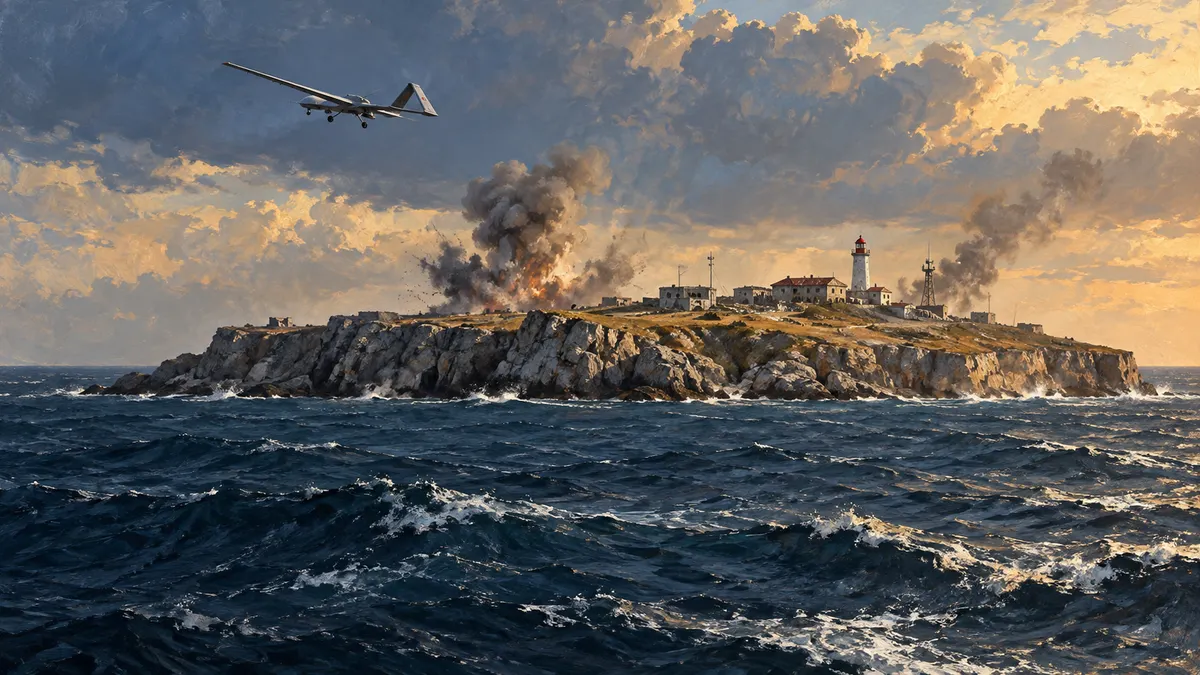
The Fight for Snake Island
Snake Island and the Danube delta coast, Odesa Oblast, Ukraine, Black Sea · 26 April to 30 June 2022
Information as of October 2026
Read the battle page: Snake Island campaign
Learning objectives
- Compare attacks on modeled sea targets and island units using observation, aircraft losses and the attrition goal. Distinguish those results from evidence about the historical garrison’s resupply and the relative effects of different strikes.
- Assess how the model’s air-defence coverage affects drone exposure and losses, without assuming it reproduces every historical engagement or confirms the cause of each aircraft loss.
- Compare the Russian and Ukrainian accounts of the withdrawal on 30 June and explain how a commander should treat strike claims that were not independently confirmed.
Run time and a good result
Default run clock: 8 minutes 0 seconds at 1×, excluding pauses, briefing and discussion. Time controls change elapsed play time.
Objective: Over four stages from late April to the end of June, put at least 12 Russian units out of action on and around Snake Island: patrol boats, landing craft, supply ships, air defence systems and the garrison. Your Bayraktar TB2s fly from the coast 35 km away, and every air defence system on the island can shoot them down.
The Fight for Snake Island: Over four stages from late April to the end of June, put at least 12 Russian units out of action on and around Snake Island: patrol boats, landing craft, supply ships, air defence systems and the garrison. Your Bayraktar TB2s fly from the coast 35 km away, and every air defence system on the island can shoot them down. Put at least 12 represented opposing units out of action; decoys do not count. The authored limit is 480 simulation seconds across 4 stages. Compare objective progress, time, losses, drone expenditure and recorded civilian harm with a second run. A strong classroom result also explains the source evidence and reconstruction estimates; it does not verify a historical casualty count.
Timings
For 60 minutes, brief for 10, run it once with a pause at each of the three decision points for 25 and review for 25; for 90 minutes, add a second run commanding Russia and compare how each side used the island's air defence; for 180 minutes, give syndicates different target orders for the first two stages, compare their losses and counts, and finish with a discussion of the two accounts of the withdrawal.
| Session | Plan |
|---|---|
| 45 minutes | Brief: 10 min; Run: 15 min; Collect: 5 min; Review: 15 min |
| 60 minutes | Before questions: 5 min; Brief: 10 min; Run: 20 min; Collect: 5 min; Debrief and after questions: 15 min; Discussion: 5 min |
| 90 minutes | Before questions: 5 min; Brief: 10 min; Run 1: with drones: 20 min; Run 2: without drones: 15 min; Collect: 5 min; Compare and discuss: 25 min; After questions: 10 min |
| 180 minutes | Before questions: 10 min; Brief and staff roles: 15 min; Run 1: with drones: 25 min; Run 2: without drones: 20 min; Break: 10 min; Run 3: syndicates: 30 min; Collect: 10 min; Seminar replay and debrief: 40 min; After questions: 10 min; Close: 10 min |
Staff roles
- commander
- Set the order of targets for each stage, decide when the island's air defence is weak enough to risk the TB2s over it, and report the running count against the goal of 12 units.
- intelligence
- Track which air defence systems on the island have revealed themselves, report every new vessel as it arrives, and note which claimed kills you have actually seen.
- fires
- In the final stage, observe the added artillery counter’s automatic fire and ammunition, and recommend the available artillery standing order. You cannot assign an individual gun target or move the gun.
- droneOps
- Plan the TB2 sorties for each stage, keep enough aircraft back to replace losses, and report every drone shot down and by which system.
Opposing staff objective
Hold Snake Island and keep its garrison supplied until 30 June. Lose fewer than 12 units to Ukrainian strikes, using the island's air defences to shoot down the TB2 drones that hunt your boats.
Decision points
- Late April, before the first strike: the island has two air defence systems and three patrol boats. Do you go for the air defence first, accepting losses, or for the boats at sea away from it?
- In the authored stage labelled7May, new landing-craft and air-defence counters appear. Compare drone-launch timing before and after the scripted arrival; unloading and individual cargo handling are not interactive mechanics.
- In the final authored stage, observe the added artillery counter’s automatic engagements and ammunition. Compare the available artillery standing order with different TB2 launch choices; individual gun-target assignment is unavailable.
Before and after questions
According to the Pentagon’s 1 July 2022 assessment, why did attacks on resupply ships matter for Snake Island?
- Vessel losses chiefly reduced the garrison's independent aerial reconnaissance capability
- Vessel attacks chiefly reduced uncertainty about the island’s fixed targets
- Vessel attacks chiefly reduced civilian exposure during subsequent island strikes
- A Pentagon official linked attacks on resupply ships to difficulty sustaining the isolated island garrison
Answer D: A senior Pentagon official linked attacks on a resupply ship to difficulty sustaining the island garrison. DOD News published that assessment on 1 July 2022; it is an attributed explanation rather than proof of every Russian motive or every vessel loss.
Which sequence did H I Sutton describe in his 18 May 2022 analysis of Snake Island?
- A reinforcement effort established the earlier defensive losses had been restored
- A Tor loss preceded further attacks and replacement efforts
- Aircraft attacks preceded the first reported losses among the defensive systems
- Moskva's loss established the remaining garrison had already abandoned the island
Answer B: Sutton describes a Tor system being struck on 6 May, further air attacks and subsequent attempts to replace air defence. This is his analysis of observed activity; it does not establish that every system had the same coverage or explain every successful strike.
How is the Russian withdrawal from the island on 30 June described?
- Russia described goodwill; Ukraine credited pressure from strikes
- Both governments credited pressure from repeated Ukrainian strikes
- Both governments attributed withdrawal exclusively to grain negotiations
- Both governments declined to explain the garrison’s withdrawal
Answer A: RFE/RL records Russia describing the 30 June withdrawal as a goodwill gesture and Ukrainian officials crediting their forces. Those are opposing explanations, not independently established motives. The article confirms that Russia acknowledged its troops had left.
Ukraine said it destroyed Pantsir-S1 systems on the island in late June. What did Russia's Defence Ministry say?
- It confirmed losses and identified the affected units
- It stated those systems were entirely absent before the attack
- It denied losses and claimed interception of aircraft and rockets
- It stated those systems had been withdrawn previously
Answer C: The War Zone records Ukraine claiming a Pantsir loss and Russia denying damage. The quoted Russian statement claims one Su-25 and twelve rockets were intercepted. Its Pentagon interview declined comment; the article does not independently confirm either loss account.
Why did the sinking of the cruiser Moskva matter for the Snake Island garrison?
- Its loss established the broader port blockade had become ineffective
- It reportedly reduced nearby naval support and protection
- Its loss chiefly affected berthing rather than defensive naval support
- Its loss chiefly changed civilian traffic rather than garrison resources
Answer B: Gatopoulos links Moskva’s loss to ships retreating and Snake Island’s exposure. This is his analysis, not verified causation.
Discussion
- Which target set did you attack first, and how many TB2s did you lose before the island's air defence was out of action? What would you change?
- Sutton’s Naval News reconstruction describes a reported sequence of air-defence losses, subsequent attacks and replacement efforts. Compare that attributed reconstruction with the exposure and losses in your model run; do not infer a universal cause of drone success.
- Where strike videos and opposing official accounts differ, what can each establish about identity, date, observed damage and unobserved losses? Explain the limits without assuming an unpublished or unfilmed event did not occur.
- Russia called the withdrawal a goodwill gesture and Ukraine called it a forced retreat. What evidence would you look for to judge between the two accounts?
Debrief rubric
- Strong
- Meets the objective or explains why it was not met; uses the published sources and run evidence, separates known facts from assumptions, compares both sides’ losses and cost exchange, and evaluates precautions against civilian harm.
- Adequate
- Describes the objective and main decisions, identifies at least one source and model limitation, reports losses and harm, and gives a reasoned change for a second run.
- Weak
- Reports only victory or points, treats teaching settings as real performance, gives unsupported historical claims, or omits uncertainty and civilian harm.
Published readings
- Naval News: Watch Ukrainian TB2 striking two Russian Raptor assault boats (May 2022)
- Naval News: Russian Serna class LCU becomes the new victim of TB2 drone (May 2022)
- Naval News: Incredible success of Ukraine's Bayraktar TB2, the ghost of Snake Island (May 2022)
Complete source list
- Wikipedia: Snake Island campaign
- Wikipedia: Snake Island (Ukraine)
- Wikipedia: Raptor-class patrol boat
- Wikipedia: Serna-class landing craft
- Wikipedia: Russian tug Spasatel Vasily Bekh
- Wikipedia: Russian ship Vsevolod Bobrov
- Wikipedia: 2S22 Bohdana
- Wikipedia: Ukrainian fast assault craft Stanislav
- Wikipedia: Baykar Bayraktar TB2
- Wikipedia: Vylkove
- Wikipedia: Prymorske, Izmail Raion, Odesa Oblast
- Wikipedia: Sulina
- Naval News: Watch Ukrainian TB2 striking two Russian Raptor assault boats (May 2022)
- Naval News: Russian Serna class LCU becomes the new victim of TB2 drone (May 2022)
- Naval News: Incredible success of Ukraine's Bayraktar TB2, the ghost of Snake Island (May 2022)
- Ukrainska Pravda: Defence Ministry confirms strike near Snake Island hit Russian boat and Tor missile systems (7 May 2022)
- RFE/RL: Ukrainian military says drone destroys Russian landing craft near Snake Island in Black Sea (May 2022)
- The War Zone: Ukraine situation report, TB2s strike Russian SAM carrying landing craft at Snake Island (May 2022)
- Forbes (David Axe): Ukraine's drones are peeling back Russian defenses on infamous Snake Island (3 May 2022)
- Kyiv Independent: UK Intelligence, Russia tries to reinforce its garrison on Zmiinyi Island (May 2022)
- Space.com: Satellite spies sunken Russian ship off Ukraine's wartorn Snake Island (May 2022)
- The War Zone: Ukraine says it destroyed more Russian air defenses on Snake Island (June 2022)
- Militarnyi: Snake Island liberation, journalists published details of Bohdana self propelled howitzer's first combat mission
- RFE/RL: Ukraine says it has retaken infamous Snake Island; Russia says it withdrew for goodwill (30 June 2022)
- Washington Post: Russian forces withdraw from Ukraine's Snake Island (30 June 2022)
- TASS: Russian Aerospace Forces down 2 Ukrainian planes, 3 copters, 2 drones off Snake Island (May 2022)
- DOD News: Russians Retreat From Snake Island, Says DOD Official (1 July 2022)
- Alex Gatopoulos, Al Jazeera: The struggle for Snake Island (30 June 2022)