
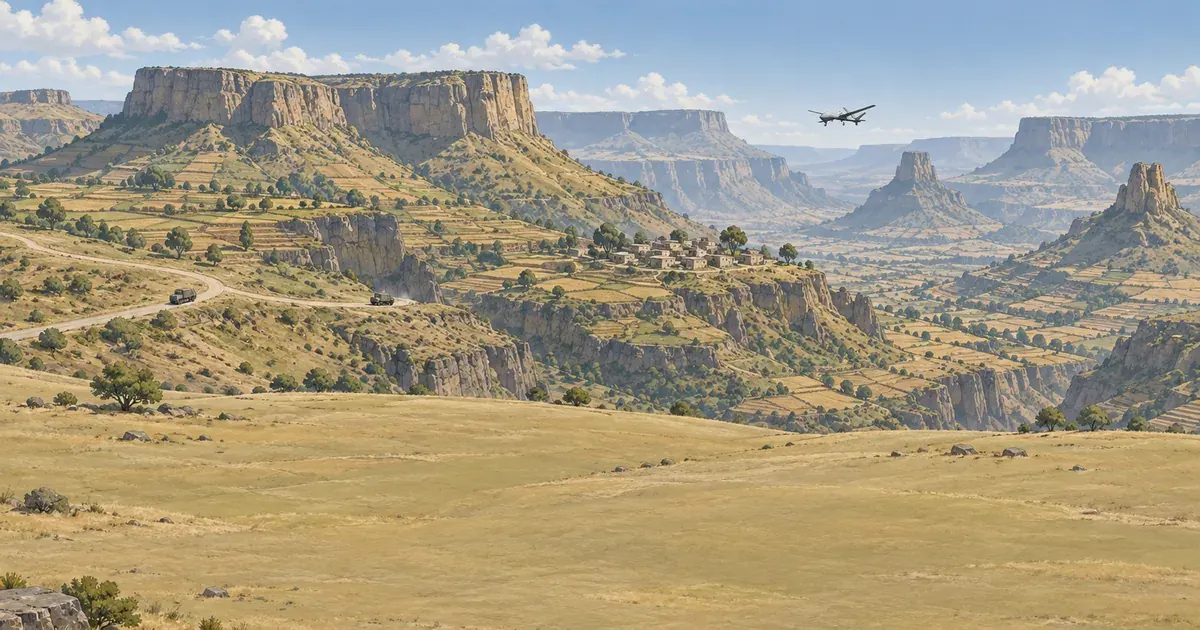
Drones over the A2
Shewa Robit and Debre Sina, A2 highway, Amhara Region, Ethiopia · 26 November to 4 December 2021
Information as of September 2026
Timeline: Tigray war (July 2021-November 2022)
Learning objectives
- Compare the drones and road observations available in this authored scenario with PAX and Oryx's attributed equipment identifications; keep platform identification separate from proof of a strike's effect or operator.
- Compare runs with and without your drones using the take-zone result, losses, time and surviving modeled supply trucks; explain why this counterfactual does not establish the historical cause of Shewa Robit's recapture.
- Compare Declan Walsh’s reported supply-convoy strikes with Zecharias Zelalem’s analysis of drone contributions and limitations. Distinguish their source-based accounts from the effects recorded in this run; neither gives a measured share of the result attributable to drones.
Run time and a good result
Default run clock: 2 minutes 40 seconds at 1×, excluding pauses, briefing and discussion. Time controls change elapsed play time.
Objective: Retake Shewa Robit and reopen the A2 highway north of Debre Sina. Your drones can reach the trucks and heavy weapons strung out along the road from Kemise, but your infantry must still take the town.
Drones over the A2: Retake Shewa Robit and reopen the A2 highway north of Debre Sina. Your drones can reach the trucks and heavy weapons strung out along the road from Kemise, but your infantry must still take the town. Occupy the marked zone with at least one combat unit and no opposing combat unit for 8 continuous simulation seconds. The authored limit is 160 simulation seconds across 1 stage. Compare objective progress, time, losses, drone expenditure and recorded civilian harm with a second run. A strong classroom result also explains the source evidence and reconstruction estimates; it does not verify a historical casualty count.
Timings
For 60 minutes, brief for 10, run it once with the three pauses for 25 and review for 25; for 90 minutes, add a run without drones and compare how many TDF supply trucks reached Shewa Robit; for 180 minutes, have half the syndicates command the TDF, add a run with strict rules of engagement, and close with a reading of the Crisis Group podcast and the Human Rights Watch report on Dedebit. These are classroom session budgets including pauses and discussion; the unpaused authored run is 160 seconds. No drones removes the selected player side's drones, not every enemy drone.
| Session | Plan |
|---|---|
| 45 minutes | Brief: 10 min; Run: 15 min; Collect: 5 min; Review: 15 min |
| 60 minutes | Before questions: 5 min; Brief: 10 min; Run: 20 min; Collect: 5 min; Debrief and after questions: 15 min; Discussion: 5 min |
| 90 minutes | Before questions: 5 min; Brief: 10 min; Run 1: with drones: 20 min; Run 2: without drones: 15 min; Collect: 5 min; Compare and discuss: 25 min; After questions: 10 min |
| 180 minutes | Before questions: 10 min; Brief and staff roles: 15 min; Run 1: with drones: 25 min; Run 2: without drones: 20 min; Break: 10 min; Run 3: syndicates: 30 min; Collect: 10 min; Seminar replay and debrief: 40 min; After questions: 10 min; Close: 10 min |
Staff roles
- commander
- Set the pre-run posture and standing orders, choose drone observation or strike areas, and report the automatic infantry and armour advance toward Shewa Robit. You cannot order individual ground units into the town.
- intelligence
- Track the TDF supply trucks moving south from Kemise and any air defence that has fired, and report which stretches of the A2 no drone has watched.
- fires
- Observe the artillery's automatic engagements on contacts revealed around Shewa Robit, recommend the available artillery and rules-of-engagement standing orders, and flag civilian risk. Individual gun-target assignments are unavailable.
- droneOps
- Report each authored Wing Loong, TB2 and Mohajer-6 launch, loss and return, including the cause recorded in the review. Compare modeled losses without treating generic air-defence probabilities as verified flight ceilings or aircraft-specific vulnerability.
Opposing staff objective
Hold Shewa Robit and the A2 highway until time runs out, and keep supply trucks moving south from Kemise to the front.
Decision points
- Before the first launch: your drones can reach the TDF supply trucks on the A2 from Kemise and the defenders in Shewa Robit, so which do they look for first?
- When a TDF air defence unit first fires on your drones: do you strike it at once, or keep your drones on the trucks and accept the risk of further losses?
- At the halfway pause, observe the automatic advance toward the populated take zone. Compare standard and strict rules of engagement and record blocked strikes and civilian harm; neither setting certifies lawful conduct.
Before and after questions
What logistical exposure did Declan Walsh report during the late-2021 Tigrayan advance?
- Most supplies crossed Afar away from the principal highway
- Walsh reported drone attacks on supply convoys advancing along an exposed major highway
- Air deliveries into Dessie sustained the advancing ground formations
- OLA operations severed the southern road near Kemise town
Answer B: Walsh reports drone attacks on supply convoys advancing along a major highway. This supports the reported exposure, without proving that all supplies used one road.
How does ECFR qualify the drone contribution to the Ethiopian government’s 2021 reversal?
- Drone success accounts for the reversal without further causal analysis
- Published aircraft losses explain the reversal better than political negotiations
- The reversal establishes lasting government control over later rebel strongholds
- Drones contributed without removing the need for negotiations
Answer D: ECFR describes a drone contribution to the 2021 reversal and a continuing need for mediated talks. Its later stronghold discussion concerns different campaigns; it does not independently rank every cause of the 2021 outcome.
What did Insecurity Insight record about the November 2021 drone strike at Chefa Robit?
- A market strike reportedly killed at least 38
- A depot strike reportedly caused no civilian deaths
- An air-defence strike reportedly destroyed a TDF system
- A convoy strike reportedly involved a TDF drone
Answer A: Insecurity Insight recorded a 4 November 2021 Chefa Robit market strike with at least 38 killed and over 40 injured. It describes its first known drone civilian-harm incident in Amhara, not the first such harm everywhere.
Which aircraft origins are represented by the armed-drone types identified in PAX’s Ethiopian imagery investigation?
- Aircraft recovered locally established the origins of the attacking force
- Prewar procurement records established origins without checking the observed aircraft
- Aircraft types identified from Iran, China and Turkey
- Domestic assembly established origins regardless of the underlying aircraft designs
Answer C: PAX identifies Turkish TB2, Chinese Wing Loong and Iranian Mohajer-6 presence. Aircraft identification does not establish a complete export chain, operator roster or responsibility for individual strikes.
What did Tsadkan Gebretensae report about drones during the late-2021 advance, in his interview with Declan Walsh?
- Flights principally at night while supplies moved
- Several armed drones reportedly airborne at once
- Flights principally supporting radio interference over convoys
- Small numbers reportedly intercepted soon after deployment
Answer B: Tsadkan told Walsh that ten drones were airborne at one time. The article attributes that account to him; it is not an independently verified fleet count or a confirmed A2 patrol pattern.
Discussion
- Walsh reported attacks on supply convoys and interviewed Tsadkan about drones overhead. Zelalem’s later analysis distinguishes defensive success from offensive losses and negotiations. What does each source establish, and what evidence would be needed to quantify the drones’ contribution?
- Read the separately attributed Chefa Robit and Dedebit civilian findings. Chefa Robit is north of this teaching map and its reported strike preceded this episode; Dedebit is also outside the map and occurred later. Keep weapon identification separate from proof of aircraft or operator. What do distinction, proportionality and precaution require when civilians and fighters use the same road?
- PAX identified a TB2 in imagery dated 9 December 2021 at Harar Meda and separately described footage whose date and location it could not verify. Which claims concern aircraft presence, which concern operators, and which would require evidence tied to a particular strike?
- Zelalem’s 2025 analysis distinguishes drone contributions to defending the capital from offensive losses and difficulty dislodging rebels. Compare that assessment with the run’s drone effects and automatic infantry movement; do not treat a simulated result as verification of the analysis.
Debrief rubric
- Strong
- Meets the objective or explains why it was not met; uses the published sources and run evidence, separates known facts from assumptions, compares both sides’ losses and cost exchange, and evaluates precautions against civilian harm.
- Adequate
- Describes the objective and main decisions, identifies at least one source and model limitation, reports losses and harm, and gives a reasoned change for a second run.
- Weak
- Reports only victory or points, treats teaching settings as real performance, gives unsupported historical claims, or omits uncertainty and civilian harm.
Facilitator notes
Instructors choose the scenarios used by a class. Students may have personal ties to this conflict; explain the scenario’s historical period, information cutoff and source limits before starting, and allow an alternative exercise where appropriate.
Published readings
- Al Jazeera: Tigrayan forces claim to capture new town of Kombolcha (31 October 2021)
- Al Jazeera: UAE air bridge provides military support to Ethiopia government (25 November 2021)
- Al Jazeera: Ethiopian government says it retook string of towns from Tigray forces (1 December 2021)
Complete source list
- Wikipedia: ENDF National Unity Offensive
- Wikipedia: TDF OLA joint offensive
- Wikipedia: Tigray war
- Wikipedia: Timeline of the Tigray war (July 2021–November 2022)
- Wikipedia: Tigray Defense Forces
- Wikipedia: Tigray People's Liberation Front
- Al Jazeera: Tigrayan forces claim to capture new town of Kombolcha (31 October 2021)
- Al Jazeera: UAE air bridge provides military support to Ethiopia government (25 November 2021)
- Al Jazeera: Ethiopian government says it retook string of towns from Tigray forces (1 December 2021)
- Al Jazeera: Ethiopian forces recapture two key towns from Tigrayan forces (6 December 2021)
- Al Jazeera: How armed drones may have helped turn the tide in Ethiopia's war (Alex Gatopoulos, 10 December 2021)
- International Crisis Group: Tigrayan Forces Retreat in Ethiopia (podcast with William Davison, 16 December 2021)
- The Irish Times, republishing the New York Times: Foreign drones tip the balance in Ethiopia's civil war (Declan Walsh, 21 December 2021)
- Responsible Statecraft: How foreign drone intervention and more turned tide for Abiy in Ethiopia (Alex de Waal, 23 December 2021)
- Martin Plaut, republishing James Jeffrey in Quillette: The key role of drones in the Tigray war (15 January 2022)
- PBS NewsHour: Tigrayan forces announce retreat, but Ethiopia rejects peace overture (22 December 2021)
- PAX: Ethiopia now confirmed to fly Chinese armed drones (November 2021)
- PAX: Turkish drones join Ethiopia's war, satellite imagery confirms (January 2022)
- Oryx: Iranian Mohajer-6 drones spotted in Ethiopia (Stijn Mitzer and Joost Oliemans, 11 August 2021)
- Oryx: The Tigray Defence Forces, documenting its heavy weaponry (September 2021)
- Amnesty International Citizen Evidence Lab: Identifying the drone launched munitions used in Ethiopian air strikes (Brian Castner, 14 February 2022)
- defenceWeb, reporting Reuters: Turkey expands armed drone sales to Ethiopia and Morocco, sources (15 October 2021)
- Insecurity Insight: The use of air delivered munitions in the context of humanitarian action in Ethiopia, with a focus on drones (December 2022)
- ACLED Ethiopia Peace Observatory: EPO Weekly, 20 to 26 November 2021
- ACLED Ethiopia Peace Observatory: EPO Weekly, 27 November to 3 December 2021
- Africanews: Air strikes kill at least 28 people in Ethiopia's Tigray region (21 December 2021)
- Human Rights Watch: Ethiopia, airstrike on camp for displaced likely war crime (24 March 2022)
- Washington Post: Ethiopian airstrike on Dedebit camp in Tigray killed dozens with Turkish made drone (2022)
- OHCHR: Press briefing notes on Ethiopia (14 January 2022)
- European Council on Foreign Relations: Deadly skies, drone warfare in Ethiopia and the future of conflict in Africa (Zecharias Zelalem, 28 February 2025)
- Political Geography Now: Ethiopia war map, Tigray rebel advance on capital and control today (25 January 2022)
- Wikipedia: Shewa Robit
- Wikipedia: Kemise
- Wikipedia: Mehal Meda
- Wikipedia: 2021 Ataye clashes (gives the location of Ataye)
- Wikipedia: Baykar Bayraktar TB2
- Wikipedia: CAIG Wing Loong
- Wikipedia: Qods Mohajer-6
- Nordic Africa Institute: Local history of Ethiopia, Cheames Kebet to Chezad Ogora (gazetteer entry for Chefe Robit)
- US Department of State: Foreign Terrorist Organizations
- UK Home Office: Proscribed terrorist groups or organisations
- ACLED Ethiopia Peace Observatory: EPO Weekly, 23 to 29 October 2021