
The Battle of Tinzaouaten
Outskirts of Tinzaouaten, Abeïbara Cercle, Kidal Region, Mali, on the Algerian border · 25 to 27 July 2024
Information as of September 2026
Read the battle page: Battle of Tinzaouaten (2024)
Learning objectives
- Compare observation around the model’s convoy route with the exposure and losses shown in the review. Distinguish approximate terrain and assumed TB2 support from independently verified historical convoy positions and capabilities.
- Assess how the simulation's scripted dust storm changes drone availability, while distinguishing its weather and TB2 support assumptions from independently confirmed events in the battle.
- Evaluate disputed claims about losses, outside help and civilian harm by naming who made each claim and what was independently verified.
Run time and a good result
Default run clock: 5 minutes 30 seconds at 1×, excluding pauses, briefing and discussion. Time controls change elapsed play time.
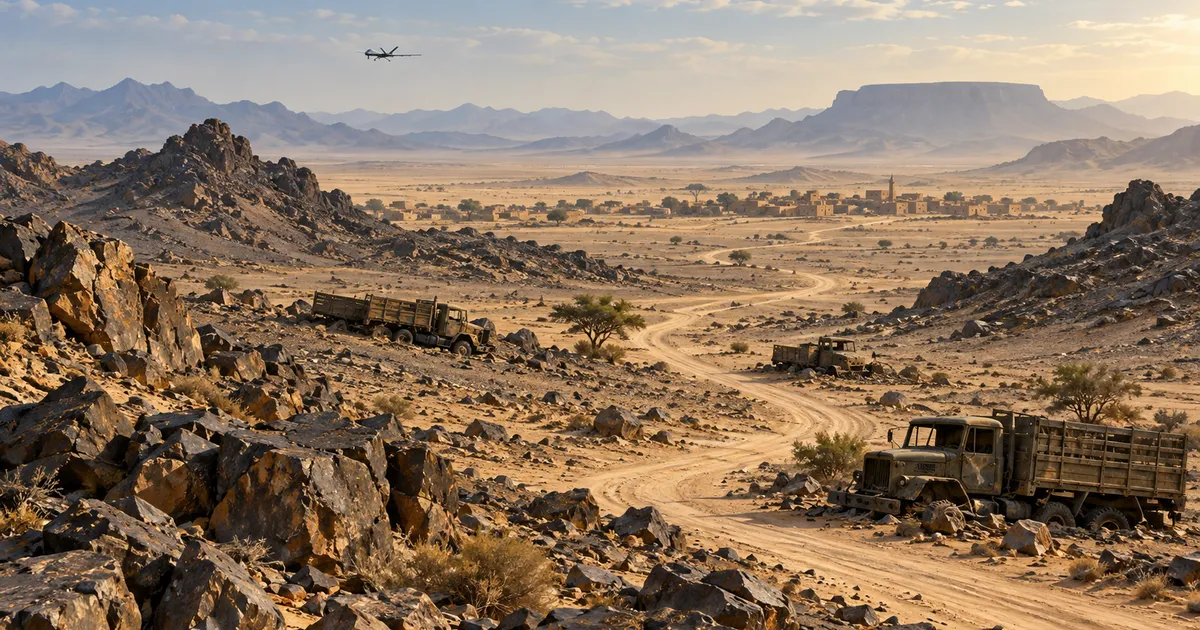
Objective: Get the convoy to Tinzaouaten and clear the Malian side of the town by the end of 27 July. Your three Bayraktar TB2 drones can find the CSP fighters on the ridges above the track, but a dust storm will ground them for a day. Civilians live in Tinzaouaten and across the border in Tin Zaouatine, so choose your strike targets with care, and keep your trucks and tankers alive.
The Battle of Tinzaouaten: Get the convoy to Tinzaouaten and clear the Malian side of the town by the end of 27 July. Your three Bayraktar TB2 drones can find the CSP fighters on the ridges above the track, but a dust storm will ground them for a day. Civilians live in Tinzaouaten and across the border in Tin Zaouatine, so choose your strike targets with care, and keep your trucks and tankers alive. Occupy the marked zone with at least one combat unit and no opposing combat unit for 8 continuous simulation seconds. The authored limit is 330 simulation seconds across 3 stages. Compare objective progress, time, losses, drone expenditure and recorded civilian harm with a second run. A strong classroom result also explains the source evidence and reconstruction estimates; it does not verify a historical casualty count.
Timings
For 60 minutes, brief for 10, run it once with a pause at each stage for 25 and review for 25; for 90 minutes, add a run in which the TB2s fly only before the dust storm and compare how far the convoy got; for 180 minutes, have half the syndicates command the CSP-DPA, add a run with strict rules of engagement for the town, and close with a reading of the Human Rights Watch findings on the August 2024 strikes and the competing loss claims.
| Session | Plan |
|---|---|
| 45 minutes | Brief: 10 min; Run: 15 min; Collect: 5 min; Review: 15 min |
| 60 minutes | Before questions: 5 min; Brief: 10 min; Run: 20 min; Collect: 5 min; Debrief and after questions: 15 min; Discussion: 5 min |
| 90 minutes | Before questions: 5 min; Brief: 10 min; Run 1: with drones: 20 min; Run 2: without drones: 15 min; Collect: 5 min; Compare and discuss: 25 min; After questions: 10 min |
| 180 minutes | Before questions: 10 min; Brief and staff roles: 15 min; Run 1: with drones: 25 min; Run 2: without drones: 20 min; Break: 10 min; Run 3: syndicates: 30 min; Collect: 10 min; Seminar replay and debrief: 40 min; After questions: 10 min; Close: 10 min |
Staff roles
- commander
- Set the pre-run posture and available standing orders, allocate drone flights, and report automatic convoy movement, weather changes and progress toward the take zone. Individual halt, formation and withdrawal commands are unavailable; allied units remain computer controlled.
- intelligence
- Map contacts revealed by the TB2s, record what remains visible during scripted dust, and distinguish the authored final-stage allied arrivals from independently verified historical participation.
- fires
- Observe automatic convoy fire and drone strikes, recommend available standing orders, and flag civilian or boundary risk before a launch. The model does not provide individual gun-target assignment.
- droneOps
- Share the TB2s between the ridges beside the track and the route ahead, bring them home before the dust storm, and report how many remain and how much flight time is left.
Opposing staff objective
Stop the Malian and Wagner convoy from taking Tinzaouaten. Hold the ridges above the track, use the dust storm to regroup and close in, and keep your fighters dispersed and hidden from the TB2 drones. Civilians live in the town behind you.
Decision points
- Before launching, compare TB2 observation areas around the authored convoy route and the town. Set the pre-run posture; during the run, report the convoy’s automatic movement rather than issue an unavailable halt command.
- Before the authored dust change, compare using the TB2s now with retaining aircraft for the later clear-weather interval. Their return and grounding follow the model’s weather rules.
- In the final authored stage, observe the new computer-controlled allied units and remaining convoy strength. What do drone launches, standing orders and the take-zone result show, and what withdrawal choices would require a different model?
Before and after questions
What did Wagner claim the sandstorm allowed the rebels to do?
- It enabled movement north before the column resumed operations
- It enabled renewed supplies before the column resumed operations
- Wagner claimed the sandstorm allowed its opponents to regroup and increase their numbers
- It enabled aerial observation despite the reduced local visibility
Answer C: Reuters, republished by France24, quotes Wagner claiming a sandstorm let its opponents regroup and increase their numbers. The reported number is a party claim, not an independently verified strength estimate.
If reported loss totals for Tinzaouaten differ, what should an analyst do?
- Attribute estimates and distinguish verified evidence from claims
- Prefer the highest estimate as the most comprehensive
- Prefer the Russian estimate as the most cautious
- Average the estimates into a single verified total
Answer A: Attribute each estimate, record its date and counted category, and distinguish independently supported evidence from party claims. Selecting the highest or lowest figure, or averaging conflicting reports, does not make a disputed loss total verified.
In this simulation, what can the TB2 inventory establish before any drone has flown?
- A complete current picture of opposing positions along the convoy route
- A verified explanation of the real convoy’s July 2024 battlefield losses
- Available modeled aircraft, without proof of a current reconnaissance picture
- A confirmed historical deployment pattern for aircraft across the entire campaign
Answer C: At creation, the tested scenario has TB2 stock in the hand but no airborne blue drone. Visibility is computed from active modeled observers, not the stock count alone. The allocation does not verify a historical fleet total, terrain relationship or cause of the real convoy’s losses.
What did Human Rights Watch find about the drone strike near a pharmacy in Tinzaouaten on 25 August 2024?
- It affected vehicles without any reported civilian casualties
- It involved Algerian aircraft rather than Malian aircraft
- It struck an evacuated pharmacy without causing casualties
- It reportedly killed seven civilians, including five children
Answer D: Human Rights Watch found that a Malian military drone strike near the pharmacy killed seven civilians, five of them children aged 14 to 16, about ten minutes after a first strike on vehicles parked in front of it (Human Rights Watch).
Tinzaouaten lies on the Algerian border. How did the drone strikes near the town reach Algeria?
- Algeria treated the incidents mainly as a joint border-security issue
- Algeria protested strikes and later claimed a drone interception
- Algeria confined its response to movement restrictions at the border
- Algeria treated the incidents mainly as disputed civilian-damage reports
Answer B: RFI reported Algeria raising civilian-death allegations at the UN and Mali disputing them in August 2024. Reuters reported Algeria’s April 2025 shootdown claim and Mali’s different account of a surveillance-aircraft crash. Keep these attributed accounts separate; they do not independently establish the aircraft model or where it crossed the border.
Discussion
- Compare the authored terrain and convoy route with the sources’ accounts. Which observations can the model produce, and which claims about real positions, visibility and causation need evidence beyond it?
- When parties give competing casualty figures or conflicting accounts of outside help, what would you record about claimant, date, counting basis and independent corroboration? Explain why averaging the claims does not verify them.
- After the battle, Human Rights Watch found that a Malian drone strike near a pharmacy in Tinzaouaten killed seven civilians, five of them children, about ten minutes after a first strike on vehicles. What do the laws of war require before a second strike on the same place, and what does it mean for a force to replace a ground presence with drones?
- Compare the reported diplomatic dispute over civilian deaths with Reuters’ April 2025 account of Algeria’s claimed drone interception and Mali’s reported surveillance-aircraft crash. The accounts differ and do not identify an Akıncı in that report. What evidence would be needed to establish the aircraft, location and responsibility?
Debrief rubric
- Strong
- Meets the objective or explains why it was not met; uses the published sources and run evidence, separates known facts from assumptions, compares both sides’ losses and cost exchange, and evaluates precautions against civilian harm.
- Adequate
- Describes the objective and main decisions, identifies at least one source and model limitation, reports losses and harm, and gives a reasoned change for a second run.
- Weak
- Reports only victory or points, treats teaching settings as real performance, gives unsupported historical claims, or omits uncertainty and civilian harm.
Facilitator notes
Wagner and JNIM allied counters are computer controlled under Drone Front’s current control policy and cannot be selected as a side. Their authored appearance does not independently verify every historical participation claim or certify current official designation status. Instructors can choose another historical scenario.
Published readings
- AFP, via Voice of America: Mali army, Russian allies suffer heavy losses in country's north, sources say (27 July 2024)
- Reuters, via Voice of America: Mali rebels say they killed and injured dozens of soldiers, Wagner mercenaries in fighting (28 July 2024)
- Reuters: Russia's Wagner says it took losses in heavy fighting against rebels in Mali (29 July 2024)
Complete source list
- Wikipedia: Battle of Tinzaouaten (2024)
- Wikipedia: Tinzaouaten
- Wikipedia: Tin Zaouatine
- Wikipedia: Strategic Framework for the Defense of the People of Azawad
- Wikipedia: Azawad Liberation Front
- Wikipedia: Baykar Bayraktar TB2
- Wikipedia: Baykar Bayraktar Akinci
- Wikipedia: Algeria–Mali relations
- AFP, via Voice of America: Mali army, Russian allies suffer heavy losses in country's north, sources say (27 July 2024)
- Reuters, via Voice of America: Mali rebels say they killed and injured dozens of soldiers, Wagner mercenaries in fighting (28 July 2024)
- Reuters: Russia's Wagner says it took losses in heavy fighting against rebels in Mali (29 July 2024)
- RFI: Mali separatists claim major victory over army, Russian allies (28 July 2024)
- The Daily Telegraph: Dozens of Wagner fighters killed and Russian helicopter destroyed in Mali ambush (28 July 2024)
- Al Jazeera: Mali rebels claim major victory over army, Russian mercenaries (28 July 2024)
- France 24: Russia's Wagner group reports casualties in intense clash with Tuareg rebels in Mali (29 July 2024)
- CNN: Dozens of Russian mercenaries killed in rebel ambush in Mali, in their worst known loss in Africa (29 July 2024)
- Institute for the Study of War: Russian Offensive Campaign Assessment, July 29, 2024
- Reuters: Al Qaeda branch says it killed 50 Russian mercenaries, 10 Malian soldiers in Mali (30 July 2024)
- BBC News: Mali army admits significant losses in joint battle with Wagner (30 July 2024)
- Voice of America: Wagner lost veteran fighters in Mali ambush, in setback to Russia's Africa campaign
- The New York Times: How Wagner's ruthless image crumbled in Mali (1 November 2024)
- RUSI: Mercenary politics, Algeria's response to Wagner in Mali
- Reuters: Mali drone strikes kill at least 21 in northern town, rebels say (25 August 2024)
- Al Jazeera: Twenty one civilians killed in Mali drone strikes, separatist group says (26 August 2024)
- RFI: Tinzaouatène, le Mali accuse l'Algérie de diffuser de la propagande terroriste et hausse le ton à l'ONU (31 August 2024)
- Human Rights Watch: Mali, atrocities by the army and Wagner Group (12 December 2024)
- Human Rights Watch: World Report 2025, Mali
- defenceWeb: Malian Air Force commissions Bayraktar TB2 UAVs and other aircraft (20 March 2023)
- Military Africa: Mali acquired Akinci drone, after Bayraktar TB2 (December 2024)
- Military Africa: Algeria shoot down Mali's newly acquired Akinci drone (April 2025)
- US Department of State: Foreign Terrorist Organizations
- UK Home Office: Proscribed terrorist groups or organisations (updated 7 July 2026)
- Reuters, via SRN News: Algeria, Mali report downed drone in border area but differ on details (1 April 2025)
- Le Monde: Au Mali, les chefs rebelles de l’Azawad s’unissent et subissent un bombardement mortel (2 December 2024; updated 3 December)
- Reuters, via VOA: Mali says army drone strike killed senior rebel commander, others (1 December 2024; model unspecified)