
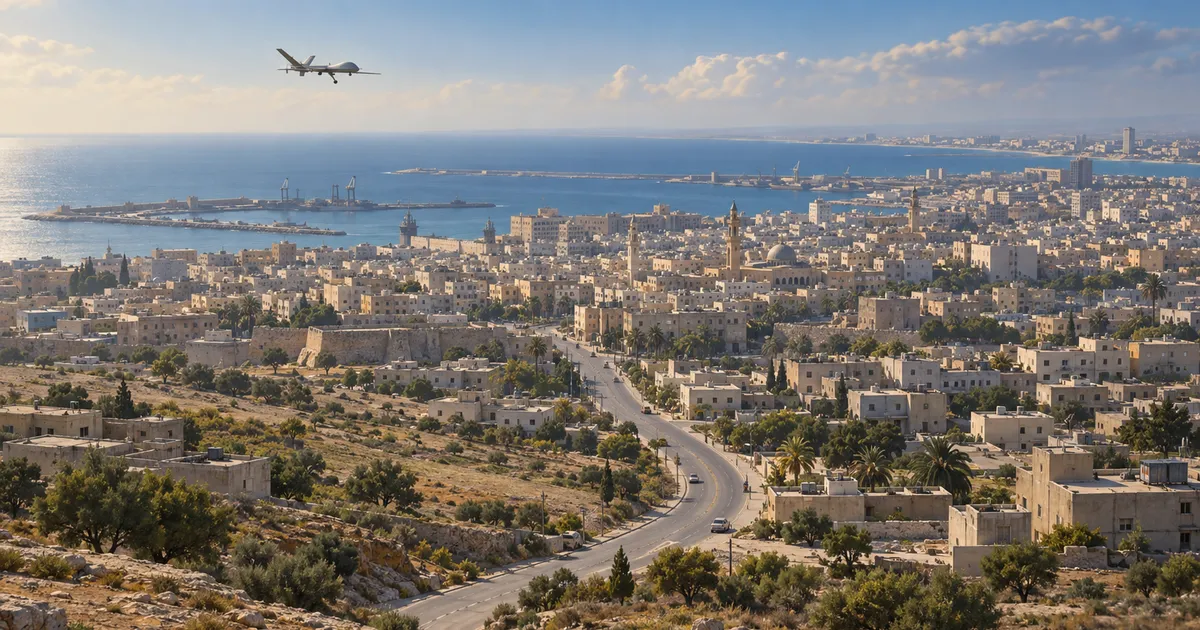
The Drone War over Tripoli
Tripoli and its southern approaches, Tripoli District, north west Libya · 4 April 2019 to 5 June 2020
Information as of September 2026
Read the battle page: Western Libya campaign
Learning objectives
- Compare the UN Panel’s description of Turkey-supplied TB2s with BBC’s investigated UAE-operated Wing Loong II case. Distinguish those attributed findings from the run’s authored rosters and supplies; they are not a complete operator or aircraft inventory.
- Analyse the UN Panel’s account of Turkish naval and ground air defence, intelligence support and reinforcement in early 2020. Separate that campaign assessment from this run’s simplified drone, air-defence and jamming counters.
- Evaluate how investigators tied strikes in a crowded city to an aircraft type and an operator, and why the answer matters for accountability.
Run time and a good result
Default run clock: 8 minutes 0 seconds at 1×, excluding pauses, briefing and discussion. Time controls change elapsed play time.
Objective: Hold central Tripoli through all four waves. Keep GNA units in the city centre, use your TB2s to find and strike the LNA columns, guns and air defence before they reach the southern suburbs, and keep Mitiga airport working.
The Drone War over Tripoli: Hold central Tripoli through all four waves. Keep GNA units in the city centre, use your TB2s to find and strike the LNA columns, guns and air defence before they reach the southern suburbs, and keep Mitiga airport working. Prevent an unopposed enemy occupation of the marked zone lasting 8 continuous simulation seconds; retain a fighting force until the episode ends. The authored limit is 480 simulation seconds across 4 stages. Compare objective progress, time, losses, drone expenditure and recorded civilian harm with a second run. A strong classroom result also explains the source evidence and reconstruction estimates; it does not verify a historical casualty count.
Timings
For 60 minutes run the briefing, one full run through the four waves and a short debrief on the drone exchange; for 90 minutes add a second run with a different target order and two discussion questions; for 180 minutes pause at each wave for the decision points, use all four discussion questions, and read the UN and BBC findings on the Tajoura and military academy strikes.
| Session | Plan |
|---|---|
| 45 minutes | Brief: 10 min; Run: 15 min; Collect: 5 min; Review: 15 min |
| 60 minutes | Before questions: 5 min; Brief: 10 min; Run: 20 min; Collect: 5 min; Debrief and after questions: 15 min; Discussion: 5 min |
| 90 minutes | Before questions: 5 min; Brief: 10 min; Run 1: with drones: 20 min; Run 2: without drones: 15 min; Collect: 5 min; Compare and discuss: 25 min; After questions: 10 min |
| 180 minutes | Before questions: 10 min; Brief and staff roles: 15 min; Run 1: with drones: 25 min; Run 2: without drones: 20 min; Break: 10 min; Run 3: syndicates: 30 min; Collect: 10 min; Seminar replay and debrief: 40 min; After questions: 10 min; Close: 10 min |
Staff roles
- commander
- Set the pre-run posture and available standing orders, decide when to launch newly supplied drones, and report the modeled hold zone at each wave. Ground-unit positioning and movement are automatic.
- intelligence
- Track LNA columns on the roads from Gharyan and Tarhuna, report where Wagner units and Pantsir air defence appear, and warn when a Wing Loong II is overhead.
- fires
- Observe the guns’ automatic engagements around the modeled airport and suburbs, recommend the artillery and rules-of-engagement standing orders, and flag civilian risk. Individual gun-target assignments are unavailable.
- droneOps
- Report every TB2 and Kargu-2 launch, loss and return, keep Mitiga airport in mind as the base, and say when air defence makes a target too costly.
Opposing staff objective
Take central Tripoli. Advance from Tripoli International Airport, Qasr bin Ghashir and Wadi al Rabie, use your Wing Loong IIs against GNA guns, troops and Mitiga airport, and drive the GNA out of the city centre before the last wave ends.
Decision points
- In the authored first stage, three TB2s are available. Compare launches near the modeled airport-road columns with launches near the guns, recording observation, losses and stocks.
- In this authored scenario stage, second wave, autumn 2019: a Pantsir now covers the airport and Wagner units join the attack. Do you risk your TB2s against the air defence, or keep them over your own front?
- In this authored scenario stage, third wave, January 2020: with more TB2s, a frigate offshore and jamming, do you go after the LNA guns and air defence, or the troops closing on the southern suburbs?
Before and after questions
What external drone support do the UN Panel and BBC’s investigation describe for the opposing Libyan forces?
- Competing domestic manufacturers supplying most aircraft to the opposing forces
- Local force aircraft conducting most strikes without significant foreign support
- Foreign operators replacing local forces as the principal ground belligerents
- The cited investigations describe external drone support for opposing forces, including Turkish and UAE involvement
Answer D: The UN Panel records Turkey-supplied TB2s for the GNA, while BBC’s investigation links UAE-operated Wing Loong II aircraft to the academy strike. These attributed findings establish external support in the cited cases, not a complete aircraft or manufacturing inventory.
In this modeled comparison, drones are lost but later waves add aircraft. Which constraint should be examined beyond one aircraft’s performance?
- Continued replacement support from external suppliers
- Exceptional performance from one individual operating crew
- Consistently favourable weather over the surrounding plain
- Additional runways within the contested urban perimeter
Answer A: The authored waves replenish drone stocks. Compare those deliveries, recorded losses and unused stocks when assessing the run’s dependence on continuing support. This comparison does not establish a complete historical replacement tally or prove the motives of an external supplier.
Why were LNA forces around Tripoli International Airport exposed by spring 2020?
- Transferred defences restored enough coverage to limit the airport's significance
- Redeployment reduced ground exposure while retaining the earlier defensive air coverage
- Loss of defensive cover and electronic interference increased exposure
- Reduced sortie rates established that remaining local defensive coverage was adequate
Answer C: The UN Panel reports substantial Pantsir losses and KORAL jamming of HAF drone capabilities during the 2020 campaign (S/2021/229, paragraphs 63–64). The simulation represents the airport sector; the report does not prove every modeled unit’s placement or loss.
The LNA denied responsibility and the UAE had denied military involvement. What did the BBC investigation conclude?
- A GNA aircraft mistakenly attacked a friendly academy
- A UAE-operated Wing Loong reportedly struck the academy
- An industrial accident caused deaths without an aerial strike
- A Turkish TB2 reportedly attacked the military academy
Answer B: BBC Africa Eye attributed the academy strike to a UAE-operated Wing Loong II and reported 26 unarmed cadets killed. The LNA denied responsibility; the UAE had previously denied military involvement and did not respond to BBC. This is an investigative finding, not an admission.
What did the joint UNSMIL and OHCHR report find about the strike on the Tajoura migrant detention centre?
- It attributed the strike tentatively and raised possible unlawfulness
- It treated weapon origin as sufficient proof of the operating force
- It treated reported military use as sufficient evidence of lawful precautions
- It treated announced relocation as evidence that civilians had already departed
Answer A: The report found the strike was probably carried out by a state other than Libya under LNA command or in support of the LNA and may have been illegal under international humanitarian law; the LNA denied responsibility (civilian harm notes).
Discussion
- The UN Panel and BBC investigation describe external support in specific cases. What would dependence on foreign suppliers and operators mean for evidentiary accountability? Distinguish these findings from the envoy’s qualified description of the drone-war scale and avoid treating a superlative as a measured inventory.
- In this authored run, later waves add drones after earlier losses. Compare the delivery schedule, recorded losses and unused stocks. What additional evidence would establish the real replacement rate or the decisions of an outside supplier?
- BBC investigated the academy strike through weapons and air-base evidence; UNSMIL/OHCHR assessed the Tajoura strike separately. How do the conclusions, attribution limits and party responses differ?
- Read the UN Panel’s paragraph 63 account of Kargu-2 and its reported capability to attack without a continuing data connection. Which control and accountability questions follow? The description does not independently verify a specific autonomous killing.
Debrief rubric
- Strong
- Meets the objective or explains why it was not met; uses the published sources and run evidence, separates known facts from assumptions, compares both sides’ losses and cost exchange, and evaluates precautions against civilian harm.
- Adequate
- Describes the objective and main decisions, identifies at least one source and model limitation, reports losses and harm, and gives a reasoned change for a second run.
- Weak
- Reports only victory or points, treats teaching settings as real performance, gives unsupported historical claims, or omits uncertainty and civilian harm.
Published readings
- Al Jazeera: 'Largest drone war in the world', how airpower saved Tripoli (28 May 2020)
- Al Jazeera: UAE drone strike on factory near Tripoli killed 8 civilians, HRW (29 April 2020)
- Al Jazeera: Russian groups' 1,200 mercenaries fighting in Libya, UN report (7 May 2020)
Complete source list
- Wikipedia: Western Libya campaign (2019 to 2020)
- Wikipedia: CAIG Wing Loong II
- Wikipedia: Baykar Bayraktar TB2
- Wikipedia: Wagner Group activities in Libya
- Wikipedia: Turkish intervention in Libya (2020–present)
- Wikipedia: 2019 Tajoura migrant center airstrike
- Wikipedia: Tripoli military school airstrike
- Wikipedia: STM Kargu
- Wikipedia: Tripoli International Airport
- Wikipedia: Mitiga International Airport
- Wikipedia: Tarhuna
- Wikipedia: Ain Zara
- Wikipedia: Qasr Bin Ghashir
- Wikipedia: Tajura
- Al Jazeera: 'Largest drone war in the world', how airpower saved Tripoli (28 May 2020)
- Al Jazeera: UAE drone strike on factory near Tripoli killed 8 civilians, HRW (29 April 2020)
- Al Jazeera: Russian groups' 1,200 mercenaries fighting in Libya, UN report (7 May 2020)
- Al Jazeera: Turkey's parliament approves military deployment to Libya (2 January 2020)
- Al Jazeera: Libya's GNA retakes Tripoli airport from Haftar's forces (3 June 2020)
- Al Jazeera: Libya's GNA says it regained full control of the capital, Tripoli (4 June 2020)
- UNSMIL: UN report urges accountability for Libya airstrike deaths (January 2020)
- UNSMIL and OHCHR: Report on the airstrikes on the Daman building complex, including the Tajoura Detention Centre (January 2020)
- OHCHR: Attack on Libyan migrant detention centre, statement by UN High Commissioner for Human Rights Michelle Bachelet (July 2019)
- Middle East Monitor: UAE killed 26 unarmed cadets in Libya, BBC says (28 August 2020)
- The New Arab: UAE 'involved in Libya attack that killed 26 cadets' (28 August 2020)
- Bloomberg: ‘Putin’s Chef’ Deploys Mercenaries to Libya in Latest Adventure
- New America: Foreign boots on the ground, the 2019 battle for Tripoli and beyond
- War on the Rocks: Drones, deniability, and disinformation, warfare in Libya and the new international disorder (March 2020)
- Drone Wars UK: Libyan war sees record number of drones brought down to earth (1 July 2020)
- ICRC Casebook: Libya, the use of lethal autonomous weapon systems (quotes UN Panel of Experts report S/2021/229)
- Human Rights Watch: World Report 2020, Libya
- UN Panel of Experts on Libya: Final report S/2021/229 (2021, PDF)
- BBC, reproduced by MyJoy: UAE implicated in lethal drone strike in Libya (28 August 2020)