
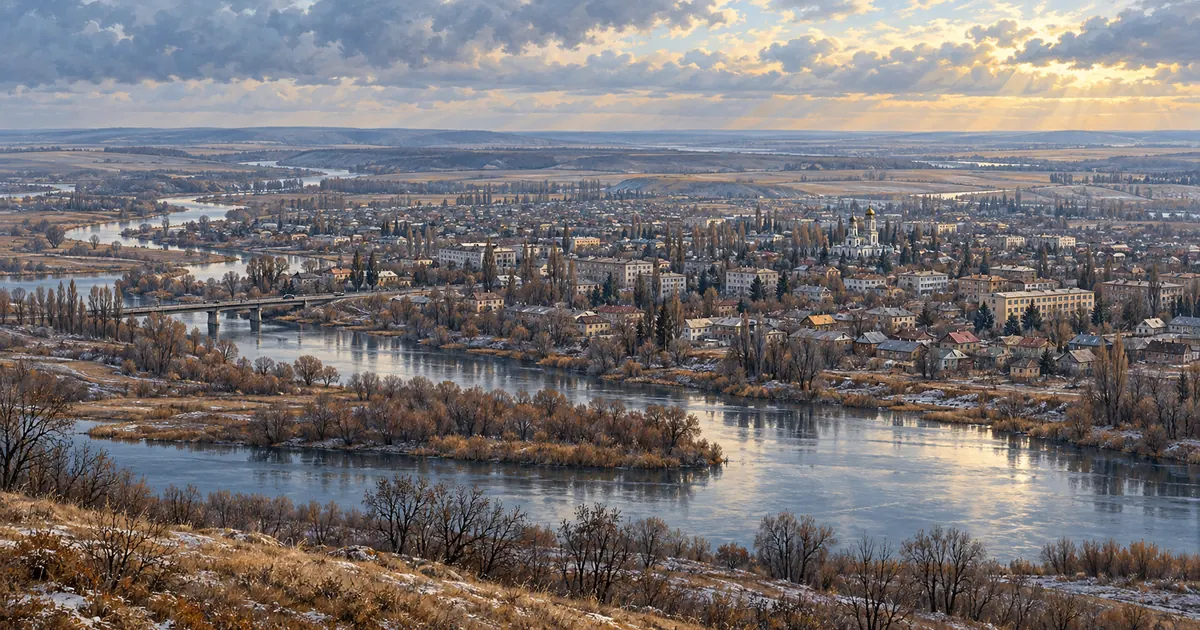
Velyka Novosilka: The River Town
Velyka Novosilka and its river approaches, Donetsk Oblast, Ukraine · 20 November 2024 to 28 January 2025
Information as of October 2026
Battle index: Velyka Novosilka offensive
Learning objectives
- Locate the town and its three named rivers.
- Follow the changing front through three dated phases.
- Distinguish the historical result from a limited delay goal.
Run time and a good result
Default run clock: 6 minutes 0 seconds at 1×, excluding pauses, briefing and discussion. Time controls change elapsed play time.
Objective: Delay the capture of the marked town centre until the episode ends. Ukraine did not retain Velyka Novosilka historically; this is a limited delay mission.
Velyka Novosilka: The River Town: Delay the capture of the marked town centre until the episode ends. Ukraine did not retain Velyka Novosilka historically; this is a limited delay mission. Prevent an unopposed enemy occupation of the marked zone lasting 8 continuous simulation seconds; retain a fighting force until the episode ends. The authored limit is 360 simulation seconds across 3 stages. Compare objective progress, time, losses, drone expenditure and recorded civilian harm with a second run. A strong classroom result also explains the source evidence and reconstruction estimates; it does not verify a historical casualty count.
Timings
For 60 minutes, brief for 15, run with pauses for 25 and discuss for 20. For 90 minutes, compare both sides. For 180 minutes, compare the surrounding campaigns.
| Session | Plan |
|---|---|
| 45 minutes | Brief: 10 min; Run: 15 min; Collect: 5 min; Review: 15 min |
| 60 minutes | Before questions: 5 min; Brief: 10 min; Run: 20 min; Collect: 5 min; Debrief and after questions: 15 min; Discussion: 5 min |
| 90 minutes | Before questions: 5 min; Brief: 10 min; Run 1: with drones: 20 min; Run 2: without drones: 15 min; Collect: 5 min; Compare and discuss: 25 min; After questions: 10 min |
| 180 minutes | Before questions: 10 min; Brief and staff roles: 15 min; Run 1: with drones: 25 min; Run 2: without drones: 20 min; Break: 10 min; Run 3: syndicates: 30 min; Collect: 10 min; Seminar replay and debrief: 40 min; After questions: 10 min; Close: 10 min |
Staff roles
- commander
- Track capture and delay goals.
- intelligence
- Compare dated and attributed accounts.
- fires
- Record simulated effects and civilian exposure.
- droneOps
- Compare observation and attack roles.
Opposing staff objective
Capture the marked Velyka Novosilka centre. Russian forces took the town after advances around its approaches.
Decision points
- Opening: where are the town and surrounding villages?
- Middle phase: how has the area of fighting changed?
- Final phase: which limited goal remains achievable?
Before and after questions
What limitation did the 110th Brigade report at Velyka Novosilka on 22 January?
- Too little artillery and too few drones, despite enough infantry.
- Too few infantry, despite sufficient artillery and drone support.
- Too few drones, despite sufficient artillery and infantry forces.
- Too little artillery, despite enough drones and infantry forces.
Answer B: Ukrainska Pravda attributed the account to the brigade: artillery and drones were sufficient, but infantry personnel were critically short. It is not a verified inventory.
How did the brigade's 26 January account describe the Mokri Yaly River?
- As a barrier affecting Russian advance alone throughout the episode.
- As a supply corridor without any reported movement difficulties.
- As a Ukrainian supply difficulty and an obstacle to Russian advance.
- As a barrier affecting Ukrainian supply alone throughout the episode.
Answer C: The brigade said Mokri Yaly had complicated Ukrainian supply and had then become an obstacle to Russian advance. These are attributed claims, not a reconstruction of every crossing.
What is the scope of Ukraine's Velyka Novosilka objective in the model?
- Retain the whole sector throughout the historical campaign.
- Recapture all surrounding villages before the episode ends.
- Preserve every defending unit until the historical withdrawal.
- Delay capture of the marked centre until the episode ends.
Answer D: The authored objective is a hold goal for the marked town centre until episode end. It explicitly describes a limited delay, not a reversal of the historical result.
Which detail is not reconstructed by Velyka Novosilka's three-phase model?
- Bridge conditions and changing weather during the episode.
- A marked town-centre area for the limited hold objective.
- A 400-metre grid scale covering the surrounding approaches.
- Three dated stages compressing the represented battle period.
Answer A: The accuracy notes explicitly omit bridge conditions and changing weather. The marked centre, 400-metre scale and three dated phases are model features.
What do unspecified civilian deaths and injuries mean in this episode's record?
- The episode's records establish that no civilians were harmed.
- A separate civilian casualty total is not asserted for the episode.
- Displaced residents are counted instead as injured civilians.
- Military casualty figures provide the missing civilian totals.
Answer B: The civilian record leaves killed and injured unset and says no separate total is asserted. Missing totals are not zero; displacement and military losses are different categories.
Discussion
- Why did reported drone and artillery availability not ensure that the town could be held?
- What difficulties did the rivers create?
- Why do the reports describe the last days differently?
Debrief rubric
- Strong
- Meets the objective or explains why it was not met; uses the published sources and run evidence, separates known facts from assumptions, compares both sides’ losses and cost exchange, and evaluates precautions against civilian harm.
- Adequate
- Describes the objective and main decisions, identifies at least one source and model limitation, reports losses and harm, and gives a reasoned change for a second run.
- Weak
- Reports only victory or points, treats teaching settings as real performance, gives unsupported historical claims, or omits uncertainty and civilian harm.
Facilitator notes
Assess historical source analysis through the cited readings, answers and discussion. Run metrics describe the simulated run; they do not verify historical claims or demonstrate that a source-analysis objective has been met.
Published readings
- OSW: Commander of the Land Forces of Ukraine returns to the front, 28 January 2025
- OSW: Britain pledges a century of support for Ukraine, 21 January 2025
- Ukrainska Pravda, Anastasia Prots: 110th Brigade on Velyka Novosilka, 22 January 2025
Complete source list
- Wikipedia: Velyka Novosilka offensive, accessed 4 October 2026
- OSW: Commander of the Land Forces of Ukraine returns to the front, 28 January 2025
- OSW: Britain pledges a century of support for Ukraine, 21 January 2025
- Ukrainska Pravda, Anastasia Prots: 110th Brigade on Velyka Novosilka, 22 January 2025
- Ukrainska Pravda, Roman Petrenko: Ukrainian brigade account of Velyka Novosilka, 26 January 2025
- Associated Press: Russia says its troops have captured a strategic town, 26 January 2025
- Ukrainska Pravda, Ivan Diakonov: Children and parents evacuated from Donetsk settlements (14 November 2024)
- Ukrainska Pravda, Alona Mazurenko: Situation on Vremivka front is challenging, 23 December 2024