
2003 invasion of Iraq
- When
- 23 December 2002; 20 March to 1 May 2003
- Where
- Iraq
- Sides
- US led coalition vs Iraq
From 20 March to 1 May 2003 a United States led coalition invaded Iraq, and American forces flew drones that ranged from hand launched surveillance aircraft to the high altitude Global Hawk. Wikipedia names the sides as the United States, United Kingdom, Australia and Poland, with Kurdish groups, against Iraq. AUVSI reported in May 2003 that at least eleven types of drone were committed. Months earlier, on 23 December 2002, an Iraqi MiG 25 had destroyed an armed Predator over the southern no fly zone.
What happened
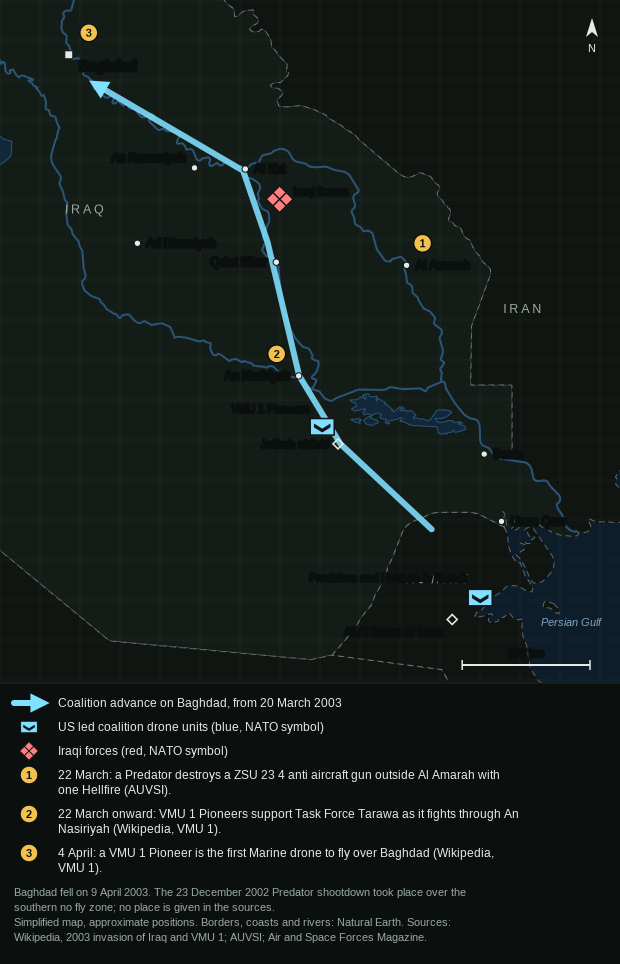
Wikipedia records that, after Operation Southern Focus raised pressure on the no fly zones from June 2002, the invasion began with an airstrike on the Presidential Palace in Baghdad on 20 March 2003 and that coalition forces crossed into Basra Governorate from near the Kuwaiti border the next day. Baghdad fell on 9 April after the six day Battle of Baghdad, and on 1 May President George W. Bush declared the end of major combat operations.
The drones
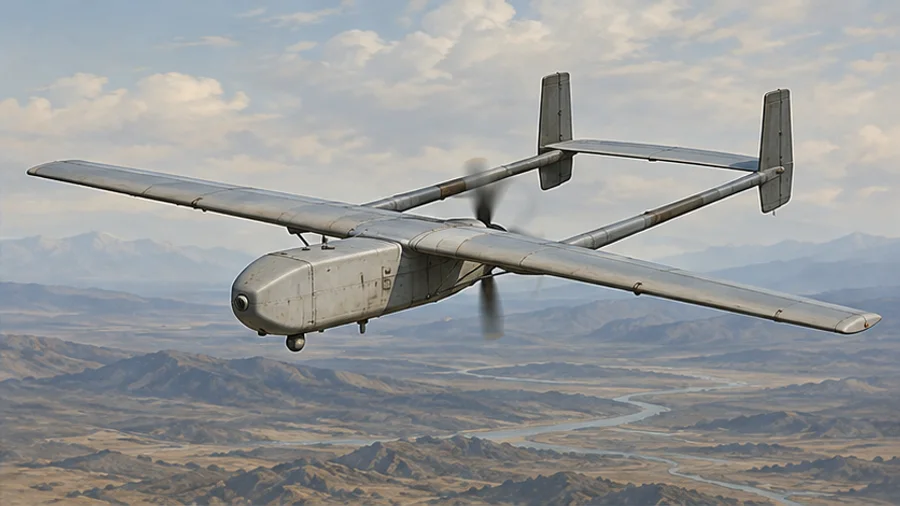
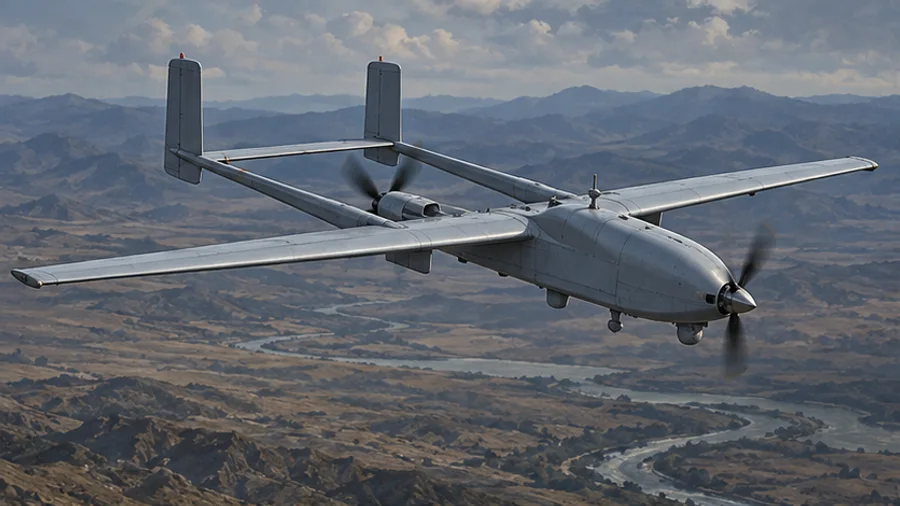
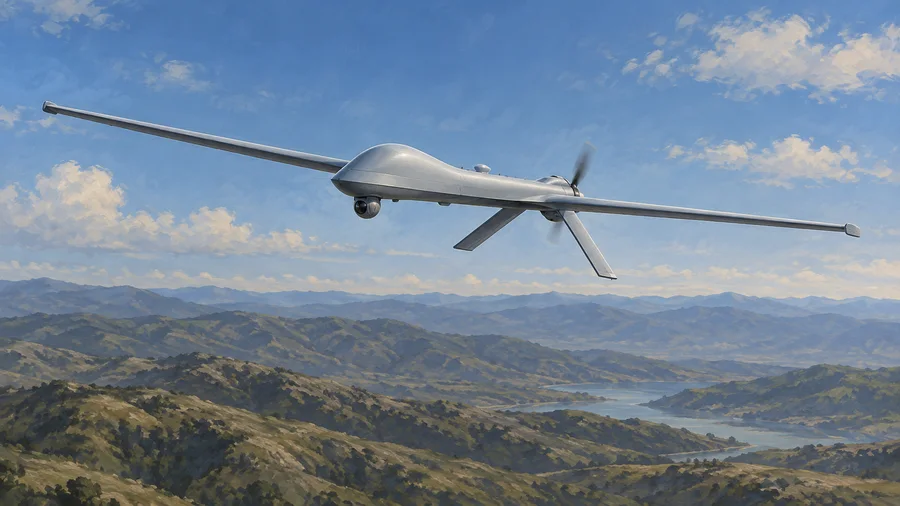
Wikipedia lists the General Atomics Predator at 8.23 m long with a 14.8 m wingspan, a 24 hour endurance and a ceiling of 7,600 m. AUVSI reported that it carried two AGM 114K Hellfire II missiles. The AAI Pioneer is 4.3 m long with a 5.15 m wingspan and a range of 185 km, and Wikipedia says it flies up to five hours with a 34 kg payload. Pentagon officials said the Global Hawk radar could image targets at 100 miles and its infrared system at 30 miles. Air and Space Forces Magazine reported that the Air Force began the war with eight Predators and three test model Global Hawks, of which one was ready.
How they were used
On 22 March a Predator found a radar guided ZSU 23 4 anti aircraft gun outside Al Amarah and destroyed it with one Hellfire, the first Predator strike of the invasion. In another case a Predator pilot in the western United States lit a missile site with the aircraft's laser and an A 10 destroyed it. Wikipedia says older Predators were stripped down and used as decoys to draw fire from Iraqi air defences. AUVSI named the Army's Shadow 200, Pointer and IAI Hunter, flown with Predators from near Camp New Jersey in Kuwait. The Marine squadron VMU 1 began flying over Iraq on 28 February, and on its first combat sortie it located an artillery battery that friendly artillery then destroyed. On 4 April one of its Pioneers became the first Marine drone over Baghdad. The Global Hawk arrived on 8 March and was flown from Beale Air Force Base in California.
What effect they had
Air and Space Forces Magazine reported that the single Global Hawk took 3,655 images, which helped locate more than 300 tanks, 13 full SAM batteries and more than 50 individual SAM launchers. Its radar kept imaging the Republican Guard through a late March sandstorm that blinded its cameras. General T. Michael Moseley, the air commander, told reporters, "I love UAVs!" The Air Force magazine added that after the December 2002 loss, the Iraqi Air Force made no further attacks on Predators. AUVSI said at least one Predator was lost during the invasion, probably to a mechanical fault rather than ground fire.
For the classroom
- Why did the Air Force send older Predators over Iraqi defences as decoys instead of its surveillance models?
- What did a Global Hawk at high altitude give commanders that a Pioneer flown by a Marine squadron could not?
- How did the 23 December 2002 fight with a MiG 25 show the limits of an armed Predator?
Sources
- Wikipedia: 2003 invasion of Iraq
- Wikipedia: VMU 1
- Wikipedia: VMUT 2
- Wikipedia: Operation Southern Focus
- Wikipedia: General Atomics MQ 1 Predator
- Wikipedia: AAI RQ 2 Pioneer
- US Military Robots Employed in Iraqi War (AUVSI, 2003)
- Eyes Wide Open (Air and Space Forces Magazine, 2003)
- Air & Space Forces Magazine: Iraqi Freedom and the Air Force
- How the Predator Grew Teeth (Air and Space Forces Magazine)
- War From Afar (Air Force Magazine, 2003)
Written 2026-10-04.