
Gulf War, Pioneer operations and the Faylaka surrender
- When
- January to February 1991; surrender 27 February
- Where
- Kuwait, Iraq, northern Gulf
- Sides
- US led coalition vs Iraq
- Drones
- AAI RQ-2 Pioneer
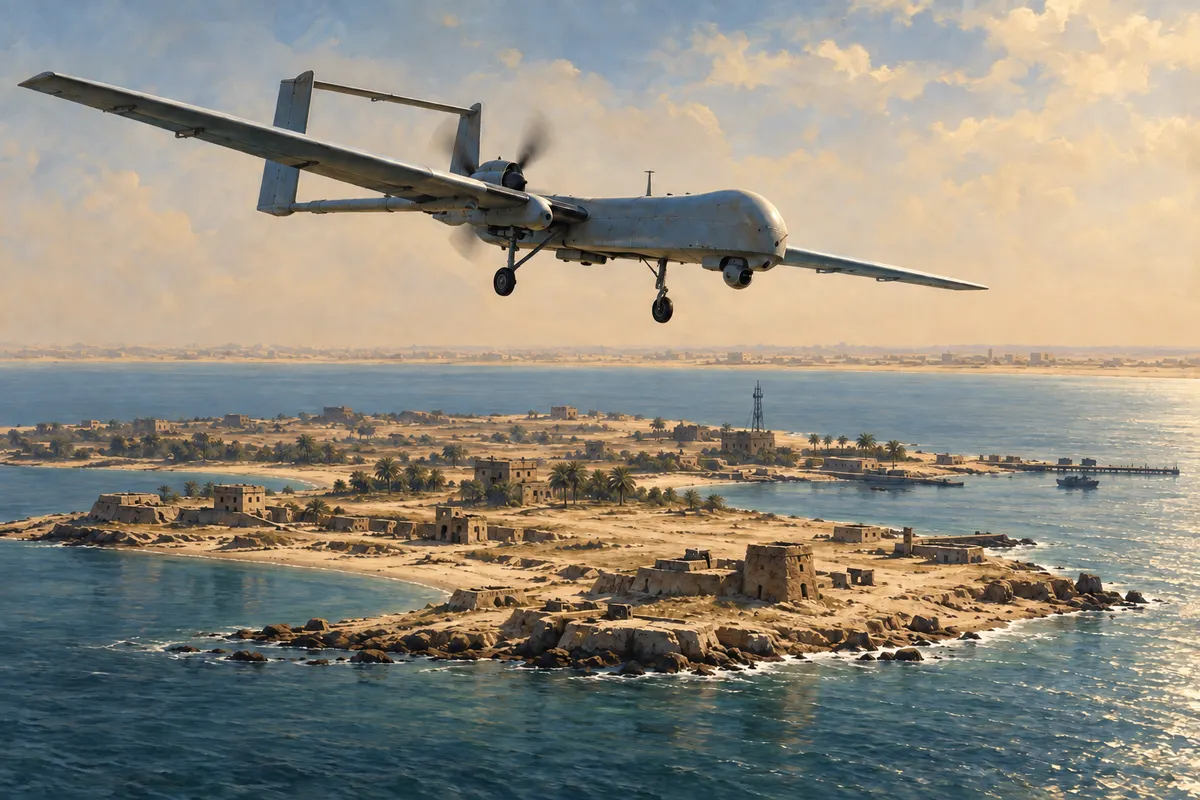
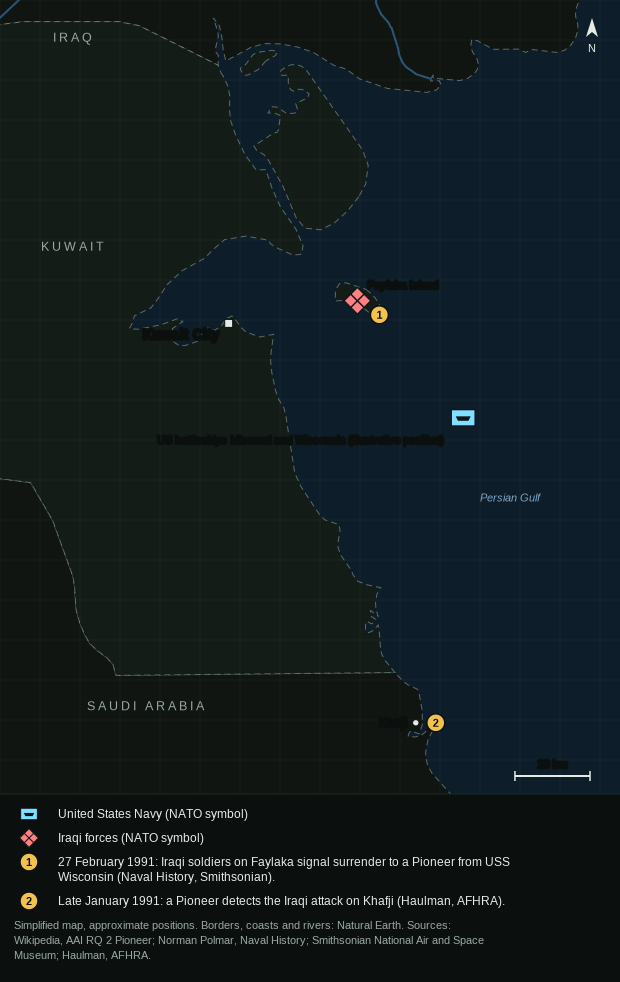
During Operation Desert Storm in January and February 1991, United States forces flew the RQ 2 Pioneer reconnaissance drone from two battleships and from bases ashore to spot naval gunfire and watch Iraqi positions. On 27 February 1991, Iraqi soldiers on Faylaka Island, off Kuwait City, signalled their surrender to a Pioneer launched from USS Wisconsin. The sides were the coalition led by the United States and Iraq.
What happened
Iraq invaded Kuwait in August 1990. The naval historian Norman Polmar dates Operation Desert Storm, the coalition campaign to expel Iraqi forces, from 16 January to 27 February 1991. The battleships USS Missouri and USS Wisconsin fired their 16 inch guns at Iraqi positions along the Kuwaiti coast. Faylaka Island, held by Iraqi troops, was one of the targets. Army and Marine Corps units ashore also flew Pioneers.
Scenario: Faylaka: Surrender to a Drone (3 to 25 February 1991)
The drones
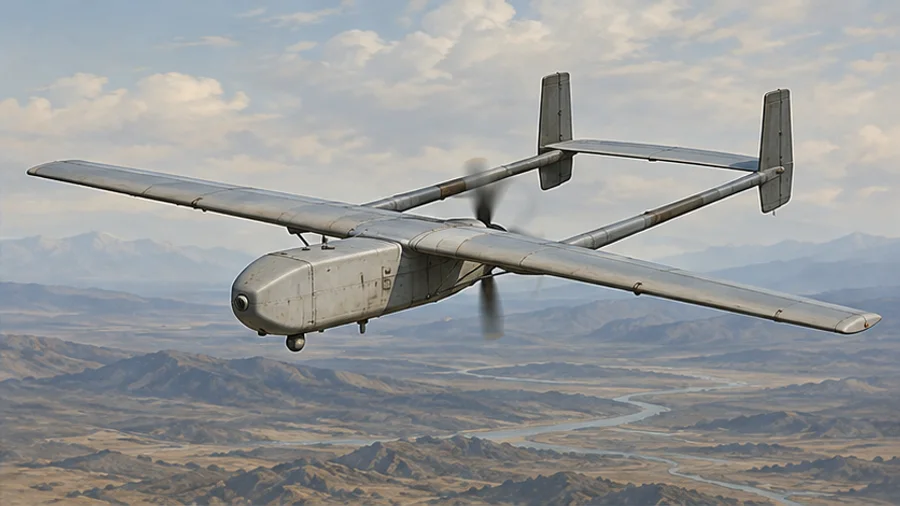
Wikipedia describes the Pioneer as a joint design by AAI Corporation and Israel Aircraft Industries, developed from the Israeli Scout to meet a United States Navy requirement. It gives a length of 4.3 m, a wingspan of about 5.15 m, a gross weight of 205 kg, a range of 185 km, a ceiling of 4,600 m and an endurance of up to five hours with a 34 kg payload.
How they were used
Polmar, writing in Naval History magazine in 2013, says the drones let each battleship receive real time target information without relying on outside spotters. Polmar lists target adjustment, battle damage assessment, reconnaissance and coordination as their tasks, with a Pioneer in the air throughout the campaign. A 2003 study for the Air Force Historical Research Agency by Daniel Haulman credits a Pioneer with detecting the Iraqi attack on Khafji, which allowed United States air strikes against the attacking force. Haulman also records problems: rain wore down the wooden propellers, and friendly electronic interference caused at least one crash.
What effect they had
Polmar reports that 40 Pioneers flew a total of 1,641 hours in the campaign and that a Department of Defense report found their availability exceeded expectations. On Faylaka, according to the Smithsonian National Air and Space Museum, which holds the aircraft, Wisconsin's Pioneer was assessing damage after shelling by Missouri. As it flew low over the island, Iraqi soldiers, expecting another bombardment, waved white flags. Polmar puts their number at about 40 and calls it the first known surrender of troops to an unmanned vehicle. The museum identifies the aircraft as Air Vehicle 159 and describes the event as the first time humans had surrendered to a robot in combat.
Related battles
For the classroom
- Why did the Iraqi soldiers surrender to an aircraft that carried no weapons?
- What did a battleship gain from having its own drone instead of relying on aircraft or spotters from other units?
- Haulman lists rain and radio interference as problems. What do those limits suggest about early drone operations?
Play this battle in the simulation
Take either side in the scenario built on this battle, with the same drones on a real map.
Sources
- Wikipedia: AAI RQ 2 Pioneer
- The Pioneering Pioneer (Naval History, 2013)
- Pioneer RQ 2A UAV (Smithsonian National Air and Space Museum)
- US Unmanned Aerial Vehicles in Combat, 1991 to 2003 (AFHRA)
Written 2026-10-03.