
Gulf War air campaign, opening night decoys
- When
- 17 January 1991
- Where
- Baghdad and the Iraqi air defence network
- Sides
- US led coalition vs Iraq
On the night of 17 January 1991, the first night of the Gulf War air campaign, the United States launched dozens of BQM 74C target drones and more than 100 ADM 141 TALD decoys toward Iraq so that Iraqi radar operators would reveal their positions. Wikipedia names the sides as the coalition, spearheaded by the United States, and Iraq. The Air and Space Forces Magazine writer Rebecca Grant reported that the drones flew 300 miles to Baghdad and orbited for 20 minutes.
What happened
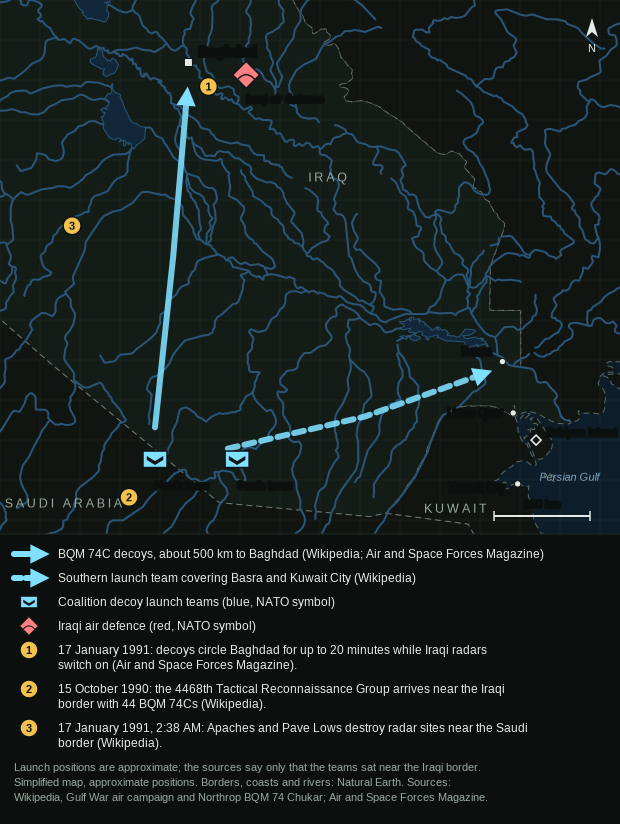
Wikipedia records that Operation Desert Storm began on 17 January 1991 at 2:38 AM Baghdad time, when eight US Army AH 64 Apache helicopters led by four USAF MH 53 Pave Low helicopters destroyed Iraqi radar sites near the Saudi border. At 3:00 AM ten F 117 Nighthawks bombed Baghdad and came under fire from 3,000 anti aircraft guns, and Tomahawk cruise missiles struck targets in the capital. Wikipedia describes Iraq's air defences as a centralised network, run through a computer system called Kari, with its national operations centre in a Baghdad bunker. Wikipedia also records that RQ 2 Pioneer drones flew reconnaissance for the coalition, as covered on the Gulf War, Pioneer operations and the Faylaka surrender page.
The drones
Wikipedia lists the BQM 74 Chukar as a Northrop target drone, a recoverable, remote controlled, subsonic aircraft built to simulate enemy threats. In the Gulf War the BQM 74C flew as a decoy: Wikipedia says each was fitted with a pair of corner reflectors to imitate a manned aircraft on radar. The ADM 141 TALD, Wikipedia says, is an American decoy missile 2.34 m long with a 1.55 m wingspan, weighing 180 kg, with a range of 126 km when launched from 12,200 m. Its flight controls can be programmed to mimic an aircraft such as the F 16.
How they were used
Wikipedia gives the decoy effort the codename Project Scathe Mean, run by the USAF Big Safari group. A 40 person team, called the 4468th Tactical Reconnaissance Group, reached the Iraqi border on 15 October 1990 with 44 BQM 74Cs and two teams of six ground launchers, one sited to cover Baghdad and the other Basra and Kuwait City. For 17 January, Wikipedia says 38 drones were assigned to the second wave and 37 launched, usually in groups of three. One group of three was intercepted by Iraqi aircraft. The rest flew more than 500 km at 630 km/h and circled Baghdad for up to 20 minutes.
What effect they had
Grant wrote that the drones looked so much like aircraft to early warning radars that Iraqi defenders switched on tracking radars, and that Navy carrier aircraft and USAF F 4G Wild Weasels then fired HARM anti radiation missiles at the active sites. Grant counted more than 66 HARMs launched in an hour. Wikipedia says the TALDs also led Iraqi crews to activate many radars, most of which were then destroyed. Grant quoted General Norman Schwarzkopf, who said the coalition had feared losses as high as 75 aircraft on the first day; the tally was four US aircraft, and all F 117s returned. Wikipedia's Chukar article says Iraq shot down only 44 manned aircraft in the war.
For the classroom
- Why would an Iraqi radar crew switch on a tracking radar for a slow target drone with corner reflectors?
- How did launching more than 100 TALDs together with 37 BQM 74Cs change what Iraqi operators could see on one night?
- Schwarzkopf feared 75 losses on the first day and four US aircraft were lost; what part could the decoys have played in that gap?
Sources
- Wikipedia: Gulf War air campaign
- Wikipedia: Northrop BQM 74 Chukar
- Wikipedia: ADM 141 TALD
- Desert Storm (Air and Space Forces Magazine, 2011)
Written 2026-10-04.