
2026 Iran war
- When
- 28 February 2026 onward; ceasefire 8 April, collapsed 8 July
- Where
- Iran, Israel, Gulf states, Iraq, Cyprus
- Sides
- United States, Israel and Gulf states vs Iran and aligned groups
From 28 February 2026, the United States and Israel struck Iran in Operation Epic Fury, and Iran answered with missiles and drones fired at Israel, US bases and Gulf states, in what Wikipedia calls the 2026 Iran war. A ceasefire began on 8 April and collapsed on 8 July. CSIS found that Shahed series one way attack drones were the main weapon of Iran's first week of retaliation, and US Central Command said it used its own LUCAS one way attack drones in combat for the first time.
What happened
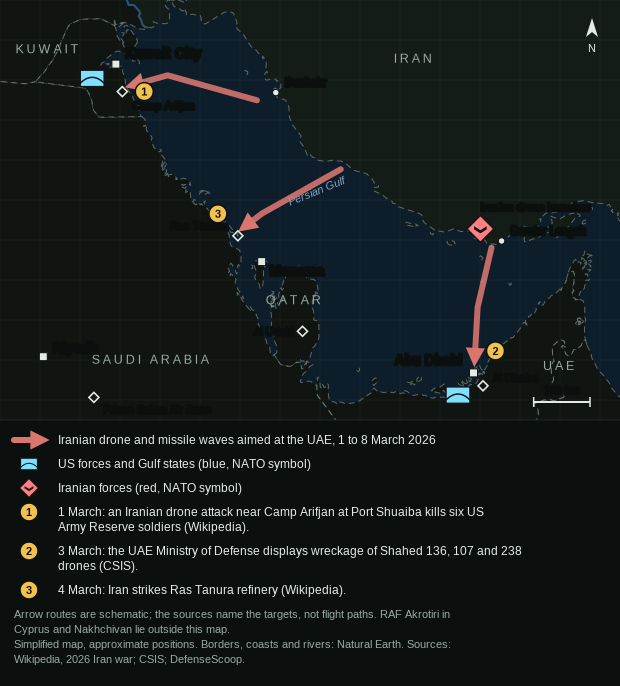
Wikipedia records that President Donald Trump authorised Operation Epic Fury on 27 February and that US and Israeli strikes began around 9:45 am Iran time on 28 February. The first strikes killed Supreme Leader Ali Khamenei. Iranian units reacted within hours with missiles and drones, and Wikipedia lists Manama, Kuwait International Airport, Abu Dhabi, Riyadh and Erbil among the early targets. On 2 March a drone strike damaged a runway at RAF Akrotiri in Cyprus. Wikipedia records a two week ceasefire from 8 April and says the truce collapsed on 8 July after Iran attacked three commercial vessels in the Strait of Hormuz. The same war includes the 2026 Strait of Hormuz campaign and the 2026 Lebanon war.
The drones
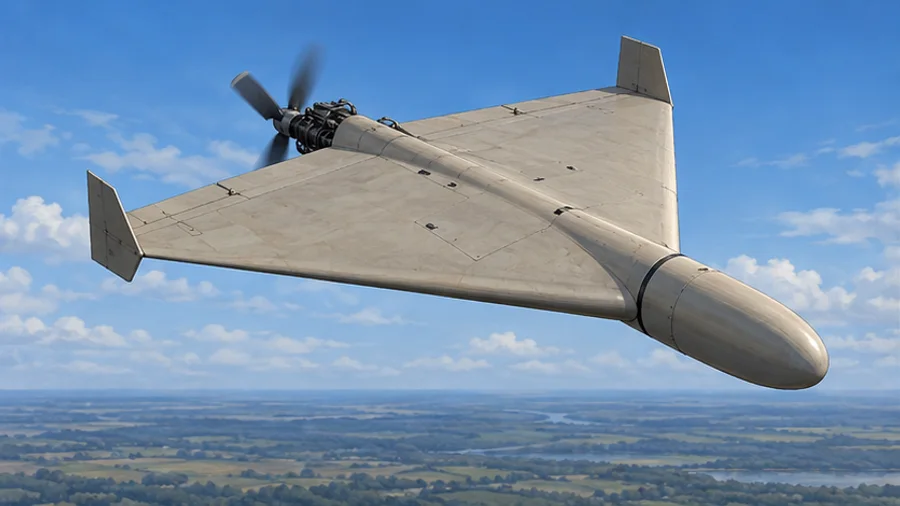
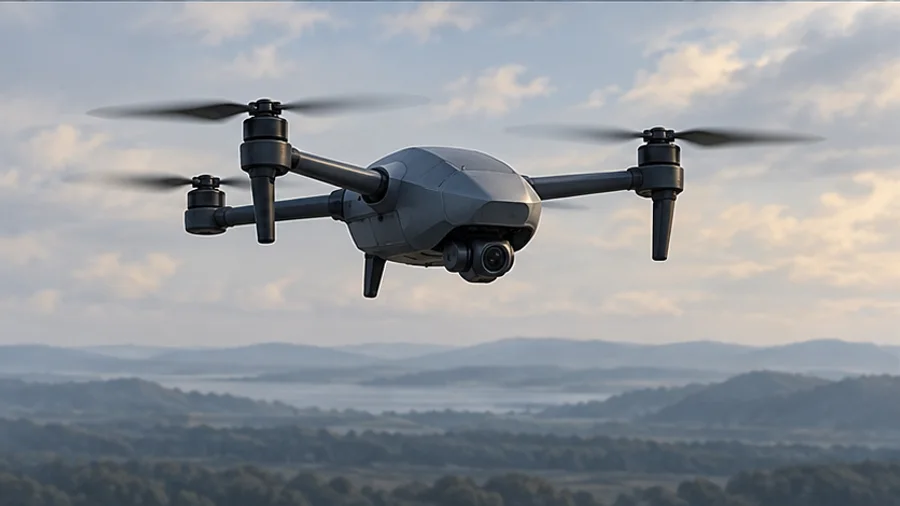
On 3 March the UAE Ministry of Defense displayed recovered wreckage and identified the Shahed 136, Shahed 107 and Shahed 238, according to CSIS. The Shahed 136 is also fielded by Russia as the Geran 2. CSIS analyst Kateryna Bondar wrote that debris in the UAE suggests a Geran 2 from the Kupol plant in Izhevsk may have been used. On the US side, DefenseScoop reported that LUCAS drones are made by SpektreWorks of Arizona, cost an estimated $10,000 to $55,000 each, and launch from catapults, rocket assisted takeoff or ground vehicles. DefenseScoop says they were designed to improve on the Shahed 136, and that CENTCOM set up Task Force Scorpion Strike in December 2025.
How they were used
CSIS counted 1,422 detected drones and 246 missiles aimed at the UAE from 1 to 8 March, 1,668 in all. That was 66 percent of all detected drones in its dataset. The first day brought 1,206 strikes, 867 of them drones, and daily strikes from 2 to 8 March ranged from 190 to 392. CSIS recorded repeated attempts on Prince Sultan Air Base and the Ras Tanura refinery in Saudi Arabia, and strikes on Al Udeid Air Base in Qatar. DefenseScoop reported that CENTCOM spokesman Capt. Tim Hawkins said LUCAS drones were used in the first wave and "remain ready for employment". Brett Velicovich, a former US Army intelligence soldier, told DefenseScoop that LUCAS likely hit sites such as Revolutionary Guard Shahed factories.
What effect they had
Wikipedia records that an Iranian drone attack near Camp Arifjan at Port Shuaiba, Kuwait, on 1 March killed six US Army Reserve soldiers and injured more than 30, the Port Shuaiba drone attack. CSIS judged that the drones were used less to destroy military targets than to disrupt infrastructure and make defenders spend costly interceptors. It put a Patriot missile at about $4 million, against $2,000 to $4,000 for the interceptor drones Ukraine uses, as in the Shahed mass raids and interceptor drones. Wikipedia cites CSIS data that about 65 percent of 2,330 US Patriot interceptors were used between February and July.
For the classroom
- Why did CSIS describe Iran's drone waves as a way to make defenders spend expensive interceptors?
- How do the UAE's 1,422 detected drones compare with the 246 missiles aimed at it?
- What reasons did DefenseScoop give for building LUCAS to improve on the Shahed 136?
Sources
- Wikipedia: 2026 Iran war
- Unpacking Iran's Drone Campaign in the Gulf (CSIS, 2026)
- LUCAS drones (DefenseScoop, 2026)
Written 2026-10-04.