
Abqaiq–Khurais attack
- When
- 14 September 2019
- Where
- Eastern Saudi Arabia
- Sides
- Houthis (claimed) or Iran (alleged) vs Saudi Arabia
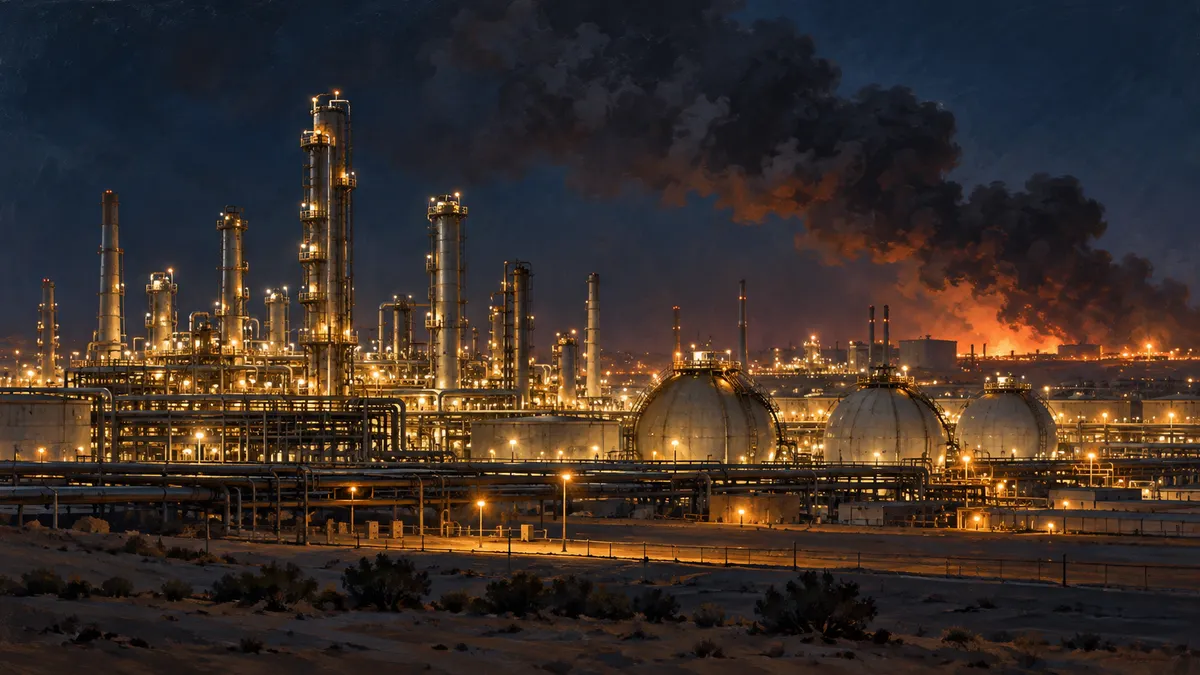
Before dawn on 14 September 2019, drones and cruise missiles struck the Saudi Aramco oil processing plants at Abqaiq and Khurais in eastern Saudi Arabia and cut the kingdom's oil output by about half for a time. The Houthi movement in Yemen claimed the attack. The United States and Saudi Arabia blamed Iran, which denied it, and a United Nations panel of experts concluded that the Houthis did not launch it. Wikipedia lists the sides as Saudi Arabia and Saudi Aramco against the attackers.
What happened
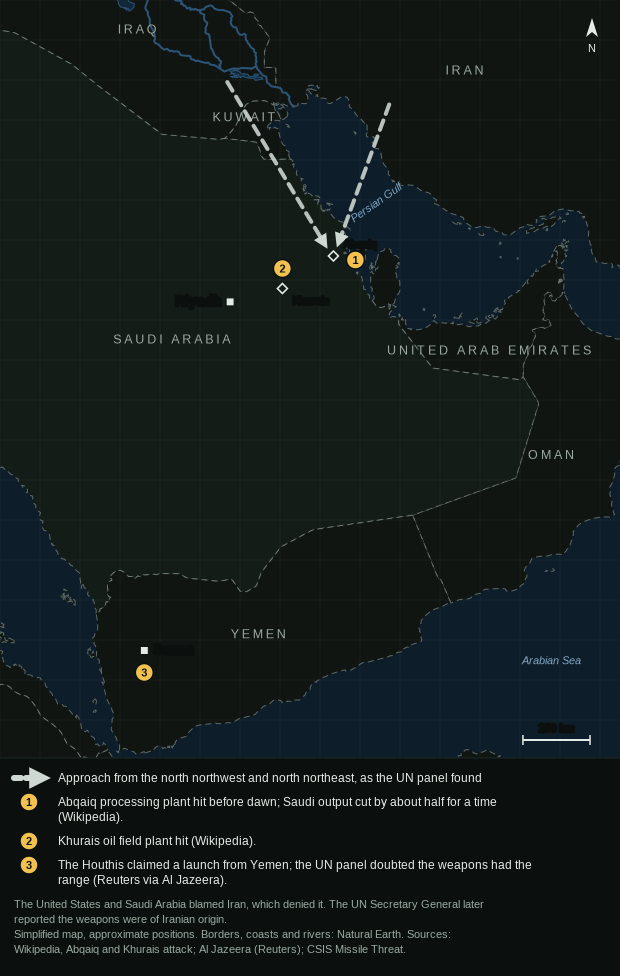
According to Wikipedia, the attack began at about 4:00 local time. The Houthis said they had sent ten newly developed drones in retaliation for the Saudi led intervention in Yemen. Wikipedia reports that the attacks cut Saudi production by about half, equal to about five percent of world production, and disrupted about 5.7 million barrels a day. No deaths were reported.
The drones
Saudi defence officials said the attackers used 18 drones and 7 cruise missiles, which they said were made in Iran, and described the drones as delta wing craft, as Wikipedia records. A Saudi coalition spokesman gave a total of 25 drones and missiles. Wikipedia notes that a December 2019 United Nations report said it could not confirm the Saudi claim that the weapons were of Iranian origin. In June 2020 the United Nations Secretary General, António Guterres, reported to the Security Council that the cruise missiles and drones used in the attack were of Iranian origin. Al Jazeera reported that the report described Farsi markings on some items and design features similar to those made by a commercial company in Iran. Iran's envoy to the United Nations replied that it had not been Iran's policy to export weapons in violation of arms embargoes.
How they were used
In January 2020 Reuters reported, as carried by Al Jazeera, that the United Nations panel of experts on Yemen doubted the weapons had enough range to be launched from Houthi held territory, and found that they approached from the north northwest and north northeast rather than from the south. Ian Williams of the Center for Strategic and International Studies wrote in September 2019 that the Patriot air defences near the site were oriented southward, toward Yemen, that the drones and missiles came in very low, and that defenders would have had no more than two minutes to identify and engage them. Williams noted that a Patriot radar covers a sector of about 120 degrees.
What effect they had
By Wikipedia's figures, about 25 drones and missiles took roughly five percent of world oil production offline for a time. Williams argued that the attack exposed two fixable gaps: the need for raised sensors that can see low flying threats from far away, and the need for air defence radars that cover all directions. The question of who launched the attack remained disputed: the Houthis kept their claim, the United States and Saudi Arabia held Iran responsible, Iran denied it, and the United Nations panel concluded only that the Houthis had not launched it.
Related battles
For the classroom
- Why would air defences facing south fail against an attack from another direction? What does this say about planning for a single expected threat?
- Several parties gave different accounts of who launched the attack. What evidence did the United Nations panel use, and what could it not settle?
- How can damage to a few industrial sites affect people far away from the attack?
Play this battle in the simulation
Take either side in the scenario built on this battle, with the same drones on a real map.
Sources
- Wikipedia: Abqaiq–Khurais attack
- UN monitors say Houthis not behind Saudi Aramco attacks (Al Jazeera, 2020)
- Missiles used to attack Saudi Arabia of Iranian origin: UN (Al Jazeera, 2020)
- Don't Waste This Lesson: How drone attacks reveal fixable flaws with American air defenses (CSIS Missile Threat, 2019)
Written 2026-10-03.