
Houthi drone attacks on Saudi Arabia
- When
- 14 May to 17 August 2019
- Where
- Saudi Arabia
- Sides
- Houthis vs Saudi Arabia
Between 14 May and 17 August 2019 the Houthi movement used armed drones to strike an oil pipeline, an airport and an oil field inside Saudi Arabia, in what Wikipedia places within the Houthi and Saudi Arabian conflict. The sides were the Houthis, who control most of Yemen's cities, and Saudi Arabia, which has led a coalition against them since 2015.
What happened
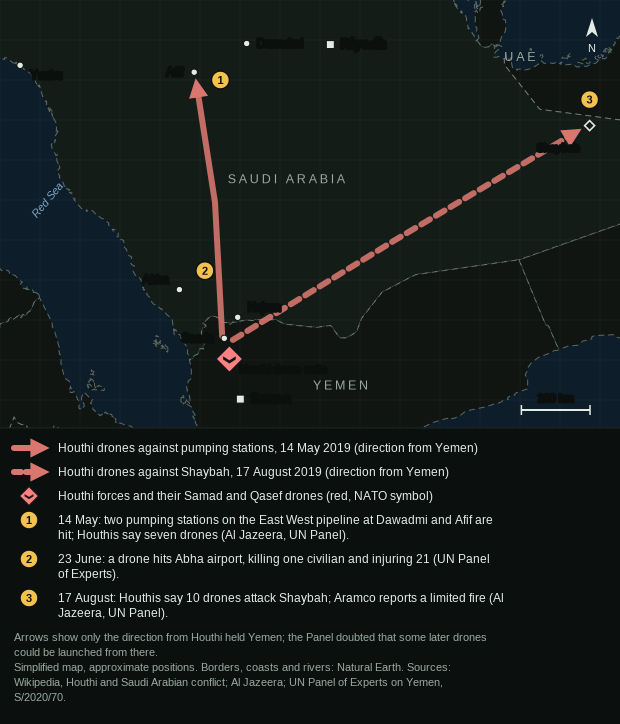
Wikipedia records that on 14 May a Houthi attack drone struck the Saudi East West Crude Oil Pipeline, which was shut for a time and later reopened. Saudi Energy Minister Khalid al Falih said two pumping stations were hit and one suffered minor damage. The Houthi spokesman Yahya Saree said seven drones took part. On 23 June a drone hit Abha International Airport, and the UN Panel documented one civilian killed and 21 injured. On 17 August the Houthis said they sent 10 drones against the Shaybah oil field. Aramco reported a limited fire at its gas liquefaction facility, with no injuries and no interruption to oil operations. On 14 September the Houthis claimed the larger Abqaiq and Khurais attack.
The drones
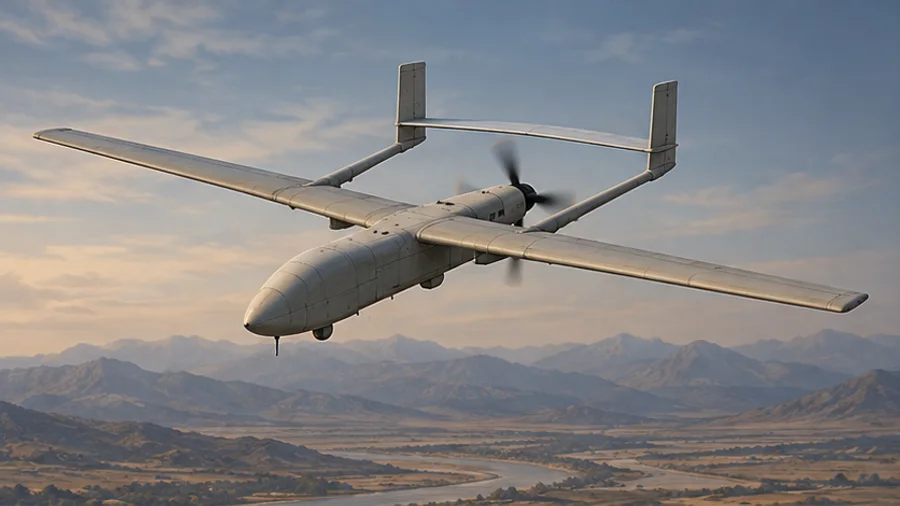
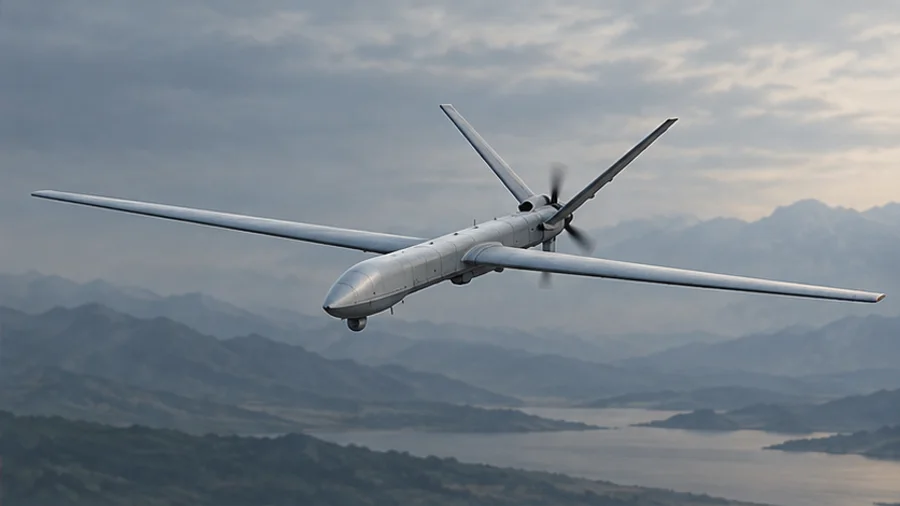
The UN Panel described two long range types. The first it calls the Samad family. It inspected debris from a drone used at Shaybah and found it similar to the Samad 3, which has an extra fuel tank on top of the fuselage. Researchers at the Netherlands Defence Academy, writing in Science and Global Security in 2020, give the Samad 2 a length of 2.80 m, a wingspan of 4.50 m and an 18 kg explosive payload, and estimate that the Samad 3 can fly more than 1,800 km. The second type is a delta wing design used at the pumping stations. The Panel measured its wingspan at 215 cm and its length at 190 to 210 cm, with a carbon fibre body and a rear mounted Wankel engine. It said the shorter range Qasef 2K was used near the southern border, including at Abha.
How they were used
Al Jazeera reported that the stricken pipeline runs from the Eastern Province to Yanbu on the Red Sea. The Panel noted that the 14 May strike came two days after tankers were attacked off Fujairah in the United Arab Emirates. Al Jazeera reported that Shaybah lies more than 1,000 km from Houthi held territory and a few kilometres from the Emirati border. Abdulmalik al Houthi said that attack was a warning to the Emirates. The Panel concluded that Qasef and Samad drones are built inside Houthi territory from local materials and parts sourced abroad. The earlier 2019 Anad base drone strike, by a Qasef 2K, killed at least five soldiers, according to the Panel.
What effect they had
The physical damage was limited. Aramco reported no injuries or production loss at Shaybah, and the pipeline reopened after the May strike. Andreas Krieg of King's College London told Al Jazeera that the strikes showed the Houthis could now attack far into Saudi territory. The Panel judged that the attacks seemed intended to push Saudi Arabia towards a more conciliatory approach, and that they came during rising regional tension over the Iran nuclear deal. Saudi Arabia accused Iran of supplying the drones, which Iran and the Houthis rejected.
Related battles
For the classroom
- Why might the Houthis have chosen a pipeline, an airport and a remote oil field as targets?
- The Samad 3 carries an extra fuel tank. How does that change which targets it can reach?
- How could drones built from local materials and imported parts reach a target more than 1,000 km away?
Sources
- Wikipedia: Houthi–Saudi conflict
- Wikipedia: 2019 Afif attack
- Wikipedia: Abha International Airport attacks
- Saudi Arabia says oil stations attacked by armed drones (Al Jazeera, 2019)
- Drone attack by Yemen rebels sparks fire in Saudi oil field (Al Jazeera, 2019)
- Final report of the UN Panel of Experts on Yemen, S/2020/70 (UN Security Council, 2020)
- Flight Performance Analysis of the Samad Attack Drones (Science and Global Security, 2020)
Written 2026-10-04.