
Al Tanf drone attack
- When
- 20 October 2021
- Where
- Al Tanf, Syria
- Sides
- Iran backed forces (per Pentagon) vs US led coalition
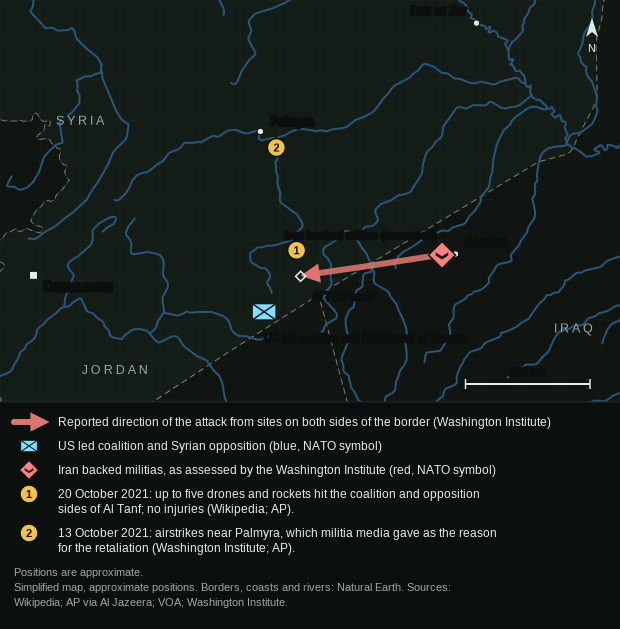
On 20 October 2021, multiple projectiles, a mix of drones and rockets, struck the Al Tanf base in southern Syria, where US led coalition troops were training a Syrian opposition unit, Maghaweir al Thowra. Wikipedia names the targets as Combined Joint Task Force Operation Inherent Resolve and Maghaweir al Thowra, and lists the Army of the Guardians of the Islamic Revolution of Iran as the alleged attacker. No one was injured.
What happened
Wikipedia records that the attack was unusually heavy, with as many as five munitions, and that both the opposition areas and the coalition areas of the base were hit. The coalition confirmed that it involved "a UAS attack coupled with IDF", meaning a drone attack together with indirect fire from rockets. Crispin Smith of the Washington Institute wrote that Iraqi militia media channels were covering the attack from about 22:46 Syria and Iraq time on 20 October and claimed five projectiles fired from both Iraq and Syria. The Associated Press reported on 25 October that US officials believed Iran provided resources and encouraged the attack but that the drones were not launched from Iran. Pentagon spokesman John Kirby called it a "complex, coordinated and deliberate attack" and said any response would come "at a time and a place and a manner of our choosing". The coalition troops at Al Tanf belonged to Operation Inherent Resolve.
The drones
US officials told the Associated Press the drones were Iranian and that as many as five carried explosive charges. One official told VOA that five drones carried out the attack and that the explosives damaged buildings without causing injuries or deaths. Smith wrote that foreign militias had so far confined their use of Iranian designed suicide drones to trusted Iraqi militias such as Kataib Hezbollah, and that the combination of one way drones with rockets pointed to either that militia or direct Iranian involvement.
How they were used
Smith assessed an Iraqi militia role, possibly supported by Iran's Islamic Revolutionary Guard Corps. The garrison and its surrounding deconfliction zone sit on the M2 highway between Damascus and Baghdad, about 120 km from the militia held town of Akashat, which Smith placed in the operating area of Kataib Hezbollah's Jazira Operations Command. Militia media reported that the munitions came from sites on both sides of the border. A group calling itself the Allies of Syria Operations Room had threatened on 14 October to respond to airstrikes near Palmyra on 13 October. The New York Times reported on 18 November, as cited by Wikipedia, that officials called the strike an Iranian response to an Israeli attack.
What effect they had
The last major Iranian attack on US forces had been in January 2020 at al Asad air base in Iraq, where more than 100 US service members suffered traumatic brain injuries. Smith concluded that further attacks were a serious possibility. In August 2022 Kurdistan24 reported another drone attack on the garrison area, in which coalition forces engaged one drone and a second detonated inside a Maghaweir al Thowra compound with no casualties.
For the classroom
- Why did the coalition describe the attack as a drone strike coupled with indirect fire, and what does combining the two do to a base's defences?
- Why would a group launch drones from sites in both Iraq and Syria at the same base?
- Why might a garrison on the Damascus to Baghdad highway be a target for groups backed by Iran?
Sources
- Wikipedia: 2021 Al Tanf drone attack
- Officials: Iran behind drone attack on US base in Syria (AP via Al Jazeera, 2021)
- Official Tells VOA Iran Believed Behind Attack on US Troops in Syria (VOA, 2021)
- Militia Propaganda Around the Attack on al Tanf (Washington Institute, 2021)
- Coalition forces respond to drone attack near Syria's al Tanf Garrison (Kurdistan24, 2022)
- Wikipedia: Akashat
- Wikipedia: Palmyra
- Wikipedia: Deir ez Zor
- Wikipedia: Damascus
Written 2026-10-04.