
Attempted assassination of Mustafa Al Kadhimi
- When
- 7 November 2021
- Where
- Baghdad Green Zone
- Sides
- Suspected Iran aligned militias vs Iraqi government
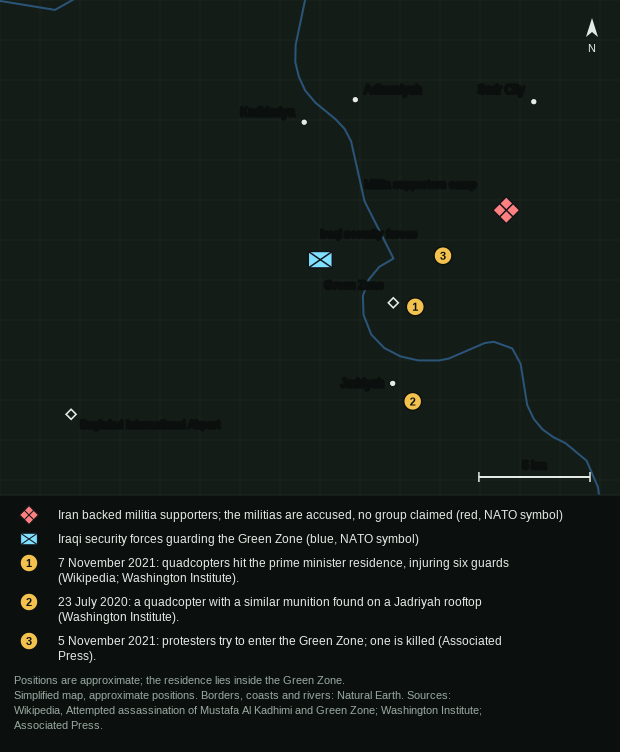
On 7 November 2021, explosive laden quadcopter drones struck the Baghdad residence of Iraqi Prime Minister Mustafa Al Kadhimi inside the Green Zone. Wikipedia records that Al Kadhimi survived and that six security guards were injured, lists the perpetrator as unknown and names Iran backed militias as the accused. No group claimed the attack.
What happened
Wikipedia reports that the Iraqi Armed Forces said one explosive laden drone hit the residence while two others were shot down. The Washington Institute and NBC News both described at least two quadcopters striking or targeting the house. The Washington Institute put the start at about 02:30 Baghdad time, when media channels linked to Kataib Hezbollah reported explosions and gunfire. The Associated Press reported that the attack followed the 10 October election, in which Iran backed militias lost about two thirds of their seats, and a protest on 5 November in which one protester was killed and dozens of security personnel were injured. Wikipedia places the attack in a wider sectarian conflict that has run since the 2003 invasion of Iraq.
The drones
The Washington Institute called them short range quadcopters of a kind seen in Iraq since July 2020. A quadcopter found on a rooftop in Jadriyah on 23 July 2020 carried a munition that closely matched an unexploded one found on the roof of the residence, and similar drones turned up in Baghdad on 2 and 5 July 2021, the second shot down by US defences. The institute listed a high quality battery management system, a 3D printed battery case and a telemetry system as features. Iraq's national security adviser, Qasim al Araji, said both drones were locally made. Reuters, as cited by Wikipedia, quoted anonymous officials who said the weapons were made in Iran.
How they were used
The Washington Institute reported that Qais al Khazali, leader of Asaib Ahl al Haq, had threatened Al Kadhimi with legal action on 5 November, two days before the strike. The Associated Press described security video of the damage: a badly mangled van, a shallow crater near the stairs, cracks in the balcony walls and ceiling, broken roof parts and two unexploded rockets. NBC News said the blast blew doors off their hinges. Al Araji said an unexploded projectile with fingerprints on it was detonated by the bomb squad before the prints were taken. Iraq's Joint Operations Command asked why US defences did not fire; the Washington Institute said those systems protect the US embassy and were unlikely to engage so close to rooftop level.
What effect they had
Wikipedia records no deaths and six injured guards. The Associated Press reported that Al Kadhimi had a light cut and a bandaged left wrist when appearing on television. General Frank McKenzie of US Central Command blamed Iran backed militias, and US officials told NBC News that Iran probably did not order it. Kataib Hezbollah's Abu Ali al Askari and Khazali dismissed the attack as staged; Al Jazeera called such claims on Telegram unsubstantiated. On 29 November al Araji said the committee had accused no person or group; Al Jazeera reported that three people were reportedly arrested.
For the classroom
- Why might a small quadcopter be a useful weapon for a group that does not want to be named?
- Why would a 3D printed battery case and a telemetry system matter to the people building such drones?
- Why did US air defences around the embassy not engage drones flying near rooftop level?
Sources
- Wikipedia: Attempted assassination of Mustafa Al Kadhimi
- Muqawama Meltdown, Part 2: Drone Attack on the Prime Minister (Washington Institute, 2021)
- Tension rises in Iraq after failed bid to assassinate prime minister (Associated Press via PBS, 2021)
- Iran likely did not order drone attack on Iraqi prime minister (NBC News, 2021)
- Probe in drone attack on Iraq PM yet to identify attackers (Al Jazeera, 2021)
- Wikipedia: Green Zone
- Wikipedia: Kadhimiya
- Wikipedia: Adhamiyah
- Wikipedia: Sadr City
- Wikipedia: Baghdad International Airport
Written 2026-10-04.