
August 2021 Kabul drone strike
- When
- 29 August 2021
- Where
- Kabul
- Sides
- United States vs suspected ISIS K (intended)
On 29 August 2021, a United States drone strike in Kabul, Afghanistan killed 10 civilians, including seven children, in the last days of the American withdrawal. Wikipedia names the attacker as United States Central Command. A single Hellfire missile fired from an MQ 9 Reaper hit a white Toyota Corolla at 4:53 pm local time. US officials believed the car carried explosives for an attack on the airport. On 17 September General Kenneth McKenzie called the strike a mistake.
What happened
Wikipedia records that the attack came soon after the fall of Kabul ended the War in Afghanistan, which began with the United States invasion of Afghanistan and lasted from 2001 to 2021. A suicide bomber had attacked Hamid Karzai International Airport during the evacuations on 26 August; Wikipedia says at least 183 people died, while Al Jazeera reported more than 150 Afghans and 13 US service members. The New York Times reported that analysts in Qatar were weighing more than 60 pieces of intelligence about an imminent attack. Wikipedia states that the US linked a 1996 Corolla and its driver, Zemari Ahmadi, to a plot. Ahmadi worked for Nutrition and Education International, a California based aid group.
The drones
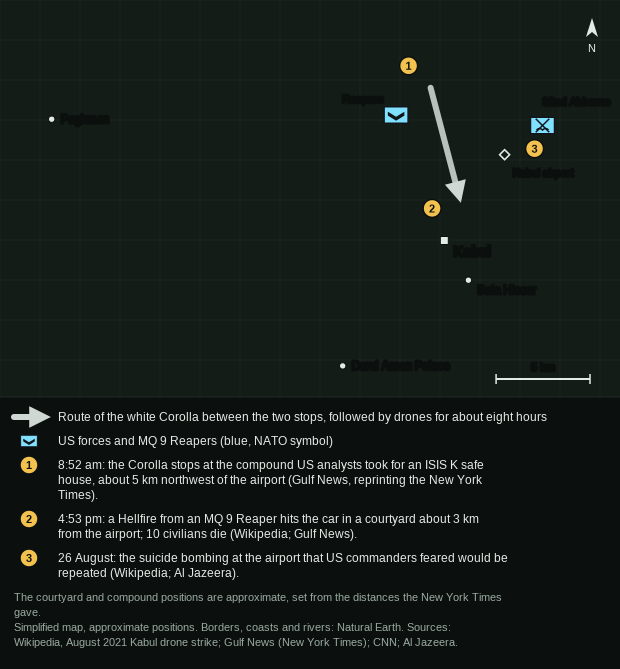
Wikipedia and the New York Times, as carried by Gulf News, say six Reaper drones watched the compound where Ahmadi stopped. Wikipedia describes the General Atomics MQ 9 Reaper as a medium altitude, long endurance aircraft with a 66 ft (20 m) wingspan. It lists an endurance of 30 hours on surveillance missions, falling to 23 hours with a full weapons load. The AGM 114 Hellfire is listed by Wikipedia at 64 in (1.6 m) long and 7 in (180 mm) in diameter. Gulf News reported that the Over the Horizon Strike Cell, created in early July, directed the drones from a base in Qatar.
How they were used
McKenzie said the strike cell followed the car for eight hours. The New York Times reported that the Corolla reached the first compound at 8:52 am, that two men got out and took a bag, and that analysts later saw men load what they took for explosives into the trunk. The military's investigation found the packages were probably water canisters. The final stop was a courtyard about 3 km from the airport. CNN reported that operators watched it for four to five minutes. Major General Christopher Donahue, the ground commander, agreed to the strike, and the missile hit in less than a minute. Seconds after launch the operators saw figures, most likely children, approaching the car.
What effect they had
Wikipedia records that the missile killed seven children and three adults. Relatives told Al Jazeera that those killed were 10 members of the Ahmadi and Nejrabi families, aged two to 40. The Pentagon first said it had killed an ISIS K facilitator and three civilians, and General Mark Milley called it a "righteous strike". On 17 September the US said all those killed were civilians; Defense Secretary Lloyd Austin said Ahmadi had no link to ISIS K. On 3 November Lieutenant General Sami Said reported "confirmation bias" and "communication breakdowns" but no violation of the law of war. On 13 December Austin announced that no personnel would be disciplined, and Human Rights Watch called that a "cause for deep concern".
For the classroom
- Why did US commanders treat a car loaded with water canisters as a bomb after watching it for eight hours?
- What could the Reaper crews see in the four to five minutes they watched the courtyard?
- What changed in the US account of the strike between 29 August and 17 September?
Sources
- Wikipedia: August 2021 Kabul drone strike
- Botched drone strike in Kabul started with wrong car (Gulf News, reprinting the New York Times, 2021)
- US military admits it killed 10 civilians and targeted wrong vehicle in Kabul airstrike (CNN, 2021)
- No misconduct in deadly US drone attack in Kabul: Pentagon review (Al Jazeera, 2021)
- Wikipedia: General Atomics MQ 9 Reaper
- Wikipedia: AGM 114 Hellfire
- Wikipedia: Kabul International Airport
- Wikipedia: Kabul
- Wikipedia: Darul Aman Palace
- Wikipedia: Bala Hissar, Kabul
- Wikipedia: Paghman District
Written 2026-10-04.