
United States invasion of Afghanistan
- When
- 7 October to 17 December 2001
- Where
- Afghanistan
- Sides
- United States and Northern Alliance vs Taliban and al Qaeda
From 7 October to 17 December 2001, the United States and its allies, working with the Northern Alliance, invaded Afghanistan and overthrew the Taliban government that had sheltered al Qaeda. Wikipedia names the sides as the United States and Northern Alliance against the Taliban and al Qaeda. The campaign included the first armed missions flown by the General Atomics MQ 1 Predator, a remotely piloted aircraft run by the CIA and the US Air Force that carried Hellfire missiles.
What happened
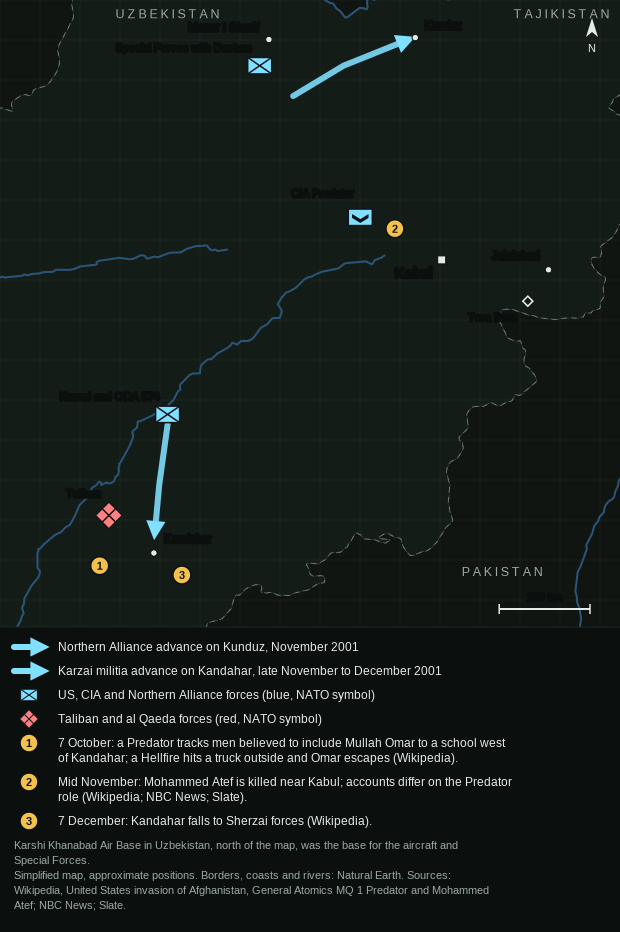
Wikipedia records that the US began air strikes on 31 targets on 7 October and destroyed most Taliban air defences and aircraft the first night. Special Forces teams flew in from Karshi Khanabad Air Base in Uzbekistan from 19 October to work with Northern Alliance commanders. The Taliban abandoned Kabul by 13 November, and Northern Alliance forces took the city the next afternoon. Kandahar fell on 7 December, when Gul Agha Sherzai's forces seized its airport and Mullah Omar left the city.
The drones
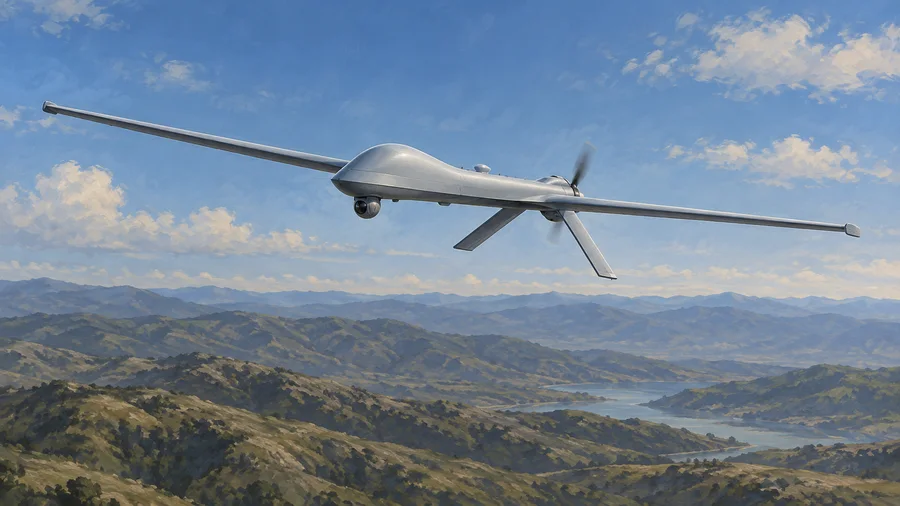
Wikipedia lists the Predator at 8.23 m long with a 14.8 m wingspan, a gross weight of 1,020 kg, 24 hours of endurance and a service ceiling of 7,600 m. It carries two AGM 114 Hellfire missiles, which Lt. Gen. John Campbell, a former associate CIA director, told NBC News were an anti tank weapon and an off the shelf solution. Wikipedia records a first test firing of three Hellfires on 16 February 2001, and that the missiles and aircraft reached their overseas base on 16 September. The first armed mission flew on 7 October, once the host country gave permission.
How they were used
On the opening night a Predator followed a group believed to include Mullah Omar from Omar's house to a school west of Kandahar. Wikipedia says General Franks refused a request to bomb the school, citing the risk to civilians and doubt that Omar was there, and the CIA fired a Hellfire at a truck outside. Omar escaped. Campbell told NBC News that a military lawyer at Central Command refused to approve a strike for nearly three hours, by which time the target was out of reach. Slate wrote that the missile missed. On 25 October a CIA Predator fired its one Hellfire to divert Taliban fighters surrounding the Pashtun leader Abdul Haq, who was captured and executed, according to George Tenet.
What effect they had
Mohammed Atef, al Qaeda's military chief, was killed near Kabul in mid November, and accounts differ. Wikipedia dates Atef's death between 14 and 16 November and, citing the Combating Terrorism Center, says bombers destroyed Atef's house while Predators destroyed vehicles outside. An intelligence analyst told NBC News that a Predator found him and directed an F 16 strike. Slate said a Hellfire from a Predator destroyed the building. Wikipedia says the Predator was the main aircraft for CIA and Air Force offensive operations in Afghanistan and Pakistan until the MQ 9 Reaper arrived. It also says armed Predators are thought to have killed Afghan scrap metal collectors near Zhawar Kili in February 2002 after one resembled bin Laden. Of the 60 Predators the Air Force had by the start of the campaign, Wikipedia says 20 were lost, few to enemy action, with icing the worst problem.
Related battles
For the classroom
- Why did it take so long to approve a strike on the opening night, and what did the delay cost?
- Wikipedia, NBC News and Slate give different accounts of the 7 October and mid November strikes. What would a historian need to settle them?
- Why might a slow aircraft that watches a target for hours suit the hunt for a single person?
Sources
- Wikipedia: United States invasion of Afghanistan
- Wikipedia: General Atomics MQ 1 Predator
- Wikipedia: Mohammed Atef
- A history of the armed drone (Slate, 2016)
- How the Predator went from eye in the sky to war on terror's weapon of choice (NBC News, 2013)
Written 2026-10-04.