
Battle of Takur Ghar
- When
- 3 to 4 March 2002
- Where
- Shah i Kot Valley, Paktia
- Sides
- United States vs Taliban and al Qaeda
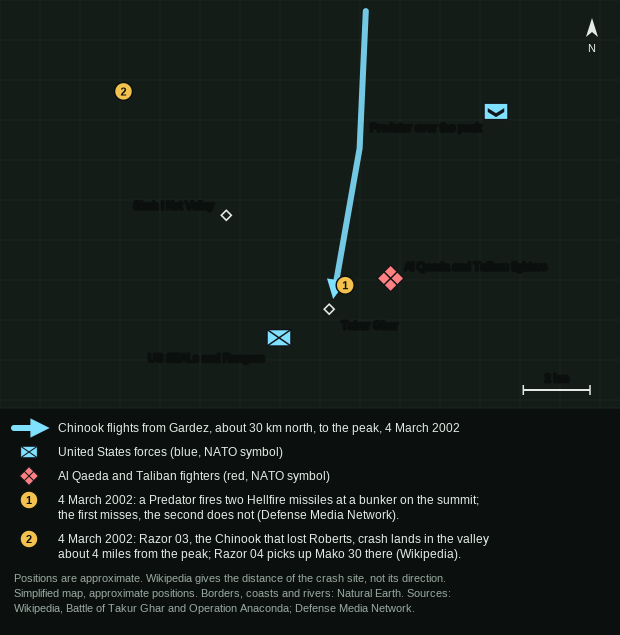
On 3 and 4 March 2002, United States special operations forces fought al Qaeda and Taliban fighters on the peak of Takur Ghar in the Shah i Kot Valley, Paktia Province, as part of Operation Anaconda. Wikipedia names the sides as the United States against the Taliban, al Qaeda and the Islamic Movement of Uzbekistan. A CIA operated MQ 1 Predator sent live video of the fight to headquarters and fired Hellfire missiles at a bunker that had pinned down Army Rangers.
What happened
Wikipedia records that early on 4 March an MH 47 Chinook carrying the SEAL team Mako 30 was hit by rocket propelled grenades as it tried to land on the peak, and Petty Officer 1st Class Neil Roberts fell from the open ramp. The helicopter crash landed in the valley about 4 miles away. Mako 30 flew back to the summit and came under heavy fire. A Ranger quick reaction force followed, and the first of its two Chinooks was also hit and crashed just below the summit. Wikipedia lists seven Americans killed, 12 wounded and two Chinooks lost. The fight belonged to the wider United States invasion of Afghanistan, and Wikipedia says US and Afghan sources believe at least 200 enemy fighters died.
The drones
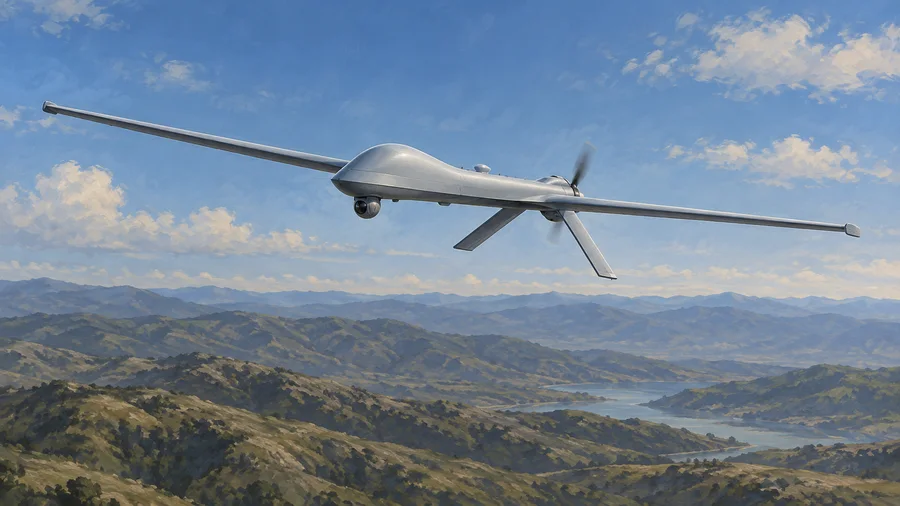
The aircraft was a General Atomics Predator. Wikipedia lists the MQ 1B at 8.23 m long with a wingspan of 14.8 m, an endurance of 24 hours, a service ceiling of 7,600 m and two AGM 114 Hellfire missiles. Wikipedia's article on the aircraft calls the one over Takur Ghar CIA operated. Fox News, citing Jane's Information Group, reported that the Predator carried a Skyball camera, synthetic aperture radar, a UHF and VHF radio relay and a satellite communications link.
How they were used
Defense Media Network reported that an AC 130 crew first saw what they took to be Roberts leaning against a tree, then a Predator carrying two Hellfires took position over the peak. Every headquarters on the net, from Bagram to the Pentagon and US Central Command in Florida, was watching the feed. Major General Frank Hagenbeck said the video showed al Qaeda fighters chasing Roberts and later dragging Roberts' body away. After two F 16s strafed the summit and dropped three bombs, Defense Media Network wrote that the Predator fired both Hellfires at the bunker, guided by laser pointers aimed at it. The first missed and the second did not. Captain Nate Self began an assault, then stopped halfway up the slope to wait for reinforcements.
What effect they had
Wikipedia says the Hellfire strike on the bunker appears to be the first use of such a weapon in a close air support role, after F 15 and F 16 flights had failed to destroy it. A senior Air Force official told Fox News that live video helps with force protection and real time targeting. Wikipedia notes that Colonel Andrew Milani and Dr Stephen Biddle wrote that the Predator was on station 90 minutes after Roberts fell. On 3 November 2002 a Hellfire fired in Yemen killed Abu Ali al Harithi, and Wikipedia says the CIA allegedly flew Predators from Pakistan from at least 2003, in what became American drone strikes in Pakistan.
For the classroom
- What could commanders in Bagram, Florida and Washington see through the Predator feed that the Rangers on the slope could not?
- Why did the Predator fire only after the F 16 strafing runs, and what did the laser pointers add?
- Milani and Biddle wrote that the Predator arrived well after Roberts fell. How does that change what its video can show?
Sources
- Wikipedia: Battle of Takur Ghar
- Wikipedia: Operation Anaconda
- Wikipedia: General Atomics MQ 1 Predator
- The Battle of Roberts Ridge, page 2 (Defense Media Network, 2012)
- The Battle of Roberts Ridge, page 3 (Defense Media Network, 2012)
- Predator Videocams Watch U.S. Forces (Fox News and AP, 2002)
- Wikipedia: Gardez
- Wikipedia: Bagram Airfield
- Wikipedia: Kabul
Written 2026-10-04.