
Abu Ali al-Harithi
- When
- 3 November 2002
- Where
- Marib Province, Yemen
- Sides
- CIA vs al Qaeda
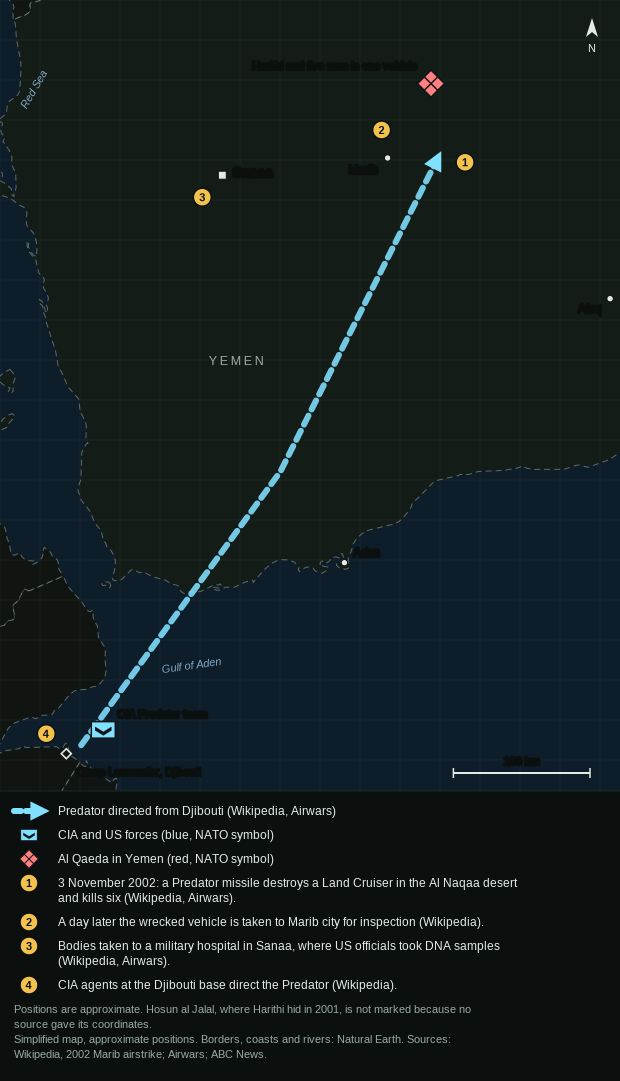
On 3 November 2002, a Central Intelligence Agency Predator drone fired a missile at a vehicle in the Al Naqaa desert of Marib Governorate, Yemen, and killed six men, among them Abu Ali al Harithi, the leader of al Qaeda in Yemen. Wikipedia calls it the first drone strike by the United States outside a conventional battlefield. The sides were the CIA, acting with the Yemeni government, and al Qaeda. One of the dead, Kamal Derwish, was an American citizen.
What happened
Wikipedia records that Harithi was wanted for involvement in the USS Cole bombing of October 2000 and that a Yemeni raid on 18 December 2001 failed to catch him. On the afternoon of the strike the National Security Agency traced a phone number linked to him to a farm in Marib. A Yemeni agent watched him get into a black Toyota Land Cruiser with five other men, while the women travelled in a second car. CIA director George Tenet and Lieutenant General Michael DeLong of US Central Command agreed to fire, and the missile hit about an hour after the signal was picked up. Wikipedia says a seventh passenger escaped injured. Airwars puts the site about 160 km east of Sanaa.
The drones
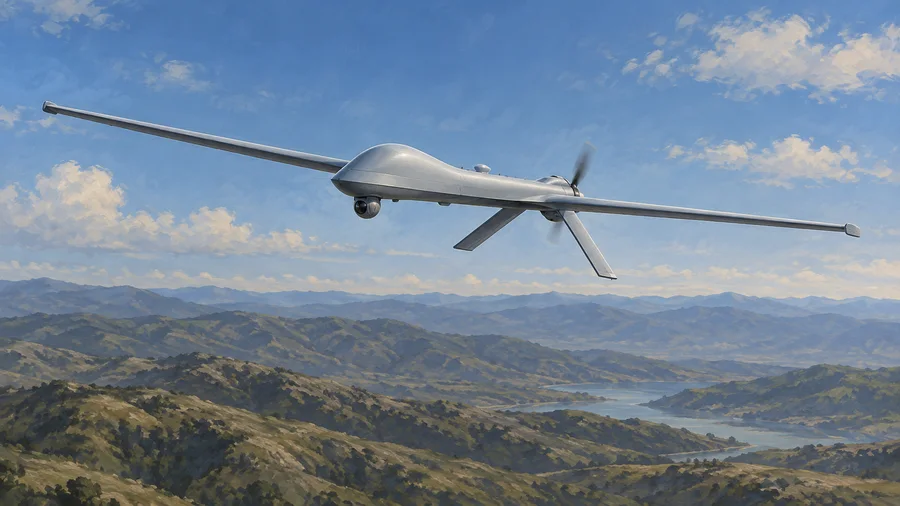
The aircraft was a Predator, which Wikipedia shows as an MQ 1 armed with AGM 114 Hellfire missiles. Wikipedia says CIA agents at a base in Djibouti directed it, with two Hellfires on board. ABC News, citing US sources, reported that two Hellfires destroyed the car. Mark Huband wrote in the Financial Times, republished by YaleGlobal on 5 November 2002, that the Predator flies at 10,000 to 15,000 ft, can loiter over a target for up to 40 hours, and carries a 900 mm zoom lens, an infrared camera and radar. Wikipedia notes the CIA had first used the Predator during the invasion of Afghanistan.
How they were used
The Predator followed the vehicle and kept the target in view until the order came. Wikipedia says operators watched a live video feed, Tenet watched it from CIA headquarters and DeLong from MacDill Air Force Base. An NSA analyst identified Harithi from a six second call in which Harithi gave directions to the driver. Airwars quotes a US official: "If the women hadn't gotten into another car, we wouldn't have fired." Wikipedia says that on at least two earlier occasions a strike was dropped because Yemeni agents said the targets were Bedouin civilians.
What effect they had
Wikipedia records that Deputy Defense Secretary Paul Wolfowitz confirmed the strike to CNN on 5 November, despite a secrecy agreement with President Ali Abdullah Saleh. Wikipedia says Yemen then banned US drone strikes, and Airwars says the next known US strike on al Qaeda in Yemen came in 2009. On 15 November the UN special rapporteur Asma Jahangir called it a clear case of extrajudicial killing, while Charles Allen of the Defense Department called it self defence. Wikipedia says that under President Obama targeted killing grew into a campaign across Yemen, Somalia and Pakistan, including the American drone strikes in Pakistan.
Related battles
For the classroom
- Why did the Predator's long loiter time and video feed matter for confirming Harithi was in the vehicle?
- Why did the women travelling in a second car change the decision to fire?
- Why did a strike meant to stay secret become public within two days?
Sources
- Wikipedia: Qaed Salim Sinan al Harethi (Abu Ali al Harithi)
- Wikipedia: 2002 Marib airstrike
- Unmanned Weapon Makes Its Mark in Yemen (YaleGlobal, Financial Times, 2002)
- U.S. Predator Kills 6 Al Qaeda Suspects (ABC News, 2002)
- USYEM001 B, 3 November 2002 (Airwars)
- Wikipedia: Sanaa
- Wikipedia: Marib
- Wikipedia: Aden
- Wikipedia: Camp Lemonnier
- Wikipedia: Ataq
Written 2026-10-04.