
United States intervention in Yemen
- When
- December 2009 onward
- Where
- Yemen
- Sides
- United States vs al Qaeda in the Arabian Peninsula
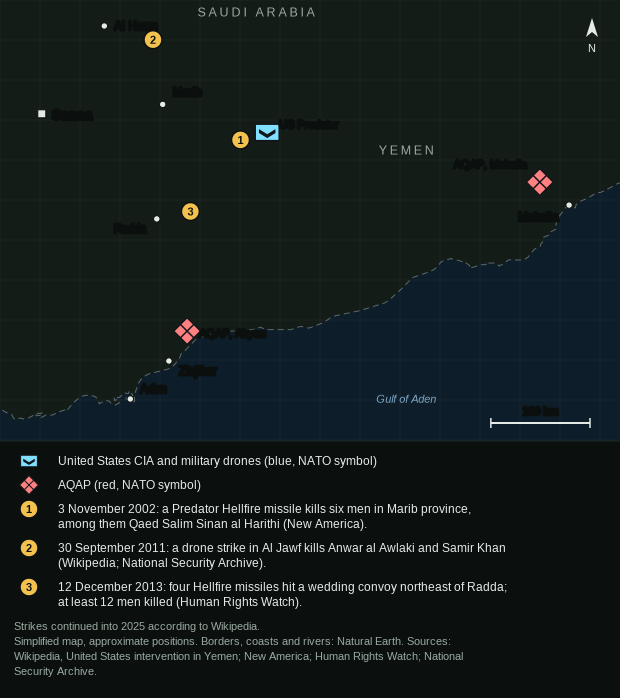
The United States used armed drones against al Qaeda in the Arabian Peninsula (AQAP) in Yemen, in one strike in November 2002 and then in a sustained campaign from December 2009, and Wikipedia records strikes continuing into September 2025. Wikipedia names the sides as the United States, including the CIA, and al Qaeda with its affiliate AQAP. The best known strikes killed the US born cleric Anwar al Awlaki on 30 September 2011 and hit a wedding convoy outside Radda on 12 December 2013.
What happened
New America reports that on 3 November 2002 a Hellfire missile from a Predator drone killed six men in a car in Marib province, among them Abu Ali al Harithi, also called Qaed Salim Sinan al Harithi, believed to have planned the 2000 attack on the USS Cole (Wikipedia dates it to 5 November). New America says the United States then carried out no strikes in Yemen for seven years. After AQAP's failed bombing of a US airliner on Christmas Day 2009, it says, the Obama administration escalated, and it raised air and drone strikes again when AQAP gained territory in 2011. Wikipedia quotes New America's count of 127 drone attacks from 2002 to 2016, 47 of them in 2012.
The drones
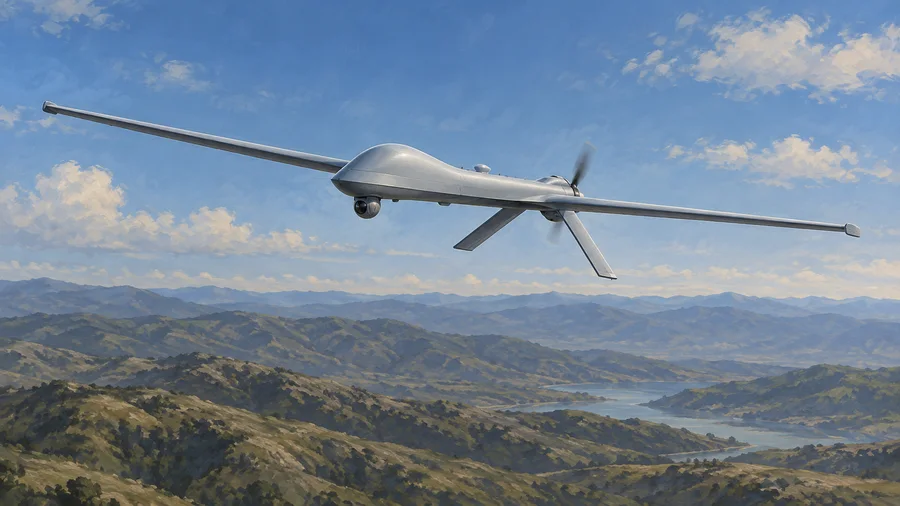
Wikipedia calls the MQ 1 Predator commonly used in drone strikes in Yemen. Human Rights Watch reported that four Hellfire missiles hit the Radda convoy, and its arms expert identified missile remnants in photographs. Wikipedia lists one MQ 9 Reaper shot down: US Central Command said on 2 October 2017 that a Reaper had come down in western Yemen the day before.
How they were used
On 30 September 2011 a drone strike in Al Jawf killed four people, including al Awlaki and Samir Khan, editor of Inspire magazine. A strike on 14 October 2011 killed al Awlaki's son Abdulrahman, 16 according to the Archive (Wikipedia says 17); US officials privately called it a mistake.
On 12 December 2013 four Hellfire missiles struck 11 vehicles carrying 50 to 60 people to a wedding. Human Rights Watch documented at least 12 men killed and at least 15 wounded. Unnamed US officials told the Associated Press that all the dead were militants and that the target, Shawqi Ali Ahmad al Badani, escaped; relatives said all the victims were civilians. On 14 December the governor of al Bayda called the killings a mistake, and officials gave the families 34 million rials and 101 rifles.
What effect they had
New America says the United States has killed more than 1,000 people in Yemen since 2002. Wikipedia gives New America's total as 1,367 to 1,758 killed, including 116 to 149 civilians, and lists 57 AQAP leaders confirmed killed, among them Nasir al Wuhayshi on 12 June 2015. Wikipedia places the intervention within the Yemeni civil war, part of the same Yemeni crisis as the later Red Sea crisis.
The National Security Archive calls al Awlaki the first US citizen since the Civil War hunted down and killed without trial by the US government. It records that President Obama added him to the kill list after a legal review and that Judge Rosemary Collyer dismissed the lawsuit brought by al Awlaki's father on 4 April 2014.
For the classroom
- Why did the 2002 Marib strike come seven years before the campaign that began in 2009?
- Why could a convoy of 11 vehicles on its way to a wedding be mistaken for a militant convoy from the air?
- How did the drone killing of a US citizen change the legal argument about targeted killing?
Sources
- Wikipedia: United States intervention in Yemen
- The War in Yemen (New America)
- A Wedding That Became a Funeral (Human Rights Watch, 2014)
- The Anwar al Awlaki File, Explained (National Security Archive, 2025)
Written 2026-10-04.