
American drone strikes in Pakistan
- When
- 18 June 2004 to 4 July 2018
- Where
- Tribal areas, mainly Waziristan
- Sides
- United States (CIA) vs Pakistani Taliban, Afghan Taliban, Haqqani network and al Qaeda
From 18 June 2004 to 4 July 2018 the United States attacked targets in northwest Pakistan with armed drones, flown by the United States Air Force under the control of the Central Intelligence Agency, Wikipedia says. Most strikes hit the tribal areas on the Afghan border, above all North and South Waziristan. Wikipedia lists the United States against the Taliban, Pakistani Taliban, Haqqani network and al Qaeda. The Bureau of Investigative Journalism counted 429 strikes by September 2017.
What happened
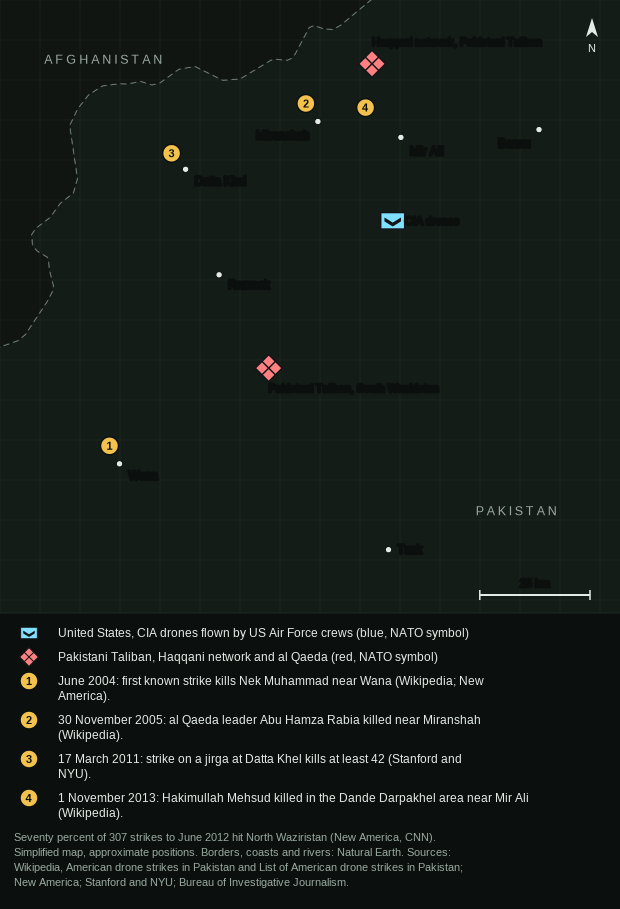
New America records that the first known strike killed the Taliban leader Nek Muhammad in South Waziristan. Wikipedia dates it to 18 June 2004, New America to 19 June, and the Bureau of Investigative Journalism to the evening of 17 June in Kari Kot, reporting that two boys aged 10 and 16 also died. New America says strikes stayed limited under President George W. Bush until 2008 and peaked in 2010 under President Barack Obama. Wikipedia records that Baitullah Mehsud, leader of the Pakistani Taliban, was killed in South Waziristan on 5 August 2009 and Baitullah Mehsud's successor Hakimullah Mehsud on 1 November 2013. The campaign followed the United States invasion of Afghanistan of 2001, across the border.
The drones
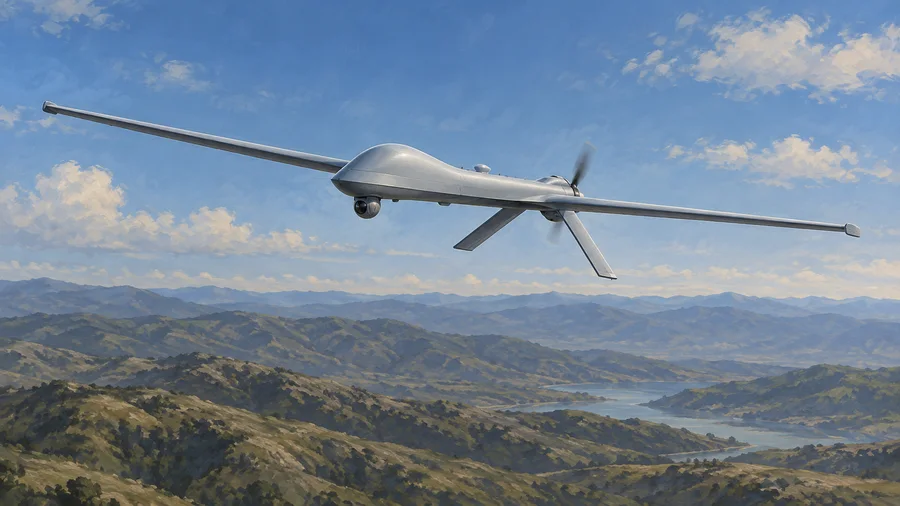
Wikipedia says about 30 Predator and Reaper drones flew under CIA direction over Afghanistan and Pakistan in September 2011, piloted from a base in the United States. The Stanford and New York University report Living Under Drones describes the MQ 1B Predator as first flown in 1994 and armed with AGM 114 Hellfire missiles, quoting P. W. Singer for a weight of 1,130 pounds and up to 24 hours aloft. Wikipedia adds that unnamed officials said a smaller missile, 21 inches long and 16 kg, came into use in 2009 or 2010.
How they were used
Wikipedia states that the CIA ran the strikes from its Counterterrorism Center at Langley, Virginia, and that from 2008 it increasingly attacked "signatures" of suspect behaviour. Peter Bergen and Jennifer Rowland of New America wrote on CNN that strikes rose from one every 40 days to one every four days between January 2009 and mid 2011, and that 70 percent of the 307 strikes to June 2012 hit North Waziristan. On 9 December 2011 Pakistan's army chief, Ashfaq Parvez Kayani, ordered US drones shot down, and strikes resumed on 10 January 2012, Wikipedia records. Stanford and NYU documented a 17 March 2011 strike on a jirga of tribal elders at Datta Khel that killed at least 42 people, mostly civilians. General Kayani said the jirga was "carelessly and callously targeted".
What effect they had
The Bureau of Investigative Journalism counted 2,514 to 4,023 killed, including 424 to 969 civilians and 172 to 207 children; New America puts civilian deaths at 245 to 303. Stanford researchers Asfandyar Mir and Dylan Moore found monthly reductions of 9 to 13 insurgent attacks in affected areas, while the Oxford Research Group said attacks rose in cities such as Karachi. The Bureau reported follow up strikes on rescuers and mourners, and Stanford and NYU found Waziris avoided gatherings. Obama's aides argued that capture was often impossible in the tribal areas of Pakistan and Yemen, Wikipedia records.
Related battles
For the classroom
- Strikes rose from one every 40 days to one every four days after 2009, so what did the CIA need to see and fire at that pace?
- What made a gathering such as the Datta Khel jirga hard to tell apart from a militant meeting on drone video?
- The Bureau counted up to 969 civilians and New America up to 303, so what might explain the gap?
Sources
- Wikipedia: American drone strikes in Pakistan
- Wikipedia: List of American drone strikes in Pakistan
- The Drone War in Pakistan (New America)
- Ten years on: Eyewitnesses describe the aftermath of the first Pakistan drone strike (Bureau of Investigative Journalism, 2014)
- Drones decimating Taliban in Pakistan (CNN, 2012)
- Living Under Drones (Stanford and NYU, 2012)
- Drone strikes rise to one every four days (Bureau of Investigative Journalism, 2011)
- Wikipedia: Wana, Pakistan
- Wikipedia: Miranshah
- Wikipedia: Mir Ali, Pakistan
- Wikipedia: Datakhel
- Wikipedia: Bannu
- Wikipedia: Razmak
- Wikipedia: Tank (city)
Written 2026-10-04.