
Shawal Valley Burraq strike (Operation Zarb-e-Azb)
- When
- 7 September 2015
- Where
- North Waziristan, Pakistan
- Sides
- Pakistan vs militants
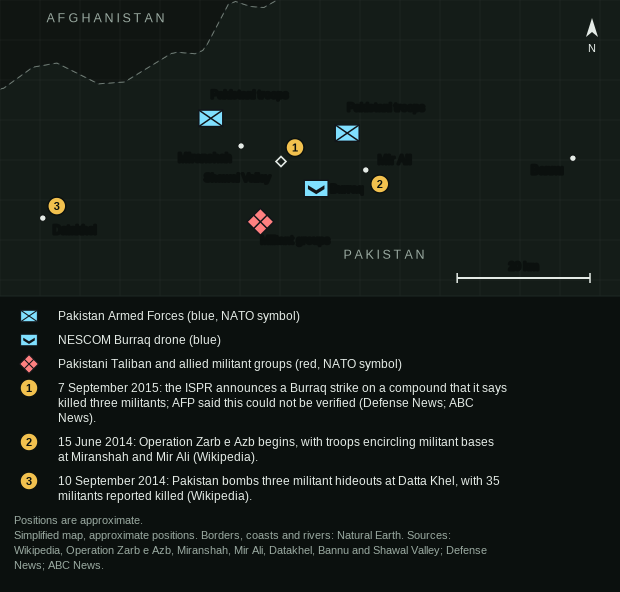
On 7 September 2015, during Operation Zarb e Azb, the Pakistani military announced the first operational strike by a Pakistan made armed drone. The Inter Services Public Relations spokesman, Major General Asim Bajwa, wrote on Twitter that a NESCOM Burraq had hit a compound in the Shawal Valley of North Waziristan, "killing 3 high profile terrorists". Wikipedia dates the operation from 15 June 2014 to 22 February 2017 and names the sides as the Pakistan Armed Forces and militant groups including the Pakistani Taliban (TTP) and the Islamic Movement of Uzbekistan.
What happened
Wikipedia records that the operation began on 15 June 2014 in North Waziristan, along the Afghan border, a week after an attack on Jinnah International Airport in Karachi that killed 28 people. Combat troops encircled militant bases in Mirali and Miranshah, and an army official said the offensive would need no more than 30,000 troops. On 13 June 2015 Bajwa said 2,763 militants and 347 Pakistani officers and soldiers had been killed. AFP reported that the Shawal Valley, on the Afghan border, saw some of the fiercest fighting, and that the area was closed to journalists. Wikipedia lists repeated Pakistani air strikes there, among them 30 militants reported killed on 10 September 2014, and American drone strikes in the same districts, part of the American drone strikes in Pakistan. On 3 April 2016 the government declared victory after clearing 640 square kilometres in Shawal and killing some 250 militants.
The drones
Wikipedia describes the Burraq as an unmanned combat aerial vehicle built by the National Engineering and Scientific Commission (NESCOM) with the Pakistan Air Force, first flown on 9 May 2009 and introduced in 2013 with the Shahpar. Its weapon is the Barq, a laser guided air to surface missile, first test fired in March 2015. Bilal Khan of Quwa reported that the Burraq was inducted in November 2013 and could carry two laser guided missiles. Khan noted its resemblance to the Chinese Rainbow CH 3, and Defense News wrote that it is widely believed to be developed from the CH 3 or built under licence. The analyst Brian Cloughley told Defense News that Chinese input may have been considerable.
How they were used
The Diplomat reported that the army gave few details and did not name the three men or their groups. AFP reported that the claim could not be verified independently. Cloughley told Defense News that the strike pointed to a more sophisticated targeting and command structure than many had expected. The former air force pilot Kaiser Tufail told the same paper that drones can loiter for hours, so air support need not be called in from far away. Wikipedia adds that the army reportedly used the Burraq in the Tirah Valley before 7 September, as part of the Khyber 1 operations. The Diplomat cited the Express Tribune, which reported officials saying it turned the tide there.
What effect they had
Wikipedia states that Pakistan became the fourth country after Israel, the United States and the United Kingdom to use an armed drone in active combat. Shaukat Qadir, a retired brigadier, told AFP that Pakistani drones would now play an important role in the fight against the insurgency. Cloughley warned that tribal areas already feared drones and resented civilian deaths from American strikes, and that residents would blame Islamabad for Pakistani strikes.
For the classroom
- What did the Burraq give Pakistan that American drone strikes in the same area did not?
- Why could reporters not confirm that three men died in the Shawal Valley strike?
- How might residents of the tribal districts tell a Pakistani drone strike from an American one?
Sources
- Wikipedia: Operation Zarb e Azb
- Wikipedia: NESCOM Burraq
- Pakistan Surprises Many With First Use of Armed Drone (Defense News, 2015)
- Pakistan armed drone kills three in first attack (ABC News, AFP, 2015)
- Pakistan Uses Indigenous Drone to Strike Terrorists (The Diplomat, 2015)
- Background on the Burraq Armed UAV (Quwa, 2015)
- Wikipedia: Miranshah
- Wikipedia: Mir Ali, Pakistan
- Wikipedia: Datakhel
- Wikipedia: Bannu
- Wikipedia: North Waziristan District
Written 2026-10-04.